Guides
How to Fit and Check a Roof Rack Safely
Racks almost never break. They work loose, they get overloaded, and they get loaded wrong. All three are checkable in two minutes.
Roof & Route is funded by affiliate commission. If you buy through a link on this page we may earn a commission at no extra cost to you. It never decides what we recommend or the order we recommend it in — read the full disclosure.
A roof rack is fitted safely when four things are true: the fit kit is the one specified for your exact model year, the clamps are at the torque the maker states, the total load is under the vehicle’s published dynamic roof limit, and the load is strapped to the rack rather than resting on it. Everything else is detail.
Racks themselves very rarely fail. What fails is the interface: a clamp that was never torqued, a fit kit that was close enough rather than correct, a load that exceeded a figure nobody looked up, or a strap that went slack in the first twenty minutes and was never retensioned. Those four account for effectively everything that ends up on the hard shoulder.
So the useful safety routine is short. Before each trip, run the six-point check below. Before each season, retorque. And after twenty minutes of every loaded drive, stop and put your hands on it. The products at the end of this page are the ones that make that routine easy to follow, not substitutes for it.
Quick picks
Tap any row to jump to the full write-up below. Scores are our editorial judgment on published specifications — not a star rating, and not a product we claim to have tested.
| # | Product | Best for | Score | Price |
|---|---|---|---|---|
| 1 | 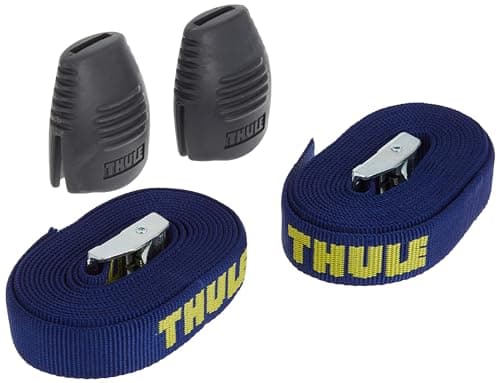 Thule Load StrapsCam buckle rather than ratchet, with a rubber buckle guard — the correct tool for anything on a roof. | The strap to use on a roof load | 8.3 | |
| 2 | 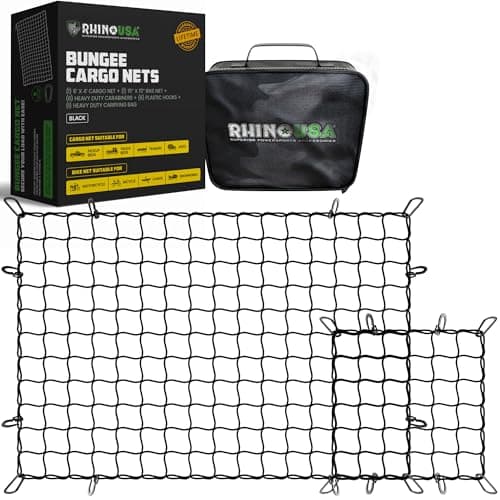 Rhino USA Cargo NetA heavier bungee net with steel hooks, sized for roof and hitch baskets — the thing that keeps loose items in an open carrier. | Stopping small items escaping | 7.9 | |
| 3 | 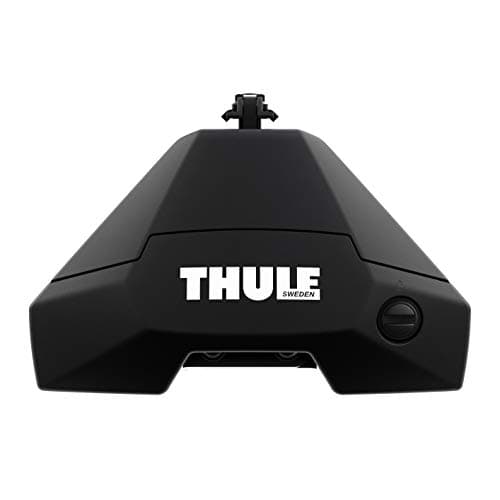 Thule Evo Clamp foot packThe foot pack that clamps Thule Evo bars to a bare roof, used with a vehicle-specific fit kit — the correct way to attach to a naked roof. | The right fit kit, not a universal one | 8.3 |
Prices checked October 11, 2026. Product photographs come from Amazon and are refreshed with the prices. Affiliate disclosure.
#1 · The strap to use on a roof load
Thule Load Straps
Cam buckle rather than ratchet, with a rubber buckle guard — the correct tool for anything on a roof.
- Type
- Cam buckle load straps
- Buckle
- Rubber guard
- Tension
- Hand only
- Sized for
- Roof-rack loads
What works
- Cannot over-tension the way a ratchet can
- The rubber guard keeps the buckle off paint and off a box lid
- Sized and shaped for roof carriers rather than flatbeds
What doesn’t
- Lower maximum tension — wrong for heavy freight
- Costs more than generic cam straps
Our scoring
8.3overall
#2 · Stopping small items escaping
Rhino USA Cargo Net
A heavier bungee net with steel hooks, sized for roof and hitch baskets — the thing that keeps loose items in an open carrier.
- Type
- Bungee cargo net
- Hooks
- Steel
- Sized for
- Roof and hitch baskets
- Role
- Containment, not restraint
What works
- Keeps small loose items in an open basket at speed
- Steel hooks grip a basket frame properly
- Cheap insurance against something small leaving the car
What doesn’t
- A net is containment, not load restraint — straps still do the work
- Steel hooks need keeping away from paint
- Bungee loses tension over seasons of sun
Our scoring
7.9overall
#3 · The right fit kit, not a universal one
Thule Evo Clamp foot pack
The foot pack that clamps Thule Evo bars to a bare roof, used with a vehicle-specific fit kit — the correct way to attach to a naked roof.
- Type
- Clamp foot pack
- Needs
- A vehicle-specific fit kit
- Roof type
- Bare roof
- Why it matters
- Clamp geometry is model-specific
What works
- Vehicle-specific fit kits put the clamp where the body is strong enough
- Published torque figures, which universal clamps rarely have
- Bars and feet carry over to another car with a new fit kit
What doesn’t
- Three part numbers to get right instead of one
- Costs more than a universal clamp-on set
- Door-frame clamping needs the seals checked after fitting
Our scoring
8.3overall
The six-point pre-trip check
- Push the bars sideways, hard. Any movement at the feet means a clamp has lost tension. This is the single most informative two seconds of the check.
- Push the bars fore and aft. Different failure, same cause. A bar that walks forward under braking was never clamped properly.
- Check the carrier on the bar. A box, cradle or bike mount has its own clamps, and they loosen independently of the rack.
- Check every strap for tension and for tails. Slack is a problem; a loose flapping tail at 70 mph will take paint off and can reach a wheel.
- Look for grit under the feet and pads. Trapped grit is what actually sands through a clear coat.
- Walk to the front and look up. Nothing should protrude past the windshield header, and nothing should be visible flapping.
Then drive twenty minutes and repeat steps one to four. Everything beds in exactly once, and that is when it happens.
The four ways rack loads actually fail
| Failure | Cause | Prevention |
|---|---|---|
| Rack moves on the roof | Clamps never torqued, or wrong fit kit | Torque to spec, use the model-year fit kit |
| Load moves on the rack | Straps only in one direction, or gone slack | Strap down and fore-and-aft, retension at 20 min |
| Roof structure damaged | Load over the published dynamic limit | Subtract bars and carrier from the limit first |
| Carrier detaches from bar | Accessory clamp loosened independently | Check the carrier as well as the rack |
Note that none of the four is the rack breaking. Published load ratings on mainstream racks have real margin; the risk sits in the attachment and the arithmetic. Our weight limits guide covers the dynamic-versus-static distinction, which is the part most owners have never seen.
Torque, and why tight is not a specification
Every reputable foot pack states a torque figure, and most come with a tool that indicates when it is reached — a clicking knob, a shear-off indicator, or a marked dial. That exists because both failure directions are real: under-torqued and the rack moves; over-torqued and you deform a door frame or crack a plastic rail cover.
Retorque at the start of each season and after the first loaded trip following any refit. Thermal cycling and vibration do loosen clamps, and a season is the sensible interval for a check that takes a minute.
If your rack has no stated figure and no indicating tool, that is information about the rack. It is the main practical argument for a vehicle-specific fit kit over a universal clamp-on set, and we go into roof types and fit kits in roof rail types.
Speed, overhang and what the makers actually say
Rack makers publish guidance on maximum speed with a loaded rack, and it is lower than most owners assume. We quote Yakima’s own answer and the reasoning in how fast can you drive with a roof box.
Overhang is the other rule people improvise. A load that extends well past the front of the vehicle changes the airflow over the windshield and the forces on the front bar; a load that extends a long way behind needs to be visible to the driver behind you. Keep long loads centered fore-and-aft on the bars rather than pushed to one end.
Finally, nothing on the roof should be able to rotate. A boat, a ladder or a length of timber held only by downward straps can pivot around the bar; the fore-and-aft lines are what stop it, which is why bow and stern lines exist.
Salt, washing and the check nobody does
Corrosion under a clamp or a pad is the slow failure. Water and road salt sit in the one place you never look, and an aluminum bar can corrode under a rack pad that looks perfect from the outside.
Twice a year, take the pads off, clean the bar, clean the clamp surfaces, and look at the metal. If the rack comes off between trips anyway — which it should, for fuel reasons — this costs nothing extra.
And do not take a loaded or ill-fitted rack through an automatic car wash. We cover which washes are survivable and which are not in car washes with a roof rack.
Common questions
How do I know if my roof rack is fitted safely?
How often should I check a roof rack?
Do roof racks come loose over time?
Is it safe to drive at highway speed with a loaded roof rack?
Sources
Not sure it fits your car?
Our vehicle pages carry the published roof load limit, the roof type by model year, and what actually mounts to it — cited, and honest about what the manufacturer does not publish.
Read next
How to Install a Roof Rack
Preparation, positioning, torque and the follow-up checks that prevent creeping and paint marks.
How Much Weight Can a Car Roof Rack Hold?
Dynamic versus static limits, what the figure includes, and why the rack's rating is not yours.
How to Tie Down Cargo
Anchor points, strap direction, correct tension, tail management and the pre-drive checks.
How Fast Can You Drive With a Roof Box?
What Thule and Yakima actually publish, and why the practical answer is lower than either.