Guides
Hitch Classes Explained
Five classes, two receiver sizes, and one number that decides whether you can fit a cargo carrier at all.
Roof & Route is funded by affiliate commission. If you buy through a link on this page we may earn a commission at no extra cost to you. It never decides what we recommend or the order we recommend it in — read the full disclosure.
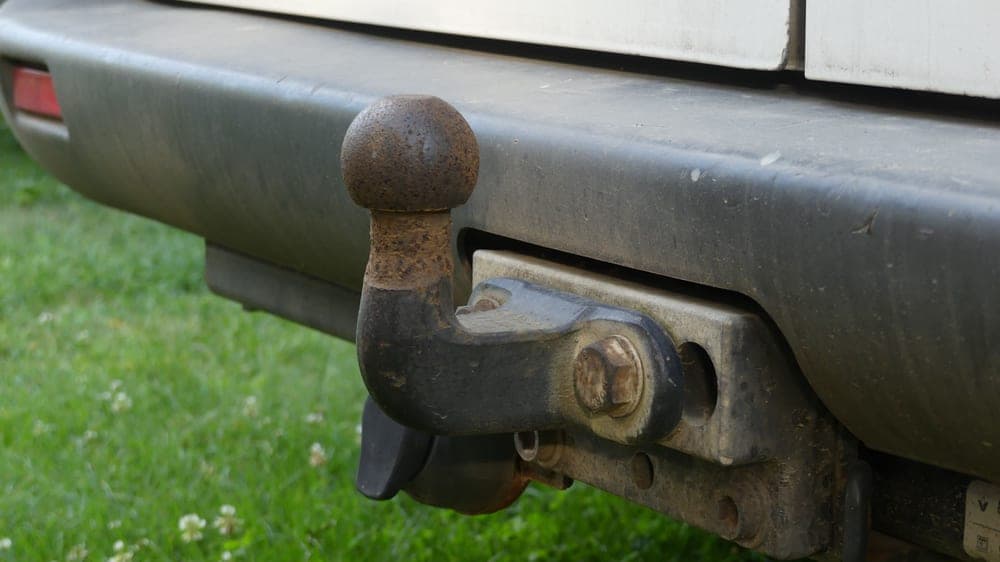
Hitch classes run from I to V and describe both a receiver opening size and a capacity rating. For a cargo carrier or a bike rack, the number that governs is tongue weight — the downward force on the receiver — not towing capacity. Classes I and II use a 1-1/4 inch opening; Class III and up use 2 inches, which is what most cargo carriers and platform bike racks require.
Quick picks
Tap any row to jump to the full write-up below. Scores are our editorial judgment on published specifications — not a star rating, and not a product we claim to have tested.
| # | Product | Best for | Score | Price |
|---|---|---|---|---|
| 1 |  MaxxHaul 70107Light for a steel basket, which leaves more of your tongue weight rating available for cargo. | Class III, best value | 7.9 | |
| 2 | CURT 18153 Folding Cargo CarrierThe folding angled shank is what you buy when a fixed carrier would foul your rear hatch. | Class III with hatch clearance | 8.5 | |
| 3 |  Saris Bones EXIf your car has no hitch and fitting one is not on the table, a trunk rack is the route that needs nothing. | No receiver at all | 7.7 |
Prices checked September 25, 2026. Product photographs are representative stock images, not the exact unit. Affiliate disclosure.
#1 · Class III, best value
MaxxHaul 70107
Light for a steel basket, which leaves more of your tongue weight rating available for cargo.
- Receiver
- 2-inch, Class III
- Rated capacity
- 500 lb
- Basket
- 60 x 20 inches
- Weight
- Low for a steel basket
What works
- More of your tongue rating stays usable
- Very cheap
- Proven design
What doesn’t
- Fixed shank
- Powder coat wears on salted roads
Our scoring
7.9overall
#2 · Class III with hatch clearance
CURT 18153 Folding Cargo Carrier
The folding angled shank is what you buy when a fixed carrier would foul your rear hatch.
- Receiver
- 2-inch, Class III
- Shank
- Folding, angled
- Basket
- 60 x 20 inches
- Material
- Steel
What works
- Folds flat when empty
- Clears tall hatches
- Robust
What doesn’t
- Heavy, which costs capacity
- Expensive
Our scoring
8.5overall
#3 · No receiver at all
Saris Bones EX
If your car has no hitch and fitting one is not on the table, a trunk rack is the route that needs nothing.
- Type
- Trunk rack, up to 3 bikes
- Needs
- No receiver
- Construction
- Injection molded
- Storage
- Folds flat
What works
- No hitch needed
- No metal-to-paint contact
- Folds away
What doesn’t
- Bikes hang by the top tube
- Trunk inaccessible while loaded
Our scoring
7.7overall
The classes
| Class | Receiver opening | Typical tongue weight | Usually fitted to |
|---|---|---|---|
| Class I | 1-1/4 in | Up to about 200 lb | Small cars and compact crossovers |
| Class II | 1-1/4 in | Up to about 350 lb | Mid-size cars, small SUVs, minivans |
| Class III | 2 in | Up to about 500-800 lb | Mid and full-size SUVs, pickups |
| Class IV | 2 in | Up to about 1,000 lb | Full-size trucks and SUVs |
| Class V | 2 or 2-1/2 in | 1,000 lb and above | Heavy-duty trucks |
These are typical ranges, not universal values — the actual rating for your hitch is on its sticker and in its documentation, and it can differ from the class norm. Always use your own figure.
Tongue weight is the number, not towing capacity
A hitch quotes two figures: gross trailer weight, which is what it can pull, and tongue weight, which is what it can support downward at the receiver.
A cargo carrier pulls nothing. Its entire load is downward force on the receiver, so tongue weight is the only figure that applies. Reading the towing number and concluding a Class II hitch can carry 3,500 lb of luggage is a genuine and common mistake.
There is a further subtlety. A trailer’s tongue weight acts right at the ball. A cargo carrier’s acts at the center of a basket extending 20 inches or more behind the receiver, which is a longer lever and a harder load. Some vehicle manufacturers publish a reduced rating specifically for cargo carriers and bike racks — if yours does, use that figure instead.
Which class you need
- Hitch cargo carrier: Class III with a 2-inch opening for almost all of them. The carrier alone can be 50-70 lb.
- Platform bike rack: Class III for most; a few are sold in 1-1/4 inch versions with a lower rating and a two-bike limit.
- Hanging bike rack: Class I or II is usually enough — these are light.
- Ramp carrier for a dirt bike or e-bike: Class III or IV, without exception.
- Four bikes: Class III. Four bikes plus a four-bike rack is 170-220 lb.
Adapters that convert a 1-1/4 inch receiver to 2 inches exist. They change the shape and not the rating, they add leverage, and most rack manufacturers advise against them. We would not use one for a loaded carrier.
Finding your rating
- Look for a sticker or stamped plate on the hitch itself, usually on the side of the receiver tube.
- Check the vehicle owner’s manual, towing section.
- If the hitch was fitted aftermarket, check the manufacturer’s documentation for the part number.
- Measure the opening with a tape — 1-1/4 inch and 2 inch are easy to tell apart.
If you cannot find a rating, treat the hitch as low-rated. An unmarked receiver is not an unlimited one, and this is particularly true on RVs, where many rear receivers are bumper-mounted and restricted to a bike rack — see our RV carrier guide.
Common questions
What hitch class do I need for a cargo carrier?
Is tongue weight the same as towing capacity?
Can I use an adapter to fit a 2-inch rack in a 1-1/4 inch hitch?
How do I find my hitch's rating?
Sources
Not sure it fits your car?
Our vehicle pages carry the published roof load limit, the roof type by model year, and what actually mounts to it — cited, and honest about what the manufacturer does not publish.
Read next
The Best Hitch Cargo Carriers for SUVs
Hitch carriers for SUVs, ranked — plus the tongue weight figure that really decides your load.
The Best Hitch Bike Racks
Platform hitch racks ranked on fit range, weight rating, loading and security.
The Best Hitch Cargo Carriers for an RV
Which carriers suit an RV, the rear-receiver rating warning, and how to load without damage.
Roof Rack or Hitch Carrier?
Bulky and light goes up top; heavy and dense goes on the back. The full comparison.