Hitch Carriers
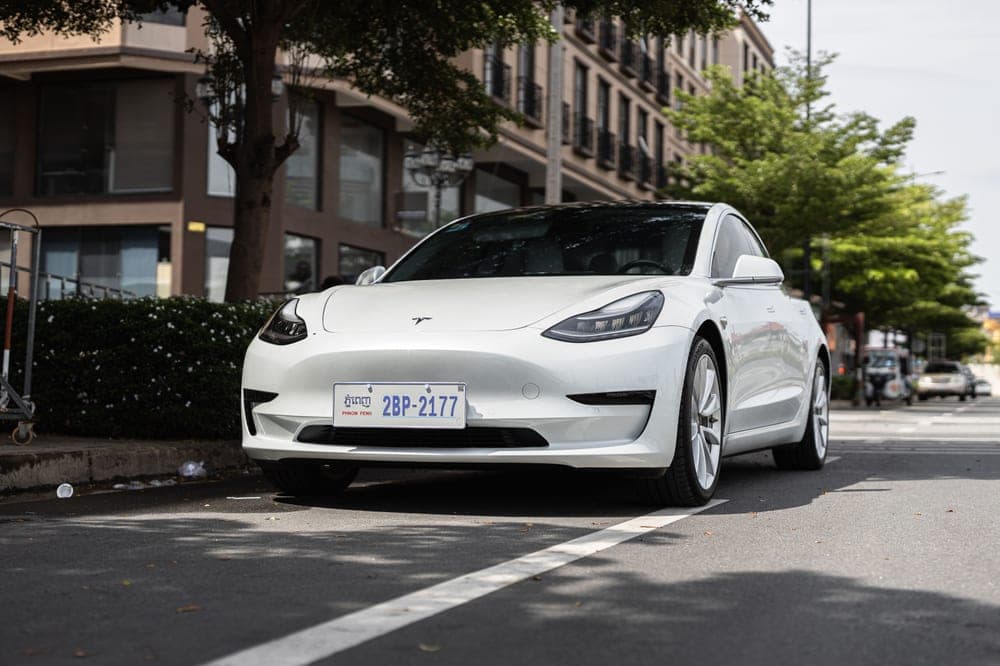
The Best Hitch Cargo Carriers for a Tesla Model Y
A Model Y receiver will physically hold a 500 lb carrier. The car will not allow anywhere near that. This page ranks around the number Tesla publishes, not the number printed on the box.
Roof & Route is funded by affiliate commission. If you buy through a link on this page we may earn a commission at no extra cost to you. It never decides what we recommend or the order we recommend it in — read the full disclosure.
On a Model Y the pick is the MaxxHaul 70108, and the reason has nothing to do with it being the best carrier on this site. It is aluminum, so it is the lightest thing here — and on this car, the carrier’s own weight is subtracted from a limit that is far smaller than most owners expect.
Here is the figure the rest of the page hangs on. Tesla’s Model Y owner’s manual rates the hitch receiver for vertical loads of up to 72 kg — about 160 lb — when it is carrying an accessory, and says plainly that this is lower than the trailer tongue rating because an accessory load sits farther back from the receiver. Tesla also tells you to include the weight of the carrier itself in that total. Separately, Tesla’s own Model X/Y hitch rack is published at 54.4 kg (120 lb). Where a manufacturer’s two numbers disagree, plan to the lower one.
So the arithmetic is not “this basket is rated to 500 lb.” It is 160 lb, minus the carrier, minus the bag, equals your cargo — and a heavy steel basket can eat a third of that before you put a single duffel in it. That inverts the usual ranking. The cheap heavy basket that wins on most vehicles finishes second here, and the aluminum tray that normally looks like an expensive luxury becomes the sensible buy.
Our Model Y fit page carries the published roof figures and the glass-roof mounting story; this page is about the receiver. One more thing Tesla states outright: do not fit an accessory carrier to a Model Y that does not have the tow package. If yours does not, the hitch classes guide explains what an aftermarket receiver does and does not change, and the aluminum carrier roundup covers the weight argument in full for any vehicle.
Quick picks
Tap any row to jump to the full write-up below. Scores are our editorial judgment on published specifications — not a star rating, and not a product we claim to have tested.
| # | Product | Best for | Score | Price |
|---|---|---|---|---|
| 1 | 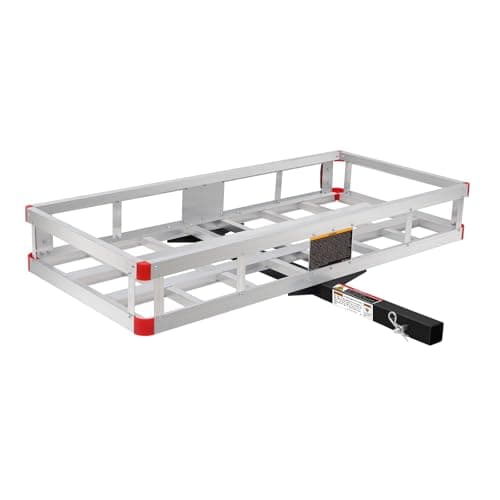 MaxxHaul 70108 Aluminum CarrierAluminum, with high side rails, in the size class that suits a crossover — the lightest carrier here, which on this car is the only specification that really ranks. | Best overall on a Model Y | 7.9 | |
| 2 | 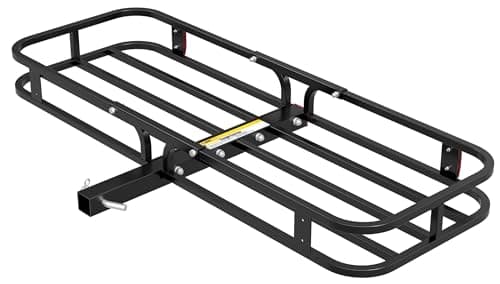 MaxxHaul 70107The 53 by 19-1/2 inch steel basket that is the cheapest honest carrier in the category — buy it if your loads are bulky rather than heavy, because its own weight is the price of admission. | Best value, if you load light anyway | 7.5 | |
| 3 | 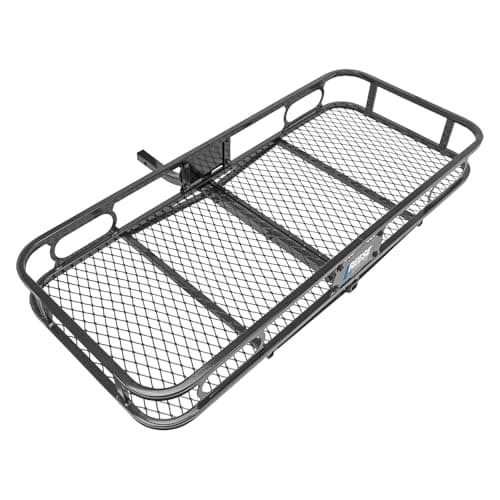 Reese Towpower Rambler 63155A 48 by 20 inch steel tray built for a 1-1/4 inch receiver and rated to 300 lb — the right shape of answer if your Model Y got an aftermarket hitch with the smaller opening. | An aftermarket 1-1/4 inch receiver | 6.6 | |
| 4 | 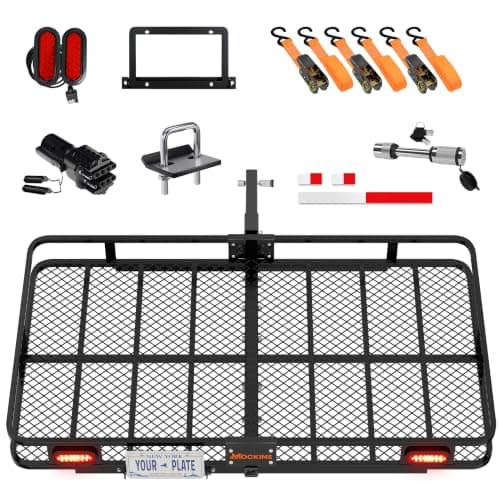 Mockins Hitch Cargo CarrierA 72 by 36 inch steel tray that ships with the waterproof bag, rear lights and plate bracket — the complete answer, and far more carrier than a Model Y needs. | Most floor area, with the weatherproofing included | 6.9 |
Prices checked October 17, 2026. Product photographs come from Amazon and are refreshed with the prices. Affiliate disclosure.
#1 · Best overall on a Model Y
MaxxHaul 70108 Aluminum Carrier
Aluminum, with high side rails, in the size class that suits a crossover — the lightest carrier here, which on this car is the only specification that really ranks.
- Material
- Aluminum
- Receiver
- 2 inch
- Rails
- High side rails
- Empty weight
- The lightest carrier on this page
- Shank
- Fixed, does not fold
What works
- Every pound it does not weigh is a pound of luggage you are allowed to carry
- Aluminum ignores road salt, including on the underside you never clean
- Light enough for one person to fit and remove without help, so it need not live on the car
- High side rails keep soft bags from working their way over the edge
What doesn’t
- Costs roughly double the steel basket of the same size
- Aluminum dents permanently where steel springs back
- Fixed shank, so the car is permanently longer until you pull the carrier out
- Published empty weights vary between listings — weigh it or budget conservatively
Our scoring
7.9overall
#2 · Best value, if you load light anyway
MaxxHaul 70107
The 53 by 19-1/2 inch steel basket that is the cheapest honest carrier in the category — buy it if your loads are bulky rather than heavy, because its own weight is the price of admission.
- Basket
- 53" x 19-1/2"
- Material
- Powder-coated steel
- Rated capacity
- 500 lb (the carrier's rating, not the car's)
- Shank
- Fixed, 2 inch
- Rails
- High side rails
What works
- A fraction of the price of everything else here, by a wide margin
- Steel is stiffer than aluminum under a concentrated load
- The most widely bought carrier in the category, so there are no surprises in the box
- Smaller footprint than the XXL trays, which suits a Model Y's rear overhang
What doesn’t
- Heavier empty than the aluminum tray, and on this car that weight is cargo you cannot carry
- Its 500 lb rating is irrelevant here — the car's limit binds first, by a long way
- Powder coat is the first thing to fail on salted roads, and then it rusts
- No fold, no anti-rattle hardware included; budget for a hitch tightener
Our scoring
7.5overall
#3 · An aftermarket 1-1/4 inch receiver
Reese Towpower Rambler 63155
A 48 by 20 inch steel tray built for a 1-1/4 inch receiver and rated to 300 lb — the right shape of answer if your Model Y got an aftermarket hitch with the smaller opening.
- Basket
- 48" x 20"
- Receiver
- 1-1/4 inch
- Rated capacity
- 300 lb (the carrier's rating)
- Material
- Alloy steel, black powder coat
- Side rails
- 5.5 in, mesh floor
What works
- Fits the 1-1/4 inch opening that the 2 inch baskets simply cannot
- 48 inches is a sensible width behind a crossover — less overhang to reverse around
- Mesh floor instead of widely spaced bars, so small items do not drop through
- Made by a towing brand that publishes ratings per part number
What doesn’t
- The most expensive carrier on this page, for the least floor area
- 300 lb carrier rating is the lowest here — though still far above what the car allows
- Steel, so it carries the same empty-weight penalty as the MaxxHaul 70107
- Does not fold
Our scoring
6.6overall
#4 · Most floor area, with the weatherproofing included
Mockins Hitch Cargo Carrier
A 72 by 36 inch steel tray that ships with the waterproof bag, rear lights and plate bracket — the complete answer, and far more carrier than a Model Y needs.
- Basket
- 72" x 36" x 6"
- Material
- Steel
- Included
- Waterproof bag, rear lights, license plate bracket
- Receiver
- 2 inch
- Shank
- Fixed
What works
- One order gets you carrier, weather protection and a legal plate and light position
- The largest floor area here by a distance, for bulky and awkward loads
- Rear lights matter on a tray this long, because it hides the car's own lights
What doesn’t
- 72 by 36 inches is a lot of steel to hang off a crossover — the empty weight is the biggest here
- On a Model Y you will hit the accessory limit long before you fill it
- The bundled straps are the first thing we would replace
- Fixed shank, and a tray this long changes how you reverse and park
Our scoring
6.9overall
The number that decides this page
Most hitch carrier shopping is a contest between capacity and price. On a Model Y it is neither, because the binding constraint arrives before both: the vertical load the car will accept on the receiver.
Tesla’s Model Y owner’s manual publishes a vertical load rating of 72 kg (about 160 lb) for accessories carried on the hitch, and is explicit that this is lower than the trailer tongue weight because the load sits farther from the receiver. It also instructs you to count the accessory carrier’s own weight toward that figure. Tesla’s own Model X/Y hitch rack, meanwhile, is published at 54.4 kg (120 lb).
Two Tesla-published numbers, 40 lb apart. We are not going to pretend to resolve that for you — we did not write either one. What we will say is what any load-rating conversation on this site says: when the figures disagree, you plan to the lower one, because nothing good happens at the top of a range you guessed at.
Now put a carrier in it. A large steel basket can be half of a 120 lb allowance before anything goes on it. An aluminum tray of the same footprint might be a quarter. That is the entire reason the ranking on this page looks different from the general SUV roundup, where the heavy steel basket wins on value and nobody minds the weight.
Tow package, aftermarket hitch, or neither
Tesla’s manual warns against installing an accessory carrier on a Model Y that is not equipped with the tow package. Take that at face value: a receiver is not just a hole, it is a load path into the vehicle’s structure, and the factory package is what certifies that path.
If your car did not come with it, the aftermarket route exists and is well established. CURT publishes a Class 3 hitch for the Model Y — part 13598 — with a 2 inch receiver tube, rated at 3,500 lb gross trailer weight and 525 lb tongue weight, listed for 2020 through 2023 cars. Torklift lists its EcoHitch for the Model Y at 3,500 lb towing with a maximum tongue weight of 350 lb on 2020-2025 cars and 425 lb on 2026-and-later cars.
Read those numbers carefully, because they are the easiest trap in this whole category. A hitch’s rating is the hitch’s rating. It tells you what that steel assembly can take. It does not raise what the vehicle is rated to carry, and Torklift says so itself: no aftermarket hitch can increase a vehicle’s factory towing capacities. A 525 lb tongue rating bolted to a car that publishes 160 lb for accessories still gives you 160 lb.
The practical consequence for shopping: a 2 inch opening is the normal case on a Model Y, factory or aftermarket, so almost every carrier in this category physically fits. If you have a 1-1/4 inch aftermarket hitch instead, your choice narrows to trays built for that opening — which is why the Reese Rambler is on this page at all. The hitch classes guide explains what the class numbers mean and why the opening size is not the same question as the rating.
How we ranked these
The order on this page is not the order these carriers would finish in on a pickup. Four things decided it, in this sequence:
- Empty weight first. On a vehicle with a 120-160 lb accessory allowance, the carrier’s own mass is the first and largest deduction. Aluminum beats steel here on the one axis that matters, which is why it finishes first despite costing more.
- Footprint second. A Model Y is a mid-size crossover, not a dually. A 72 inch tray behind one is a reversing, parking and garage problem long before it is a capacity problem — and you cannot legally fill it anyway.
- Receiver opening third. 2 inch for the overwhelming majority of cars; 1-1/4 inch only if an aftermarket hitch put that opening on your car. Measure it, do not assume it.
- Price last. Normally price does heavy lifting in this category. Here the cheapest carrier costs you cargo capacity, so the value calculation is genuinely different: you are buying allowance, not just steel.
We did not score these on load rating, which is the axis most carrier roundups rank on. On this vehicle it is a meaningless axis — every carrier here is rated far beyond what the car permits, so ranking by it would tell you nothing except which manufacturer printed the biggest number.
One carrier we left off deliberately: CURT’s 18151 basket, which we rate well on other pages, was showing a one-to-two-month ship estimate on its Amazon listing when this page was written. It is a good basket. It is not a good recommendation to someone with a trip booked.
Worked example: a weekend's worth of gear
Numbers beat adjectives, so here is the sum you should actually do, written out with the lower of Tesla’s two figures because that is how we would plan it.
Start: 120 lb allowance. Subtract the carrier: call it 30 lb for a light aluminum tray — you now have 90 lb. Subtract a weatherproof bag: a hitch-sized cargo bag is typically single-digit pounds empty, so call it 85 lb left.
Eighty-five pounds is two large soft duffels, a folded camp chair set and a sleeping bag stack. It is not a full cooler — a 45-quart cooler with ice is most of that figure on its own. It is not firewood. It is not a generator.
Now run the same sum with a heavy steel tray: 120 lb, minus perhaps 55 lb of carrier, leaves 65 lb and the bag takes it under 60. Same car, same trip, and you have lost a third of your luggage to the thing holding your luggage. That is the entire argument of this page in two sums.
If your load is genuinely heavy — the cooler, the water, the tools — the honest answer on a Model Y is that the hitch is not where it goes. Put weight inside the car, where it counts against payload rather than against a 120 lb accessory limit, and use the carrier for the bulky, light, dirty things. Roof or hitch works through where different loads belong.
Range, not mpg: what a carrier costs an EV
Every combustion car on this site loses fuel economy to a carrier. Consumer Reports’ testing of rooftop carriers is the figure we cite throughout, and it is large — a rooftop box is one of the most expensive aerodynamic accessories you can bolt to a car.
An EV pays the same physics bill in a currency you notice more. A Model Y is unusually slippery for a crossover, and the whole efficiency story of the car is built on that. Add drag and the penalty lands on your range number, in real time, on the screen, on a road trip where the chargers are planned around the old number.
We are not going to invent a percentage for you. Tesla does not publish a range penalty for accessory carriers, and anybody quoting you a single clean figure is extrapolating from somebody else’s test. What is well established and worth acting on:
- Behind beats above. A hitch carrier sits in air the car has already disturbed; a roof box sits in clean fast air at the highest-pressure point on the vehicle. For the same volume of gear, the hitch costs less.
- Shape matters more than weight. At highway speed the penalty is aerodynamic, not gravitational. A smooth, well-strapped bag costs less range than the same weight of gear strapped into open air with a net.
- Empty carriers still cost you. If it only goes on for trips, take it off between them. This is a genuine advantage of the light aluminum tray — a carrier you can lift out single-handed is a carrier that actually comes off.
- Plan the first long trip with margin. Treat your first loaded drive as the measurement, not the test of your planning.
Our fuel economy guide has the published testing behind all of this, and the same ordering holds for an EV even though the units on the dashboard are different.
Fitting one without regretting it
Four Model Y-specific things worth doing before the first trip rather than after it.
Check the liftgate’s swing with the carrier fitted. None of the carriers on this page fold. A powered liftgate that closes onto a loaded tray is an expensive discovery. If your car lets you cap the liftgate’s opening height in its settings, set that before you load, and physically watch the first open-and-close cycle with the carrier in place.
Expect the parking sensors to object. A tray in the receiver sits exactly where the rear sensors look. Reversing alerts that scream at empty air are the normal state of affairs with any hitch accessory fitted; the fix is knowing it is coming, not disabling anything.
Buy an anti-rattle device with the carrier, not after it. Every fixed-shank carrier here moves in the receiver, and an EV cabin is quiet enough that you hear every bit of it. A hitch tightener is the cheapest upgrade in this entire category.
Strap to the rails, not over the top. High side rails are anchor points. Running straps through them keeps the load low and stops the whole pile shifting rearward under braking. The tie-down guide has the pattern, and cam straps are the right tool for soft luggage — a ratchet will crush a duffel before you notice.
Common questions
How much weight can a Tesla Model Y carry on its hitch?
Can I fit a cargo carrier to a Model Y without the tow package?
Does a Model Y have a 2 inch or 1-1/4 inch receiver?
How much range will a hitch cargo carrier cost me?
Should I use a roof box on a Model Y instead?
Is an aluminum carrier really worth double the price?
Sources
Not sure it fits your car?
Our vehicle pages carry the published roof load limit, the roof type by model year, and what actually mounts to it — cited, and honest about what the manufacturer does not publish.
Read next
The Best Aluminum Hitch Cargo Carriers
Aluminum carriers ranked, plus the tongue-weight arithmetic that decides whether the price premium pays.
Hitch Classes Explained
Classes, receiver sizes and tongue weight ratings — and why tongue weight is the number that matters.
The Best Cargo Bags for a Hitch Carrier
Waterproof bags that work in a hitch basket, honestly labeled: none of them is built specifically for one.
Roof Rack or Hitch Carrier?
Bulky and light goes up top; heavy and dense goes on the back. The full comparison.