Hitch Carriers
The Best Aluminum Hitch Cargo Carriers
Steel is cheaper and stiffer. Aluminum is lighter and does not rust. Which one is right is a question about your hitch label, not your taste.
Roof & Route is funded by affiliate commission. If you buy through a link on this page we may earn a commission at no extra cost to you. It never decides what we recommend or the order we recommend it in — read the full disclosure.
The pick is the MaxxHaul 70108: an aluminum tray roughly a third the weight of the equivalent steel basket, at the lowest price anyone charges for that. If you need a ramp with it, the Black Widow AMC-400 is the answer instead.
Here is the direct answer to why you would pay more for less metal. Tongue weight is the total downward load your receiver will accept, and the carrier’s own mass counts against it in full, before a single bag goes in the basket. Swap steel for aluminum and you hand that weight straight back to the cargo.
On a 2-inch Class III receiver with a few hundred pounds of tongue rating, that is a nicety. On a Class II receiver on a car or a small crossover, it can be the difference between a usable carrier and one that is close to its limit empty. So the honest rule: the lighter the hitch, the more the aluminum premium is worth.
The second reason is less glamorous and matters more over five years. Aluminum does not rust where road salt collects, and the underside of a hitch carrier is the single most salt-exposed thing you own. Steel baskets rust at every chip, and a hitch carrier gets chipped by definition.
What you give up is stiffness. Aluminum deflects more visibly than steel under a point load, so spread heavy items across the floor of the tray rather than stacking them over the shank. Our weight limits guide has the full arithmetic.
Quick picks
Tap any row to jump to the full write-up below. Scores are our editorial judgment on published specifications — not a star rating, and not a product we claim to have tested.
| # | Product | Best for | Score | Price |
|---|---|---|---|---|
| 1 | 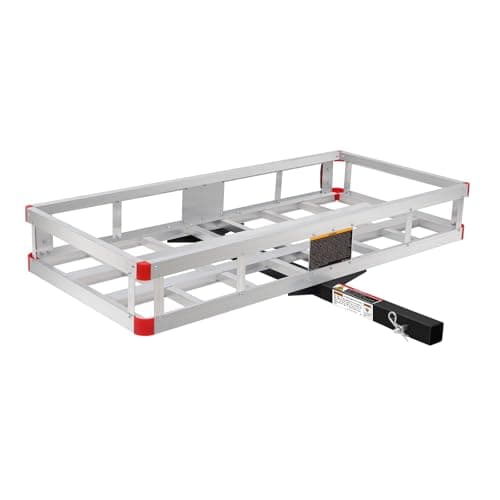 MaxxHaul 70108 Aluminum CarrierThe cheapest route into aluminum, and the one whose weight saving is the entire point of buying it. | Best overall aluminum carrier | 7.9 | |
| 2 |  Black Widow AMC-400An aluminum carrier with a self-storing roll-on ramp, rated to 400 lb on a 2-inch receiver — the one to buy if anything you carry has wheels. | Best aluminum carrier with a ramp | 7.9 | |
| 3 | Black Widow AMC-400-FThe folding-adapter version of the AMC-400, so the carrier tips up against the vehicle when empty and your hatch still opens. | Best folding aluminum carrier | 7.9 | |
| 4 | 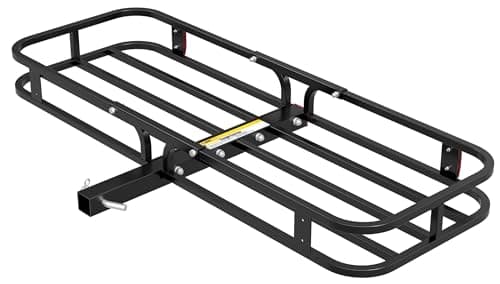 MaxxHaul 7010760 by 20 inches, 500 lb rated, non-folding, and a fraction of the price — the carrier the aluminum trays have to justify themselves against. | The steel baseline to compare against | 7.8 |
Prices checked October 12, 2026. Product photographs come from Amazon where the listing is matched, and are representative stock images otherwise. Affiliate disclosure.
#1 · Best overall aluminum carrier
MaxxHaul 70108 Aluminum Carrier
The cheapest route into aluminum, and the one whose weight saving is the entire point of buying it.
- Material
- Aluminum
- Weight
- Roughly a third of the steel equivalent
- Shank
- Fixed
- Corrosion
- No rust at chips or on the underside
What works
- Light enough for one person to fit and remove without help
- Leaves more of a modest tongue rating available for cargo
- Aluminum ignores road salt, which is where steel baskets die
- Cheapest aluminum carrier we would put on a car
What doesn’t
- Costs more than the steel basket it replaces
- Deflects more visibly than steel under a concentrated load
- No folding hinge, so a hatch is awkward with it fitted
Our scoring
7.9overall
#2 · Best aluminum carrier with a ramp
Black Widow AMC-400
An aluminum carrier with a self-storing roll-on ramp, rated to 400 lb on a 2-inch receiver — the one to buy if anything you carry has wheels.
- Material
- Aluminum
- Rated
- 400 lb on a 2-inch receiver (carrier rating)
- Ramp
- Self-storing roll-on
- Receiver
- 2 inch only
What works
- A ramp turns a lifting job into a pushing job — mowers, generators, scooters
- Ramp stores on the carrier rather than in your garage
- 400 lb carrier rating with aluminum's weight saving, which is a rare combination
- No rust on the part of the carrier you never clean
What doesn’t
- No live Amazon listing matched this model, so we show no price for it
- 2-inch receiver only — a Class I or II car cannot use it
- Costs considerably more than a plain tray
- The 400 lb rating is the carrier's, not your hitch's
Our scoring
7.9overall
#3 · Best folding aluminum carrier
Black Widow AMC-400-F
The folding-adapter version of the AMC-400, so the carrier tips up against the vehicle when empty and your hatch still opens.
- Material
- Aluminum
- Shank
- Folding adapter
- Ramp
- Self-storing roll-on
- Receiver
- 2 inch only
What works
- Folds up, so a hatch or liftgate still works with the carrier fitted
- Keeps the ramp and the aluminum weight saving of the AMC-400
- Folds for storage as well as for access
What doesn’t
- No live Amazon listing matched this model, so we show no price for it
- The folding hinge is the part that wears and rattles
- The most expensive carrier in this list
- 2-inch receiver only
Our scoring
7.9overall
#4 · The steel baseline to compare against
MaxxHaul 70107
60 by 20 inches, 500 lb rated, non-folding, and a fraction of the price — the carrier the aluminum trays have to justify themselves against.
- Basket
- 60 x 20 inches
- Rated
- 500 lb (carrier rating, not your hitch's)
- Material
- Powder-coated steel
- Shank
- Fixed, non-folding
What works
- The cheapest honest basket in the category by a clear margin
- Stiffer than aluminum under a concentrated load
- 500 lb carrier rating exceeds what most hitches will allow anyway
- Nothing to seize and nothing to adjust
What doesn’t
- Heavy — spends a big share of a Class I or II tongue rating empty
- Rusts at any chip you fail to touch up
- Does not fold, so the hatch is awkward with it fitted
Our scoring
7.8overall
When the aluminum premium pays, and when it does not
This is an arithmetic question with a clean answer, so here is the table rather than the opinion. The figures below are the shape of the problem, not a quote for a specific product — read your own hitch label and your own carrier’s shipping weight.
| Your receiver | What the carrier’s weight costs you | Verdict |
|---|---|---|
| Class III, 2 inch, generous tongue rating | A small fraction of what you have | Buy steel and spend the difference on a cargo bag |
| Class II, 1-1/4 or 2 inch, modest rating | A meaningful share before you load anything | Aluminum is worth the premium |
| Class I, 1-1/4 inch, low rating | Most of it | No carrier fixes this — use the roof |
| Any receiver, salt-belt winters | Nothing, but steel corrodes from underneath | Aluminum pays back over years rather than trips |
The second-order benefit nobody mentions: you will actually take a light carrier off. A steel basket is a two-person lift that lives on the car all year, costing fuel and collecting salt. An aluminum tray is a one-person lift that lives in the garage. Over a year that is worth more than the weight saving itself. The drag figures make the case.
Two ratings, and only one of them is yours
Every carrier in this category is sold on a capacity figure — 400 lb, 500 lb. That number is the carrier’s rating: what the basket and shank will survive. It is almost never the number that limits you.
The number that limits you is the tongue-weight rating of your hitch, printed on a label on the hitch itself. It is the total downward load the receiver will accept, and it includes the carrier. When the two disagree, the smaller one governs, and it is nearly always the hitch.
Which means a 500 lb carrier on a 350 lb hitch is a 350 lb setup, minus the basket’s own weight. Read the label, not the listing. Our hitch classes guide maps the classes to real numbers, and the weight limits guide works through examples.
Loading aluminum differently from steel
Aluminum is not weaker in any way that matters at these loads, but it is less stiff, and you will see it. A point load over the middle of an aluminum tray produces visible deflection that the same load on steel does not.
So change how you pack rather than what you buy:
- Spread the weight. Lay heavy items flat across the floor of the tray instead of stacking them in one spot.
- Heavy against the vehicle. True on any carrier, more useful here — it shortens the lever arm and keeps the deflection where the structure is deepest.
- Do not stand on it. A carrier is not a step, and an aluminum one definitely is not.
- Check the shank bolts after the first trip. Any new carrier settles once; this is when you find the one you under-torqued.
Strap down and then fore-and-aft, as always — the sequence is here, and a net over the top stops the small things leaving. The net picks are sized for these baskets.
Steel, the roof, or neither
Three honest alternatives to paying the aluminum premium.
Buy steel and accept it. If you have a Class III receiver, a garage, and no salt, the weight saving buys you very little and the money is better spent on a waterproof bag and decent straps. The SUV carrier roundup is where that path starts.
Use the roof. If your receiver is a Class I, aluminum does not save you — the rating is the problem, not the mass. A roof box or basket is the honest answer, and the roof-or-hitch guide covers the trade-offs including the fuel cost.
Do neither and pack better. Worth saying once: a lot of carrier purchases are solving a packing problem. If the trunk is full because of one bulky, light item, a roof bag costs a fraction of a carrier and weighs almost nothing.
Common questions
Is an aluminum hitch cargo carrier worth the extra money?
Are aluminum carriers strong enough?
What does the 400 lb or 500 lb rating on a carrier actually mean?
Do aluminum carriers fit a 1-1/4 inch receiver?
Sources
Not sure it fits your car?
Our vehicle pages carry the published roof load limit, the roof type by model year, and what actually mounts to it — cited, and honest about what the manufacturer does not publish.
Read next
The Best Cargo Carriers for Cars
Hitch cargo carriers that suit a car rather than a truck, plus the receiver check to do first.
The Best Heavy-Duty Hitch Cargo Carriers
The highest-capacity carriers, ranked, plus why your hitch label beats the listing's capacity figure.
Hitch Cargo Carrier Weight Limits
The three ratings that cap a hitch carrier load, and why tongue weight usually decides it.
Hitch Classes Explained
Classes, receiver sizes and tongue weight ratings — and why tongue weight is the number that matters.