Hitch Carriers
The Best Heavy-Duty Hitch Cargo Carriers
Carriers are sold on a capacity figure that is not your limit. Here is what the heavy-duty baskets actually do, and the number that governs instead.

Roof & Route is funded by affiliate commission. If you buy through a link on this page we may earn a commission at no extra cost to you. It never decides what we recommend or the order we recommend it in — read the full disclosure.
If you want the most capacity for the least money, it is the MaxxHaul 70107: 60 by 20 inches, 500 lb rated, steel, non-folding. If you need that capacity and a ramp, it is the Black Widow AMC-400.
Now the part the listings do not tell you. The 500 lb figure is the carrier’s rating — what the basket and shank will survive. Your limit is the tongue-weight rating of your hitch, printed on a label on the hitch itself, and it includes the carrier’s own weight. When those two numbers disagree, the smaller one governs, and on a passenger vehicle it is almost always the hitch.
So “heavy duty” in this category means something narrower than it sounds. It does not mean you can carry 500 lb. It means the basket will not deform under whatever your hitch does allow, the shank will not twist, and the welds will still be welds in five years. That is genuinely worth paying for if you load a carrier hard and often.
Where it does mean 500 lb is behind an RV or a truck with a heavy-duty receiver — and there the rest of the rules change too, which is why the RV carrier page exists separately. Read that one if your receiver is on a motorhome bumper rather than a vehicle frame; bumper-mounted receivers have their own much lower ratings and their own failure mode.
Quick picks
Tap any row to jump to the full write-up below. Scores are our editorial judgment on published specifications — not a star rating, and not a product we claim to have tested.
| # | Product | Best for | Score | Price |
|---|---|---|---|---|
| 1 | 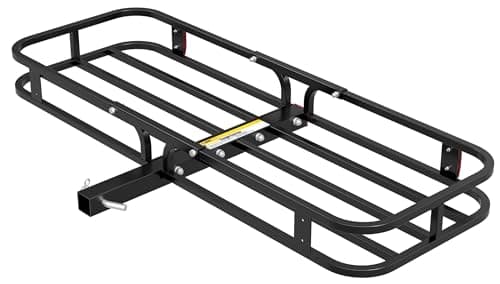 MaxxHaul 7010760 by 20 inches and a 500 lb carrier rating at a price nothing else in the category matches — the default heavy-duty basket. | Most capacity per dollar | 8.2 | |
| 2 |  Black Widow AMC-400400 lb rated on a 2-inch receiver with a self-storing roll-on ramp, in aluminum — the only way to load a mower without lifting it. | Heavy loads with wheels | 7.9 | |
| 3 | 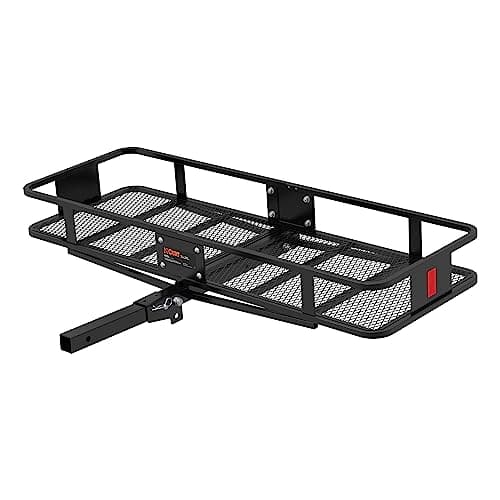 CURT 18151 Cargo CarrierA fixed-shank steel basket from a towing brand that publishes capacity and fitment per part number, which is what you want when you are loading to the limit. | Best documented heavy basket | 8.0 | |
| 4 | 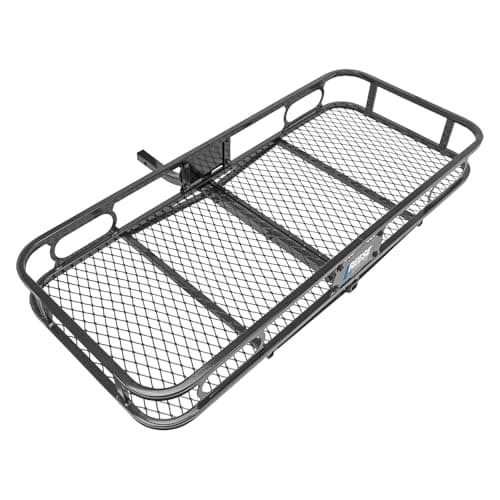 Reese Towpower Rambler 63155The Rambler that is still listed is the small-receiver one: 48 by 20 inches, 300 lb rated, alloy steel, 39 lb empty. If your receiver is the 1-1/4 inch size, this is the towing-brand basket built for it — and it asks more money than the bigger 2-inch baskets above it. | Best for a 1-1/4 inch receiver | 6.5 |
Prices checked October 12, 2026. Product photographs come from Amazon where the listing is matched, and are representative stock images otherwise. Affiliate disclosure.
#1 · Most capacity per dollar
MaxxHaul 70107
60 by 20 inches and a 500 lb carrier rating at a price nothing else in the category matches — the default heavy-duty basket.
- Basket
- 60 x 20 inches
- Rated
- 500 lb (carrier rating)
- Material
- Powder-coated steel
- Shank
- Fixed, non-folding
What works
- 500 lb carrier rating exceeds what most passenger-vehicle hitches allow
- Steel is stiffer than aluminum under the concentrated loads this is bought for
- 60 x 20 inches is a genuinely useful floor area
- Cheapest honest basket in the category by a clear margin
What doesn’t
- Heavy empty, which eats a modest tongue rating before you load
- Does not fold, so the hatch is awkward with it fitted
- Rusts at any chip you fail to touch up
Our scoring
8.2overall
#2 · Heavy loads with wheels
Black Widow AMC-400
400 lb rated on a 2-inch receiver with a self-storing roll-on ramp, in aluminum — the only way to load a mower without lifting it.
- Material
- Aluminum
- Rated
- 400 lb on a 2-inch receiver (carrier rating)
- Ramp
- Self-storing roll-on
- Receiver
- 2 inch only
What works
- A ramp converts a lifting problem into a pushing problem
- Ramp stores on the carrier, so it is there when you need it
- Aluminum keeps the carrier's own mass down at a high rating
- No rust on the underside you never see
What doesn’t
- No live Amazon listing matched this model, so we show no price for it
- 2-inch receiver only
- Costs several times the plain steel basket
- Less stiff than steel under a point load
Our scoring
7.9overall
#3 · Best documented heavy basket
CURT 18151 Cargo Carrier
A fixed-shank steel basket from a towing brand that publishes capacity and fitment per part number, which is what you want when you are loading to the limit.
- Material
- Steel
- Shank
- Fixed
- Brand
- Long-established towing manufacturer
- Documentation
- Ratings published per part number
What works
- Per-part-number ratings mean you can do the arithmetic honestly
- Fixed shank has nothing to rattle, seize or wear
- Powder-coated steel survives salt-belt winters with maintenance
- Backed by a dealer network rather than a single listing
What doesn’t
- Heavy empty
- No fold, so the hatch access is yours to plan
- Costs more than the budget steel baskets for similar capacity
Our scoring
8.0overall
#4 · Best for a 1-1/4 inch receiver
Reese Towpower Rambler 63155
The Rambler that is still listed is the small-receiver one: 48 by 20 inches, 300 lb rated, alloy steel, 39 lb empty. If your receiver is the 1-1/4 inch size, this is the towing-brand basket built for it — and it asks more money than the bigger 2-inch baskets above it.
- Basket
- 48 x 20 inches usable
- Rated
- 300 lb (carrier rating)
- Receiver
- 1-1/4 inch
- Material
- Alloy steel, 39 lb empty
What works
- 300 lb is a high carrier rating for the 1-1/4 inch class
- 5.5-inch side rails and a mesh floor, the same construction as the bigger baskets
- 39 lb empty leaves more of a small receiver's allowance for the cargo
- Rated and part-numbered per configuration, so the figure belongs to this exact basket
What doesn’t
- Costs more than the 2-inch, 500 lb baskets ranked above it
- 1-1/4 inch receivers carry the lowest tongue ratings, so 300 lb is academic on most of them
- 48 by 20 inches is the smallest floor on this page
- Sold variously as Reese, Towpower and Pro-Series, so matching the part number takes care
Our scoring
6.5overall
The listing's number versus your number
Everything in this category is marketed on capacity, and almost nobody buying it is limited by capacity. Here is the hierarchy, from the number that governs down to the number on the box.
| Number | Where you find it | Does it limit you? |
|---|---|---|
| Hitch tongue-weight rating | Label on the hitch itself | Yes — this is your real limit, and it includes the carrier |
| Vehicle’s published tongue capacity | Owner’s manual | Yes, if it is lower than the hitch’s |
| Carrier capacity (400 lb, 500 lb) | The listing | Rarely — only if it is the smallest of the three |
| Vehicle’s towing capacity | Marketing and the brochure | No. Different number, different load path, not relevant here |
The last row is the one that gets people hurt. A vehicle rated to tow 5,000 lb is not rated to hang 500 lb off the back of the receiver: a trailer carries its own weight on its own wheels and puts only a fraction on the tongue. A cargo carrier puts all of it on the tongue, as a cantilever.
Why a cantilever is harder than it looks
A hitch carrier is a lever and the receiver is the fulcrum. Weight at the far end of a 60-inch basket does not just press down — it tries to rotate the shank in the receiver, and that twisting is what finds the weak weld.
Which is why “heavy duty” should be read as a claim about the shank and the welds, not about the number. The things worth paying for, in order:
- A shank that fills the receiver. Slop is leverage you did not sign up for. An anti-rattle bolt or a hitch tightener is cheap and transformative.
- Welds along the shank-to-basket joint, not just at the corners. This is the joint that fails.
- A short overhang if you can take one. A 48-inch basket carrying the same weight loads the receiver less than a 60-inch one.
- Published per-part ratings. A brand that gives you a number per part number is a brand that measured something.
And then load it correctly: heavy items hard against the vehicle, light and bulky at the back. That single habit does more for a heavily loaded carrier than any upgrade you can buy.
Clearance, plates and the squat
Heavy loads create a problem light loads do not: the suspension squats and the basket drops with it. Measure the empty basket floor height, then load it and measure again. If the loaded figure is down around six inches you are going to catch it on a driveway, a speed bump or a boat ramp.
Two other things that get worse with weight. Plate and light visibility: a tall load behind a basket hides both, and most carriers include a plate bracket because this is a real traffic stop. And re-check interval: a heavy load settles more than a light one, so the twenty-minute strap check is not optional.
Our tie-down guide has the strapping sequence, and the ratchet strap picks cover what to use when the load is actually heavy — cam straps are for hulls and boxes, not for 300 lb of equipment.
RV bumpers and truck receivers are different problems
If your receiver is welded to a motorhome’s rear bumper rather than bolted to a vehicle frame, none of the capacity reasoning above applies in the same way. Bumper-mounted receivers on RVs typically carry much lower ratings than their size suggests, and the failure mode is the bumper, not the carrier.
That is a separate purchase with separate rules, and we gave it its own page: RV cargo carriers. Read it before you load anything behind a motorhome.
Trucks are the opposite case — a frame-mounted Class IV receiver on a pickup will usually allow more tongue weight than any carrier here is rated for, so for once the carrier’s number is the one that binds. That is the only situation in this category where buying the highest-rated carrier is straightforwardly the right call.
Common questions
Can I really carry 500 lb on a hitch cargo carrier?
Is my vehicle's towing capacity the same as what a cargo carrier can hold?
What makes a carrier heavy-duty rather than just big?
Steel or aluminum for heavy loads?
Sources
Not sure it fits your car?
Our vehicle pages carry the published roof load limit, the roof type by model year, and what actually mounts to it — cited, and honest about what the manufacturer does not publish.
Read next
The Best Hitch Cargo Carriers for an RV
Which carriers suit an RV, the rear-receiver rating warning, and how to load without damage.
The Best Aluminum Hitch Cargo Carriers
Aluminum carriers ranked, plus the tongue-weight arithmetic that decides whether the price premium pays.
Hitch Cargo Carrier Weight Limits
The three ratings that cap a hitch carrier load, and why tongue weight usually decides it.
How to Tie Down Cargo
Anchor points, strap direction, correct tension, tail management and the pre-drive checks.