Guides
Hitch Cargo Carrier Weight Limits
Three different ratings apply at once, and the lowest one wins. It is usually not the one printed on the carrier.

Roof & Route is funded by affiliate commission. If you buy through a link on this page we may earn a commission at no extra cost to you. It never decides what we recommend or the order we recommend it in — read the full disclosure.
The weight you can carry on a hitch cargo carrier is the lowest of three numbers: the carrier’s own rated capacity, the hitch’s tongue weight rating, and whatever the vehicle manufacturer states for cargo in the receiver. In practice the tongue weight rating is almost always the binding one — and the carrier’s own mass counts against it before you load anything.
A worked example. A steel basket rated 500 lb, in a Class III receiver with a 500 lb tongue rating, sounds like 500 lb of cargo. It is not. Subtract the basket’s own weight — call it 50 lb — and you have 450 lb. Then subtract for leverage, because the load is not sitting in the receiver, it is sitting a couple of feet behind it.
That leverage is the part nobody prints. Tongue ratings assume a load at or near the receiver. A cargo carrier puts the load a long way back, which multiplies the moment on the receiver and the frame. Manufacturers handle this by publishing lower ratings for extended carriers, and you should handle it by treating the stated figure as a ceiling you do not approach rather than a target you fill.
Quick picks
Tap any row to jump to the full write-up below. Scores are our editorial judgment on published specifications — not a star rating, and not a product we claim to have tested.
| # | Product | Best for | Score | Price |
|---|---|---|---|---|
| 1 |  CURT 18153 Folding Cargo CarrierA 60-inch steel basket on a folding shank from a towing brand that publishes capacity per part number. | Published ratings and a folding shank | 8.2 | |
| 2 | 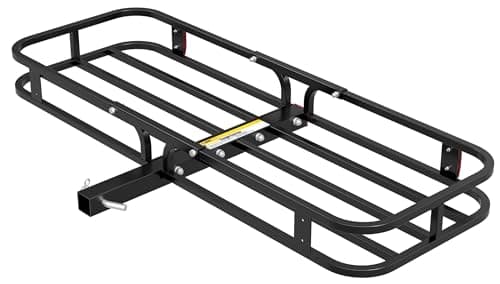 MaxxHaul 7010760 by 20 inches, 500 lb rated, 2-inch receiver, non-folding — the long-running budget basket with a real number on it. | Highest stated capacity here | 7.9 | |
| 3 | Black Widow AMC-400Aluminum, rated 400 lb on a 2-inch receiver, with a self-storing roll-on ramp — the answer when the load is too heavy to lift. | Loading heavy items without lifting | 7.8 |
Prices checked October 11, 2026. Product photographs come from Amazon where the listing is matched, and are representative stock images otherwise. Affiliate disclosure.
#1 · Published ratings and a folding shank
CURT 18153 Folding Cargo Carrier
A 60-inch steel basket on a folding shank from a towing brand that publishes capacity per part number.
- Basket
- 60 inches
- Shank
- Folding
- Material
- Steel
- Documentation
- Capacity published per part number
What works
- CURT publishes a capacity figure you can actually look up
- Folds up so the hatch still opens
- Steel construction takes real abuse
What doesn’t
- Heavy — its own weight eats into the tongue rating
- The hinge is the part that wears
- 60 inches of basket is a lot of leverage behind the receiver
Our scoring
8.2overall
#2 · Highest stated capacity here
MaxxHaul 70107
60 by 20 inches, 500 lb rated, 2-inch receiver, non-folding — the long-running budget basket with a real number on it.
- Basket
- 60 x 20 inches
- Rated capacity
- 500 lb
- Receiver
- 2-inch
- Folding
- No
What works
- A clear published capacity rating
- 500 lb is more than most hitches will allow anyway
- The cheapest route to a high-capacity basket
What doesn’t
- Your tongue rating, not this number, is the real limit
- Does not fold, so hatch access is blocked
- Heavy steel, so a big share of the rating is the basket itself
Our scoring
7.9overall
#3 · Loading heavy items without lifting
Black Widow AMC-400
Aluminum, rated 400 lb on a 2-inch receiver, with a self-storing roll-on ramp — the answer when the load is too heavy to lift.
- Rated capacity
- 400 lb
- Receiver
- 2-inch
- Material
- Aluminum
- Ramp
- Self-storing, roll-on
What works
- The ramp means a heavy item is rolled on rather than lifted
- Aluminum keeps the carrier's own weight off your tongue rating
- A published rating with a clear receiver requirement
What doesn’t
- 400 lb is lower than the steel baskets, by design
- Ramps add length, and length adds leverage
- Costs considerably more than a plain basket
Our scoring
7.8overall
The three ratings, and which one binds
| Rating | Where to find it | What it covers |
|---|---|---|
| Carrier capacity | The carrier’s own listing or label | What the steel or aluminum can take |
| Tongue weight | Sticker on the hitch itself | Downward load in the receiver, including the carrier |
| Vehicle statement | Owner’s manual, towing section | What the maker permits in the receiver |
Use the lowest of the three, then subtract the carrier’s own weight. The result is your cargo allowance. If the manual says nothing about cargo carriers specifically, the tongue weight rating is your governing number — and the hitch class table in hitch classes explained tells you what to expect by class.
The leverage nobody prints
Tongue weight is measured as a downward force in the receiver. A cargo carrier does not apply its load there; it applies it a foot or two behind, on the end of a steel arm. That converts weight into a turning moment, and the moment is what actually stresses the receiver and the frame mounts.
Double the distance from the receiver and you double the moment for the same weight. This is why a long basket loaded at its far end is harder on the hitch than the same weight pushed up against the vehicle, and why hitch extensions carry derated figures.
Two practical rules follow. Load heavy items as close to the vehicle as the basket allows. And do not use a hitch extension with a loaded cargo carrier unless the extension publishes a rating for exactly that use.
What heavy-duty actually gets you
Carriers marketed as heavy duty are usually heavier-gauge steel with a higher published capacity — and that higher capacity is frequently irrelevant, because the hitch gave up first. Paying for a 750 lb carrier on a 500 lb tongue rating buys you weight, not capacity.
Where heavy duty genuinely earns its money is stiffness. A heavier frame flexes and bounces less over bad surfaces, which is easier on the receiver, quieter, and less likely to work a pin loose. On washboard roads that is a real benefit.
For RV and motorhome applications the rules are different again, because the receiver is often further behind the rear axle and the frame overhang amplifies everything. Our RV carrier roundup covers that case specifically.
Rattle, pins and hitch tighteners
Receiver slop is not a capacity problem, but it is what everybody notices. The clearance between shank and receiver lets the carrier knock on every bump, which is annoying and over time works at the pin and the pin hole.
An anti-rattle device — a threaded clamp or a wedge that takes up the gap — fixes it for very little money. Use a proper hitch pin with a clip or a lock, and check it every time you stop, because a pin that walks out is the one failure mode with no second line of defense.
Then strap the load properly: down, and fore-and-aft. Our cargo tie-down guide has the sequence, and the working-load-limit arithmetic that applies to the straps themselves.
Common questions
How much weight can a hitch cargo carrier hold?
Does the cargo carrier's weight count toward the tongue weight limit?
Why does the load position matter on a hitch carrier?
Can I use a hitch extension with a cargo carrier?
Sources
Not sure it fits your car?
Our vehicle pages carry the published roof load limit, the roof type by model year, and what actually mounts to it — cited, and honest about what the manufacturer does not publish.
Read next
Hitch Classes Explained
Classes, receiver sizes and tongue weight ratings — and why tongue weight is the number that matters.
The Best Hitch Cargo Carriers for an RV
Which carriers suit an RV, the rear-receiver rating warning, and how to load without damage.
The Best Cargo Carriers for Cars
Hitch cargo carriers that suit a car rather than a truck, plus the receiver check to do first.
How to Tie Down Cargo
Anchor points, strap direction, correct tension, tail management and the pre-drive checks.