Hitch Carriers
The Best Cargo Carriers for Cars
A car is not a small SUV. The carrier matters less than the receiver it bolts into, so start there.
Roof & Route is funded by affiliate commission. If you buy through a link on this page we may earn a commission at no extra cost to you. It never decides what we recommend or the order we recommend it in — read the full disclosure.
For most cars the right answer is the MaxxHaul 70108 aluminum carrier: it is roughly a third the weight of the equivalent steel basket, and on a car every pound of carrier is a pound stolen from a tongue-weight rating that was never generous to begin with.
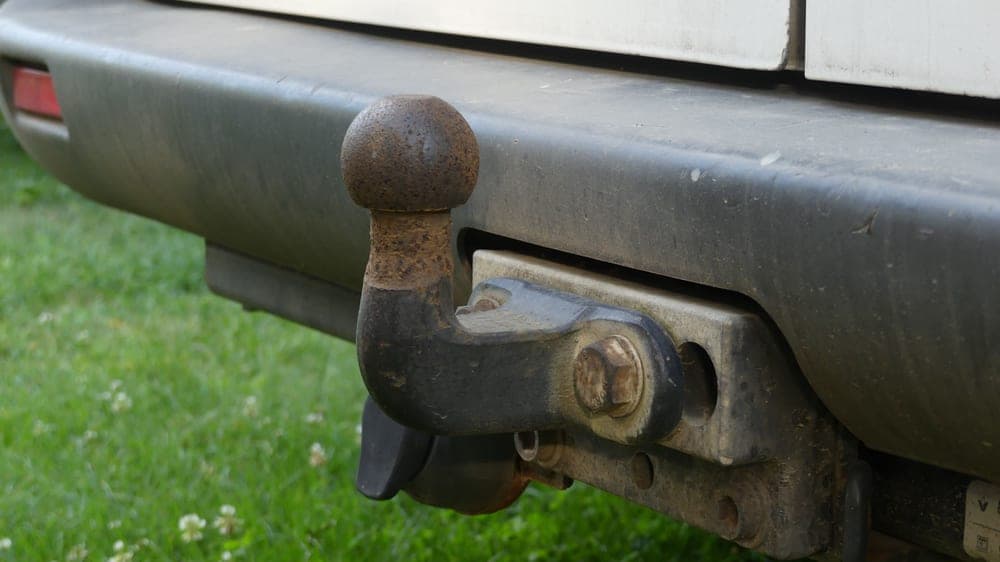
That is the whole difference between shopping for a car and shopping for an SUV. An SUV usually has a 2-inch Class III receiver with a few hundred pounds of tongue weight to play with, so the basket’s own mass is noise. A sedan, hatchback or small crossover often has a 1.25-inch Class I or Class II receiver, and a tongue rating that a heavy steel basket eats into before you load anything at all.
So before the picks, three things to check, in this order: your receiver opening (1.25 inch or 2 inch — most cargo carriers are built for 2 inch), your tongue-weight rating (printed on the hitch label, and it includes the carrier itself), and your rear overhang (a 60-inch basket hanging off a short sedan changes how the car behaves and how it parks). Our hitch classes guide has the class-by-class numbers; the weight limits guide shows the arithmetic.
Quick picks
Tap any row to jump to the full write-up below. Scores are our editorial judgment on published specifications — not a star rating, and not a product we claim to have tested.
| # | Product | Best for | Score | Price |
|---|---|---|---|---|
| 1 | 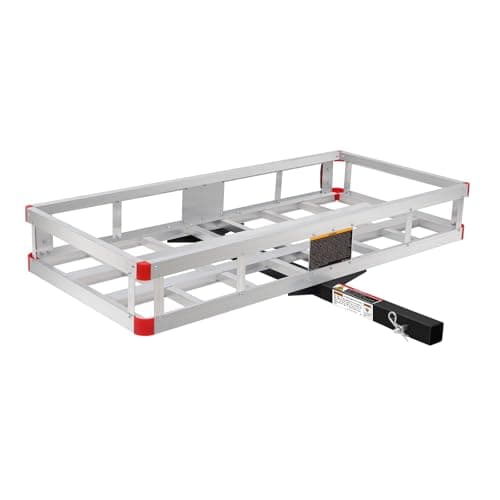 MaxxHaul 70108 Aluminum CarrierAluminum instead of steel, which is the single most useful property a carrier can have on a car. | Best for a car's tongue weight | 7.7 | |
| 2 | 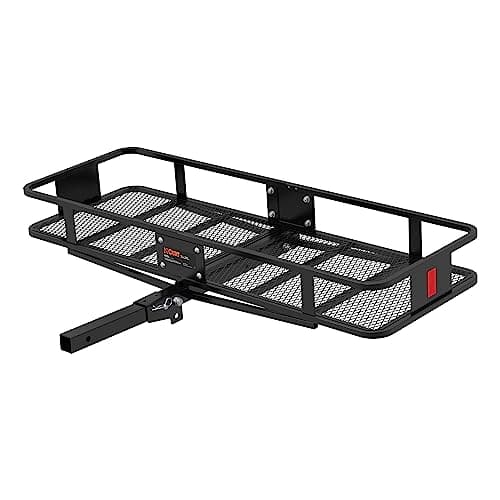 CURT 18151 Cargo CarrierThe fixed-shank CURT basket — no hinge to work loose, from a towing brand that publishes its ratings per part number. | Cheapest steel basket worth buying | 7.8 | |
| 3 |  CURT 18153 Folding Cargo CarrierA 60-inch steel basket on a folding shank, so the carrier tips up and out of the way of the tailgate. | Hatchbacks and liftgates | 8.0 | |
| 4 | 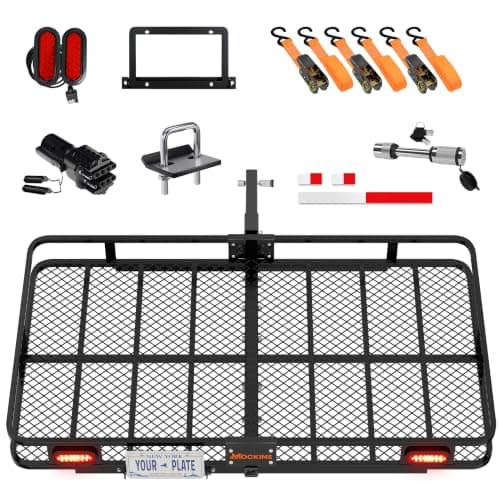 Mockins Hitch Cargo CarrierUsually sold bundled with a waterproof bag, a net and straps — which is what you were going to buy next anyway. | Buying the whole setup at once | 7.4 |
Prices checked October 11, 2026. Product photographs come from Amazon where the listing is matched, and are representative stock images otherwise. Affiliate disclosure.
#1 · Best for a car's tongue weight
MaxxHaul 70108 Aluminum Carrier
Aluminum instead of steel, which is the single most useful property a carrier can have on a car.
- Material
- Aluminum
- Weight
- Roughly a third of the steel equivalent
- Shank
- Fixed
- Why it suits a car
- Less of the tongue rating spent on the carrier
What works
- Light enough that one person can fit and remove it without help
- Leaves more of a modest tongue-weight rating for actual cargo
- Aluminum does not rust where road salt collects
- Easier to stand up in a garage corner between trips
What doesn’t
- Costs more than the steel basket it replaces
- Aluminum deflects more visibly under a concentrated load
- No folding hinge, so a hatch is awkward with it fitted
Our scoring
7.7overall
#2 · Cheapest steel basket worth buying
CURT 18151 Cargo Carrier
The fixed-shank CURT basket — no hinge to work loose, from a towing brand that publishes its ratings per part number.
- Material
- Steel
- Shank
- Fixed
- Brand
- Long-established towing manufacturer
- Documentation
- Ratings published per part number
What works
- A fixed shank has one less thing to rattle or seize
- CURT publishes capacity and fitment clearly for each part number
- Powder-coated steel takes abuse that aluminum does not
- Usually the cheapest carrier we would put on a car
What doesn’t
- Heavy — the carrier itself takes a real bite out of a car's tongue rating
- Does not fold, so the trunk is awkward to reach with it fitted
- Steel will rust at any chip you fail to touch up
Our scoring
7.8overall
#3 · Hatchbacks and liftgates
CURT 18153 Folding Cargo Carrier
A 60-inch steel basket on a folding shank, so the carrier tips up and out of the way of the tailgate.
- Basket
- 60 inches
- Shank
- Folding
- Material
- Steel
- Best on
- Hatchbacks, wagons and liftgate crossovers
What works
- Folds up so a hatch or liftgate still opens with the carrier fitted
- Also folds for storage, which matters in a single garage
- 60 inches is enough for coolers, bags and camp chairs
What doesn’t
- The hinge is the part that wears and the part that rattles
- Heavier than the aluminum trays
- 60 inches is a lot of overhang behind a short car
Our scoring
8.0overall
#4 · Buying the whole setup at once
Mockins Hitch Cargo Carrier
Usually sold bundled with a waterproof bag, a net and straps — which is what you were going to buy next anyway.
- Material
- Steel
- Usually bundled with
- Waterproof bag, cargo net, straps
- Shank
- Fixed on most variants
- Weather protection
- From the bag, not the basket
What works
- One purchase instead of four
- The bundled bag is the difference between a basket and weather protection
- Cheapest route to a working, covered carrier
What doesn’t
- Bundle contents vary by listing — read what is actually in the box
- Bag and net are adequate rather than good
- Heavy steel, with the same tongue-weight penalty as any steel basket
Our scoring
7.4overall
Check the receiver before you check the basket
Cargo carriers are overwhelmingly built for a 2-inch receiver. Many cars have a 1.25-inch one. Adapters that step a 1.25-inch receiver up to 2 inches exist, and we would not use one for a cargo carrier: the adapter adds leverage at exactly the point where the load is already trying to twist the receiver, and it does nothing about the tongue-weight rating that was the real limit.
If your car has a 1.25-inch receiver, look for a carrier sold specifically for that size, or move the load to the roof. A cargo box sized for a sedan is often the honest answer on a small car with a Class I hitch.
| What to read | Where it is | Why it decides the purchase |
|---|---|---|
| Receiver opening | Measure it, or read the hitch label | Most carriers only fit 2 inch |
| Tongue weight rating | Sticker on the hitch itself | Carrier mass counts against it in full |
| Rear overhang | Tape measure, bumper to basket end | Changes handling, parking and plate visibility |
| Trunk or hatch swing | Open it with the carrier fitted | Decides folding versus fixed shank |
Why the SUV picks are the wrong picks here
Our SUV carrier roundup leans toward big steel baskets and ramp-equipped trays, because an SUV has the receiver class and the tongue rating to carry them and the ride height to keep them off the ground.
A car changes three inputs at once. The receiver is often smaller. The tongue rating is lower. And the carrier sits far closer to the road, so a loaded basket on a sedan will touch down on a steep driveway that an SUV clears without noticing.
That last one is the surprise. Measure the height of the empty basket floor, then load it and measure again — the suspension squats and the basket drops with it. If the loaded figure is down around six inches, you are going to catch it on something.
Loading a carrier on a car
- Heavy items against the vehicle. Weight at the far end of the basket multiplies the leverage on the receiver.
- Strap down, then strap fore-and-aft. Down holds the load in the basket; fore-and-aft stops it migrating. Both are needed, and our tie-down guide has the sequence.
- Keep the plate and lights visible. A basket that hides either is a stop waiting to happen; most carriers have a plate bracket for this reason.
- Re-check after twenty minutes. Everything settles once, and that is when straps go slack.
- Take it off between trips. An empty carrier is still drag, still weight and still something to reverse into.
When a car should not use a hitch carrier at all
If your car has no hitch, fitting one purely to carry luggage is rarely worth it — the hitch, the wiring you do not need and the carrier together cost more than a roof setup that also carries bikes and boats.
If your car has a Class I hitch rated for very little tongue weight, a carrier is the wrong tool and no amount of shopping fixes it.
In both cases the roof is the answer, and on a car that usually means crossbars plus something low. Start at crossbars for cars with no roof rails and then a box sized for a sedan roof. The fuel cost of a roof load is real and we have the measured figures, but on a small car it is often the only load path that exists.
Common questions
Can any car use a hitch cargo carrier?
Does the weight of the carrier count toward the limit?
Can I use a 1.25 to 2 inch hitch adapter for a cargo carrier?
Is a hitch carrier better than a roof box on a car?
Sources
Not sure it fits your car?
Our vehicle pages carry the published roof load limit, the roof type by model year, and what actually mounts to it — cited, and honest about what the manufacturer does not publish.
Read next
The Best Hitch Cargo Carriers for SUVs
Hitch carriers for SUVs, ranked — plus the tongue weight figure that really decides your load.
Hitch Classes Explained
Classes, receiver sizes and tongue weight ratings — and why tongue weight is the number that matters.
Hitch Cargo Carrier Weight Limits
The three ratings that cap a hitch carrier load, and why tongue weight usually decides it.
The Best Cargo Boxes for Sedans
Cargo boxes that suit a sedan's short bar spread and lower roof limit, not an SUV's.