Kayak Racks
The Best Canoe Roof Racks and Carriers
Canoes travel upside down on the bars. That makes this a padding and tie-down problem, not a cradle problem.

Roof & Route is funded by affiliate commission. If you buy through a link on this page we may earn a commission at no extra cost to you. It never decides what we recommend or the order we recommend it in — read the full disclosure.
For most canoes the setup to buy is crossbar pads plus cam straps — the Dakine Aero rack pad set is our pick — because a canoe rides upside down with its gunwales flat on the bars and needs padding and tension, not a molded cradle.
This is the thing the kayak aisle gets wrong for canoe owners. A kayak has a rounded hull that wants a saddle or a J-cradle to hold its shape. A canoe has two straight gunwales and an open hull, and the correct way to carry it is inverted, resting on those gunwales, directly on padded crossbars. Add a cradle and you are usually making the load taller, less stable and more expensive for no gain.
Which means the shopping list is short and cheap: pads for the bars, two belly straps over the hull at each bar, and bow and stern lines to the vehicle’s ends. The last of those is the one people skip, and it is the one that matters most on a long hull at highway speed. Our boat tie-down guide has the sequence and the knots.
Quick picks
Tap any row to jump to the full write-up below. Scores are our editorial judgment on published specifications — not a star rating, and not a product we claim to have tested.
| # | Product | Best for | Score | Price |
|---|---|---|---|---|
| 1 | 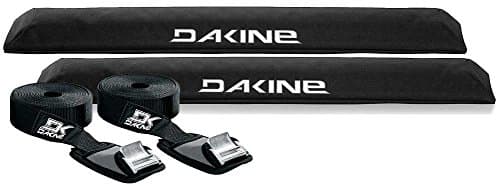 Dakine Aero Rack Pad Set (28 in)A pair of 600-denier padded crossbar sleeves sold with 12 ft tie-down straps — pads and straps in one purchase, which is the whole canoe kit. | Best canoe setup overall | 8.6 | |
| 2 |  NRS Heavy-Duty Tie-Down StrapsThe paddlesport-standard 1-inch cam strap, in fixed lengths with a padded buckle cover — hand tension only, which is what a hull needs. | The straps to use | 8.4 | |
| 3 | Malone SpeedLine Bow/Stern Tie-DownsRatcheting bow and stern lines with hood loops — the second line of defense, and on a long canoe the one that counts. | Bow and stern lines | 8.2 | |
| 4 | 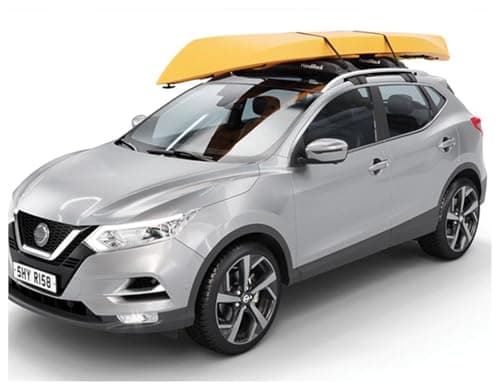 Malone HandiRackInflatable bars strapped through the door frames — a genuinely temporary way to carry a boat on a bare roof. | A canoe on a car with no rack | 7.8 |
Prices checked October 11, 2026. Product photographs come from Amazon where the listing is matched, and are representative stock images otherwise. Affiliate disclosure.
#1 · Best canoe setup overall
Dakine Aero Rack Pad Set (28 in)
A pair of 600-denier padded crossbar sleeves sold with 12 ft tie-down straps — pads and straps in one purchase, which is the whole canoe kit.
- Pads
- 28 in, 600-denier
- Straps
- 12 ft, included
- Fits
- Bars you already own
- What it protects
- Gunwales and bar finish
What works
- Pads and straps together — the complete canoe setup in one box
- 600-denier covers survive seasons of sun and grit
- 28 in sleeves cover enough bar for wide gunwales
- Works on any bar profile, including bars you already have
What doesn’t
- No bow and stern lines included — buy those separately
- Pads trap grit against the bar if you never take them off
- Does not locate the hull, so loading needs a little more care
Our scoring
8.6overall
#2 · The straps to use
NRS Heavy-Duty Tie-Down Straps
The paddlesport-standard 1-inch cam strap, in fixed lengths with a padded buckle cover — hand tension only, which is what a hull needs.
- Type
- 1 inch cam strap
- Tension
- Hand only
- Buckle
- Padded cover
- Lengths
- Fixed, several options
What works
- A cam buckle physically cannot over-tension and deform a hull
- The padded cover keeps the metal buckle off the gunwale and the roof
- The standard strap in paddling for decades, and sold in sane lengths
- No ratchet mechanism to seize or skip
What doesn’t
- Lower maximum tension than a ratchet, by design
- Fixed lengths mean buying the right one for your boat
- More expensive per strap than a hardware-store set
Our scoring
8.4overall
#3 · Bow and stern lines
Malone SpeedLine Bow/Stern Tie-Downs
Ratcheting bow and stern lines with hood loops — the second line of defense, and on a long canoe the one that counts.
- Type
- Bow and stern tie-downs
- Includes
- Hood loops
- Adjustment
- Ratcheting
- Why it matters
- Controls lift and yaw on a long hull
What works
- Hood loops give a solid anchor on cars with no tow eye to reach
- Controls the lift and side-to-side swing that belly straps cannot
- Fast to adjust, so there is no excuse to skip them
- The one item that keeps a boat on the car if a belly strap fails
What doesn’t
- Ratcheting lines can be over-tightened — snug, not taut
- Two more things to fit and remove at each end of the trip
- Hood loops need to be routed so they do not chafe paint
Our scoring
8.2overall
#4 · A canoe on a car with no rack
Malone HandiRack
Inflatable bars strapped through the door frames — a genuinely temporary way to carry a boat on a bare roof.
- Type
- Inflatable crossbars
- Mounting
- Straps through the door frames
- Rack needed
- None
- Storage
- Packs into a bag
What works
- Works on a completely bare roof, which no hard rack does
- Packs away into a bag between trips
- Far cheaper than a crossbar system plus pads
- The spread is adjustable because you choose where to place them
What doesn’t
- Temporary by design — not a season-long solution
- Straps run through the door frames, so water can track in
- Lower load capability and more movement than real bars
- Needs re-checking more often than any hard setup
Our scoring
7.8overall
Why a canoe goes upside down
Inverted, a canoe rests on two straight gunwales — the strongest, stiffest part of the boat — spread across both crossbars. The load path is clean, the hull keeps its shape, and rain does not collect inside.
Carried the right way up, the same boat rests on a curved hull that wants to rock, collects water, and presents a scoop to the airflow. The only reason to carry a canoe upright is if you are carrying gear in it, and you should not be.
| Boat | Correct carry | What it needs |
|---|---|---|
| Canoe | Inverted on the gunwales | Padded bars, belly straps, bow and stern lines |
| Kayak, one boat | Hull down in saddles or on edge in a J-cradle | A cradle sized to the hull |
| Kayaks, two boats | On edge against a stacker | A stacker post and four straps |
The full carrier-style comparison for boats that do need a cradle is in J-cradle vs saddle vs stacker.
Bar spread matters more than it does for a kayak
A canoe is long, and a long hull on a narrow bar spread pivots. The wider the spread, the less the boat can yaw and the less work the bow and stern lines have to do.
On a short car roof the spread is what it is, which is exactly why the bow and stern lines stop being optional. On an SUV or a van with a long roof, push the bars as far apart as the manufacturer allows. We cover minimum and maximum spread figures, and how to measure yours, in crossbar spread and length.
Also check your published dynamic roof load limit. A canoe is lighter than most people expect and heavier than a car’s roof allowance sometimes is — the figures and where to find them are in roof rack weight limits.
Loading a canoe on your own
- Pads on, straps laid over the bars first. Threading straps with a boat already up there is how pads get dragged out of position.
- Lift the stern onto the rear bar. Stand the boat on its end beside the car, then walk the stern up onto the rear bar while the bow is still on the ground.
- Walk round and lift the bow. You are lifting half the boat’s weight, twice, instead of all of it once.
- Center it, then belly-strap at both bars. Over the hull, around the bar, cam buckle on the side away from the paint.
- Bow and stern lines last. Snug, not taut — you are stopping movement, not pre-loading the hull.
- Push the boat hard with both hands. If it moves on the bars, something needs retensioning. Then drive twenty minutes and check again.
Two canoes, and canoes with kayaks
Two canoes can be carried on a wide bar spread, gunwale to gunwale, if the bars are long enough and the combined weight is inside your roof limit. It is a slow load and it needs four belly straps and four end lines, and on most cars the honest answer is a trailer or a second trip.
A canoe and a kayak together usually means the canoe inverted on the bars and the kayak on edge against a stacker beside it, which asks a lot of the bar length. Check the bar length before assuming it fits.
If the boats are kayaks rather than canoes, the dedicated two-boat answer is a stacker setup, covered in racks for two kayaks.
Common questions
Do I need a special rack for a canoe?
Should a canoe be carried upside down?
Do I need bow and stern lines for a canoe?
Can you carry a canoe on a car with no roof rack?
Sources
Not sure it fits your car?
Our vehicle pages carry the published roof load limit, the roof type by model year, and what actually mounts to it — cited, and honest about what the manufacturer does not publish.
Read next
J-Cradle vs Saddle vs Stacker
Hull protection, boats per bar and loading ease across the three carrier styles.
How to Tie Down a Kayak
The full sequence including bow and stern lines, correct tension, and the pre-drive checks.
The Best Kayak Racks for Two Kayaks
Stackers and paired J-cradles for two boats, and the weight arithmetic that decides it.
What Size Crossbars Do I Need?
How to measure crossbar spread and length, and what each carrier type needs.