Kayak Racks
The Best Paddleboard and Surfboard Roof Racks
A board is light, wide, flat and expensive — which makes it the easiest thing to carry on a roof and the easiest thing to ruin doing it.

Roof & Route is funded by affiliate commission. If you buy through a link on this page we may earn a commission at no extra cost to you. It never decides what we recommend or the order we recommend it in — read the full disclosure.
Boards are the one piece of water gear where the cheap answer is often the right answer. A 10 ft 6 in inflatable SUP weighs around 20-25 lb and a shortboard under 10. Nothing here is a weight problem. What boards are is wide, flat and soft-skinned — so the real risks are a board lifting in the airflow, a strap crushing a rail, and a crossbar pressing a dent into the deck over four hundred miles.
That changes what you are shopping for. On a kayak you buy a cradle that holds a heavy hull safely; on a board you buy contact surface, strap quality and — if you leave boards on the car at a trailhead or a beach lot — a lock. Our cradle, saddle and stacker comparison covers the kayak side of that decision.
Five options below, from a locking two-board rack down to a pair of pads and two straps. We have been explicit about which ones need crossbars, because that is the detail that turns a $50 purchase into a $400 one.
Quick picks
Tap any row to jump to the full write-up below. Scores are our editorial judgment on published specifications — not a star rating, and not a product we claim to have tested.
| # | Product | Best for | Score | Price |
|---|---|---|---|---|
| 1 | 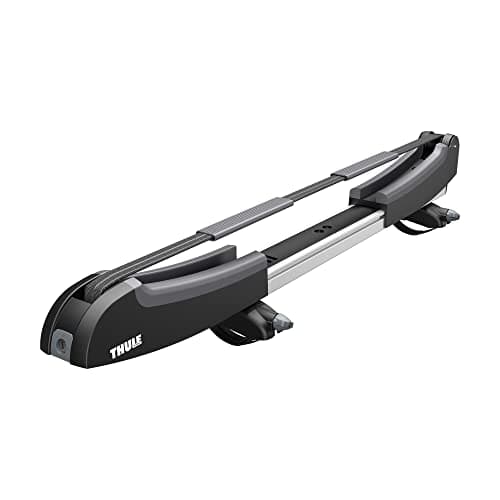 Thule SUP Taxi XTSoft arms that cradle the rails rather than the deck, locks for both the carrier and the boards, and tool-free mounting to almost any crossbar. | Two boards, locked, on any bars | 8.4 | |
| 2 | 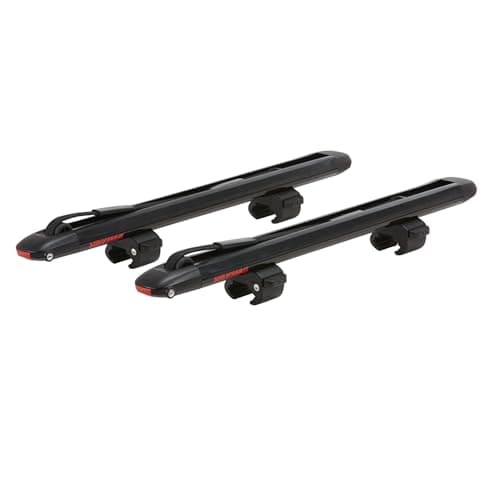 Yakima SupDawgRollers built into the rear of the carrier, so an oversized board gets pushed on from behind the car instead of lifted over it. Also takes wider boards than the Thule. | Loading a big board by yourself | 8.3 | |
| 3 | 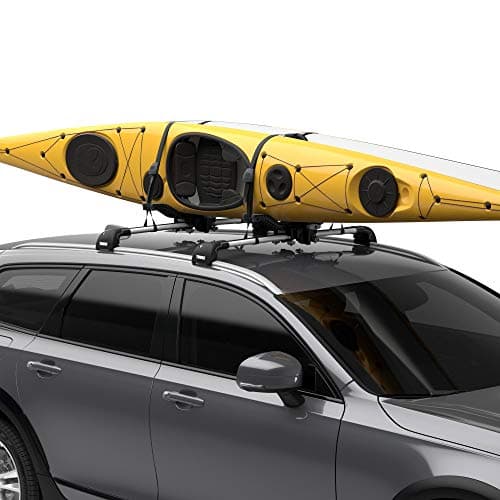 Thule CompassFolds between J-cradle, saddle, stacker and paddleboard modes, so one carrier covers both the SUP weekend and the kayak weekend. A genuine compromise, honestly priced. | A household with boards and a kayak | 8.5 | |
| 4 | 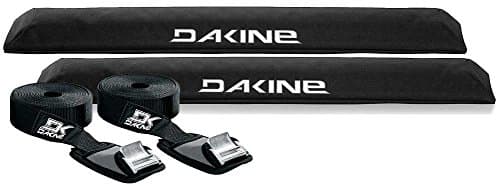 Dakine Aero Rack Pad Set (28 in)Pads over the bars, straps over the boards, done. This is how surfers have carried boards for fifty years, and for most people it is still the correct answer. | Bars you already own | 8.0 | |
| 5 |  Malone HandiRackInflatable bars that strap through the door frames. A real answer for a few short trips a year on a bare roof, and not a substitute for a rack. | A car with no rack at all | 7.8 |
Prices checked October 10, 2026. Product photographs come from Amazon and are refreshed with the prices. Affiliate disclosure.
#1 · Two boards, locked, on any bars
Thule SUP Taxi XT
Soft arms that cradle the rails rather than the deck, locks for both the carrier and the boards, and tool-free mounting to almost any crossbar.
- Boards
- Up to two SUPs
- Max load
- 55 lb
- Board width
- 28-34 in loading width
- Weight
- 15 lb
What works
- Integrated locking cylinders lock the carrier to the bars and the boards to the carrier — the only pick here that does both
- Steel-reinforced webbing straps rather than plain polypropylene
- Speed-Link mounting is tool-free and fits most factory and aftermarket crossbars, not just Thule
- Holds boards on their rails, so nothing presses on the deck
What doesn’t
- The most expensive option here by a wide margin
- 34 in is a real ceiling — a wide-bodied yoga or fishing SUP will not fit
- 55 lb is plenty for two boards and nothing else; it is not a kayak carrier
- Still needs crossbars, which are not included
Our scoring
8.4overall
#2 · Loading a big board by yourself
Yakima SupDawg
Rollers built into the rear of the carrier, so an oversized board gets pushed on from behind the car instead of lifted over it. Also takes wider boards than the Thule.
- Boards
- Up to two SUPs
- Board width
- Up to 36 in
- Loading
- Integrated rollers
- Weight
- 14 lb
What works
- Integrated rollers make a big, awkward board a one-person job
- 36 in board width is the widest published figure here
- SKS locks included, locking both the rack and the boards
- Bow and stern tie-downs included, which most carriers charge for
What doesn’t
- Yakima does not publish a maximum load figure for it, so you are working without that number
- Rollers are another thing to keep clean — grit on a roller is grit on your board
- Published fitment is Yakima round, factory, aero and square bars; verify before assuming it clamps to a third-party bar
- Premium price for a job pads can do
Our scoring
8.3overall
#3 · A household with boards and a kayak
Thule Compass
Folds between J-cradle, saddle, stacker and paddleboard modes, so one carrier covers both the SUP weekend and the kayak weekend. A genuine compromise, honestly priced.
- Carries
- One or two kayaks, or up to two SUPs in saddle mode
- Max load
- 130 lb
- Boat width
- Up to 36 in
- Included
- Load straps with buckle bumpers, bow and stern tie-downs
What works
- Four carrying modes from one carrier — the cheapest way to cover boards and boats
- 130 lb capacity is far above anything board-only here, so a kayak weekend is in scope
- Universal mounting hardware fits almost any rack system, no tools
- Folds flat when empty rather than sitting up in the airflow all week
What doesn’t
- At 20 lb it is the heaviest carrier on this page
- A convertible carrier is never quite as quick as a purpose-built one in any single mode
- No board-specific roller or loading aid
- Does not lock the boards to the carrier the way the Thule and Yakima board racks do
Our scoring
8.5overall
#4 · Bars you already own
Dakine Aero Rack Pad Set (28 in)
Pads over the bars, straps over the boards, done. This is how surfers have carried boards for fifty years, and for most people it is still the correct answer.
- Type
- Padded crossbar sleeves, sold as a pair
- Length
- 28 in each
- Material
- 600-denier polyester, hook-and-loop closure
- Fits
- Bar circumference roughly 5.5-8 in
What works
- A tenth of the price of a dedicated carrier, and it fits bars you already have
- UV-resistant recycled polyester shell; these live outdoors and survive it
- Sold with 12 ft tie-down straps, so there is nothing else to buy
- No added height, no added noise when the boards are off the car
What doesn’t
- No locking at all — boards on pads must never be left unattended
- Nothing stops a board sliding sideways except strap tension and your technique
- Boards ride deck-down on the pads, so the deck pad takes the pressure, not the rails
- Check your bar circumference: an oversized aero bar may be outside the 5.5-8 in range
Our scoring
8.0overall
#5 · A car with no rack at all
Malone HandiRack
Inflatable bars that strap through the door frames. A real answer for a few short trips a year on a bare roof, and not a substitute for a rack.
- Type
- Inflatable roof bars
- Mounting
- Straps run through the door frames
- Storage
- Deflates into a bag
- Use case
- Occasional, short distance, moderate speed
What works
- No rack, no fit kit, no permanent cost — the cheapest way onto a bare roof
- Packs into a bag between trips, so nothing lives on the car
- Far better than improvised foam blocks, which is the alternative most people reach for
What doesn’t
- Straps run through the door openings, so doors must stay shut and the straps get wet in rain
- Not a highway-speed, long-distance solution and Malone does not present it as one
- Nothing locks, and a board on inflatable bars is the easiest thing on this page to steal
- Needs re-checking for pressure and tension on any stop
Our scoring
7.8overall
How we ranked them
Weight capacity, the headline figure on every kayak carrier, barely matters here — a pair of boards rarely clears 50 lb. These are the things that do.
Board width, published. The specification people skip and then return the rack over. Thule publishes 28-34 in for the SUP Taxi XT; Yakima publishes up to 36 in for the SupDawg. Modern wide-bodied yoga, fishing and beginner-stable SUPs run 33-36 in, which puts some of them outside the Thule’s range entirely. Measure the board, not the listing.
What touches the board. A rail-cradling carrier presses on the strongest part of a board. Pads on a crossbar press on the deck, which is softer, and on a bare bar that pressure becomes a dent on a long hot drive. Padding area and where it sits are worth more than any load rating.
Loading reach. A 12 ft board is awkward rather than heavy. Rollers — the SupDawg’s defining feature — turn an overhead lift into a push. On a tall SUV that is the difference between using the rack and leaving the board at home.
Locking. Boards get left on cars at beach lots and trailheads, where a rack with no lock is an invitation. Only the Thule and Yakima board carriers lock both themselves and the boards.
What it needs underneath. Four of the five options here require crossbars. If your roof is bare, that is the first purchase, and our bare-roof rack roundup covers it — or the HandiRack sidesteps the question for occasional use.
Pads or a dedicated rack? Answer two questions
How often, and how far? A board on pads is completely adequate for a 20-minute drive to the lake a dozen times a summer. On a six-hour interstate run with a crosswind, a carrier that mechanically traps the board between arms is a different level of security, and the difference is not in the straps — it is in what happens if one strap loosens.
Do you ever walk away from the car? If the boards sit on the roof while you get lunch, locking matters more than anything else on this page, and that narrows the field to the SUP Taxi XT and the SupDawg. If the boards come off the moment you park, pads are fine.
There is a third consideration that catches people out. Pads make the board the aerodynamic surface; a carrier holds the board on its rails, edge up, which is a smaller frontal area. On a long highway drive the carrier is usually the quieter and more fuel-efficient option, which our gas mileage guide puts numbers to.
The part that actually ruins boards
Almost every damaged-board story comes down to one of four mistakes, and none of them is the rack.
A ratchet strap on a board. Never. A ratchet multiplies your hand force and a board rail will crush before the strap complains. Cam buckle straps, hand tension only — that is the paddling standard, and our cam buckle strap roundup covers the ones worth owning.
A buckle resting on the board. A metal cam buckle vibrating against a deck for four hours grinds a mark into it. Position the buckle on the strap run beside the board, or use a strap with a padded buckle cover.
Fins forward. Boards go on fins up and fins toward the rear. Fins forward puts the fin into the airflow as a lever and loads the fin box in the direction it was never designed for.
No bow line on a long board. A 12 ft board overhanging the windshield generates real lift. A bow line to a tow point or hood loop is cheap insurance, and the SupDawg and Compass include the lines. The method is the same as for a boat — our tie-down walkthrough applies directly.
And the one that is not a mistake so much as a surprise: an inflatable SUP does not need any of this. Deflate it, roll it, put it in the trunk. The whole reason inflatables took over the beginner market is that they make the roof-rack question optional.
Carrying more than two boards
Every dedicated carrier here stops at two. If your household has three or four boards, there are only two honest routes.
Pads and a wide stack. Surfboards stack flat on pads perfectly well — deck to deck, bottom to bottom, biggest at the base, with towels or foam between them. Two straps per stack, hand tension, bow line on the longest board. This is standard practice on a surf trip and there is nothing wrong with it.
A platform. If the boards are all going every time, a flat roof platform gives you a full-width surface with tie-down points everywhere instead of two narrow bars. Our roof platform roundup covers the no-drill options.
What does not work is bolting two board carriers side by side. Published widths assume one carrier centered on the bars, the clamps need the bar space, and you will run out of crossbar before you run out of boards.
The verdict
If you carry boards often and leave them on the car, Thule’s SUP Taxi XT is the best board carrier here: it locks both ways, it holds boards on their rails, and the straps are properly made. Check your board is under 34 in wide first.
If your board is big, wide or awkward — or you load alone — the Yakima SupDawg’s rollers and 36 in width make it the easier rack to live with, and it includes the bow and stern lines.
For a household that owns a kayak as well as boards, the Thule Compass is the best value on this page by a distance: one carrier, four modes, 130 lb, lines included.
And for most people most of the time, a pair of Dakine Aero rack pads and two cam straps on the bars you already own carries a board as safely as anything else, for a tenth of the price. If your roof is bare and this is a twice-a-summer activity, the Malone HandiRack gets you there without buying a rack at all.
Common questions
Can you carry a paddleboard on a roof rack without a special carrier?
How wide a paddleboard will a SUP rack take?
Should a surfboard go on the roof fins up or fins down?
Can you use ratchet straps on a paddleboard?
Do you need a bow line for a paddleboard?
How many paddleboards can you carry on a car roof?
Sources
Not sure it fits your car?
Our vehicle pages carry the published roof load limit, the roof type by model year, and what actually mounts to it — cited, and honest about what the manufacturer does not publish.
Read next
J-Cradle vs Saddle vs Stacker
Hull protection, boats per bar and loading ease across the three carrier styles.
The Best Kayak Racks for Cars Without Rails
Clamp-on bars, inflatable racks and what to avoid when the roof is bare.
The Best Cam Buckle Straps
Cam straps for hulls and cargo boxes, why hand tension is the point, and how many to buy.
The Best No-Drill Roof Platform Racks
Flat roof trays that mount to factory rails or existing crossbars without drilling, compared on published load, weight and what the fitting hardware adds.