Kayak Racks
The Best Kayak Racks for Trucks
Truck owners usually do not need a kayak rack. They need a bed extender and a red flag.
Roof & Route is funded by affiliate commission. If you buy through a link on this page we may earn a commission at no extra cost to you. It never decides what we recommend or the order we recommend it in — read the full disclosure.
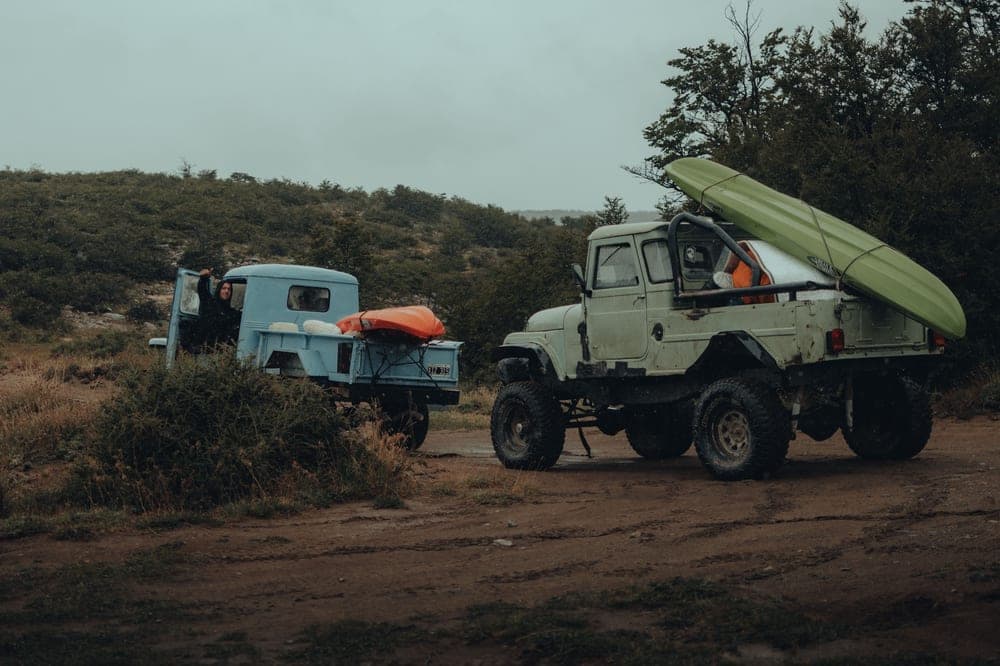
If you own a pickup and a kayak, you already own the best kayak carrier in this article. The bed loads at waist height, carries the boat low where it does not affect handling, and costs nothing.
The only complication is length. A ten-foot boat in a five-foot bed overhangs, and overhang is regulated — most states require a red or orange flag on any load extending beyond the rear of the vehicle, with the specific distance varying by state. Check your state’s rule and carry a flag.
A bed extender — a T-shaped bar that sits in the receiver and gives the boat a second support point at the back — turns an awkward overhang into a properly supported load. That, plus a flag and a couple of cam straps, is the whole solution for most truck owners.
Quick picks
Tap any row to jump to the full write-up below. Scores are our editorial judgment on published specifications — not a star rating, and not a product we claim to have tested.
| # | Product | Best for | Score | Price |
|---|---|---|---|---|
| 1 |  NRS Heavy-Duty Tie-Down StrapsCam straps are the correct tool for a hull. The bed already gives you tie-down points; these are what goes through them. | Strapping a boat in a bed | 8.7 | |
| 2 | Malone SpeedLine Bow/Stern Tie-DownsA boat hanging out the back needs a stern line as well as hull straps — this is the purpose-made version. | Securing the overhang | 8.4 | |
| 3 |  Malone SeaWingA low cab-roof cradle for the case where the bed is already committed — hull down, minimum added height. | When the bed is full | 7.8 | |
| 4 |  Yakima JayLowFolds flat, works on bed-rack bars as well as cab bars, and doubles as a stacker for a second boat. | Bed rack or cab roof, two boats | 8.6 |
Prices checked September 25, 2026. Product photographs are representative stock images, not the exact unit. Affiliate disclosure.
#1 · Strapping a boat in a bed
NRS Heavy-Duty Tie-Down Straps
Cam straps are the correct tool for a hull. The bed already gives you tie-down points; these are what goes through them.
- Type
- 1-inch cam buckle straps
- Buckle
- Padded cover
- Tension
- Hand tension only
- Use
- Over the hull to the bed's anchor points
What works
- Cam buckles cannot over-tension and deform a hull
- Padded buckle keeps metal off the boat and the bed rail
- The paddling standard
What doesn’t
- Slower than a ratchet
- Store out of UV to preserve the webbing
Our scoring
8.7overall
#2 · Securing the overhang
Malone SpeedLine Bow/Stern Tie-Downs
A boat hanging out the back needs a stern line as well as hull straps — this is the purpose-made version.
- Type
- Ratcheting stern line
- Included
- Anchor loops
- Use
- Boat stern to the vehicle
- Note
- Independent of the hull straps
What works
- Stops the boat pivoting on the tailgate
- Quick to adjust
- Anchor loops solve trucks with no convenient point
What doesn’t
- Easy to over-tension on a light hull
- One set per boat
Our scoring
8.4overall
#3 · When the bed is full
Malone SeaWing
A low cab-roof cradle for the case where the bed is already committed — hull down, minimum added height.
- Type
- V-style saddle cradle
- Mounting
- Cab-roof crossbars
- Profile
- Very low
- Capacity
- One boat
What works
- Adds very little to an already-tall vehicle's height
- Hull-down carrying is gentle over long distances
- Quiet compared with a J-cradle
What doesn’t
- Needs cab-roof crossbars, which most trucks do not have
- A short cab roof means a narrow bar spread
- Loading onto a truck cab roof is a serious lift
Our scoring
7.8overall
#4 · Bed rack or cab roof, two boats
Yakima JayLow
Folds flat, works on bed-rack bars as well as cab bars, and doubles as a stacker for a second boat.
- Type
- Folding J-cradle / stacker
- Mounting
- Any crossbar, including bed racks
- Capacity
- One in J mode, two in stacker mode
- Folding
- Folds flat
What works
- Works equally on a bed rack and a cab rack
- Two boats in stacker mode
- Ships with straps and lines
What doesn’t
- On-edge carrying raises the load on an already tall vehicle
- Still a lift, wherever you mount it
Our scoring
8.6overall
Use the bed, and use it properly
Boat in the bed, bow forward, resting on the tailgate or a bed extender. Straps through the bed’s anchor points over the hull, hand tension only. A stern line to stop the boat pivoting. A flag on the overhang.
Two details that matter. Put something under the hull where it crosses the tailgate — a folded towel or a piece of pipe insulation — because a tailgate edge is a hard line to rest a boat on for four hundred miles. And if the boat overhangs far enough that the tailgate is down, check your license plate and lights are still visible.
Bed extenders: what they solve
A bed extender is a T-bar that drops into the hitch receiver and stands up behind the truck at roughly bed-rail height. It gives the boat a second support point, which turns a lever hanging off the tailgate into a properly supported span.
It also fixes the flag problem by giving you an obvious place to attach one, and it stops the boat bouncing on the tailgate edge. For a five-foot bed and a ten-foot boat, it is the single most useful thing you can buy.
Check the receiver size and the extender’s rating; our hitch classes guide covers what your receiver is rated for.
When the cab roof makes sense
Only when the bed is already full. A cab roof on a pickup is high, short and — on several popular trucks — carries no manufacturer-published load figure at all. Our Tacoma fitment page is explicit about that gap.
If you are going that route, a bed rack is usually better than a cab rack: it gets the boat above the bed line without relying on the cab roof, and it gives you a much wider bar spread. Our truck roof rack roundup covers both.
Common questions
Can I carry a kayak in a truck bed?
Do I need a bed extender for a kayak?
Do I need a flag on an overhanging kayak?
Sources
Not sure it fits your car?
Our vehicle pages carry the published roof load limit, the roof type by model year, and what actually mounts to it — cited, and honest about what the manufacturer does not publish.
Read next
The Best Roof Racks for Trucks
Cab roof versus bed rack versus hitch on a pickup, and the crossbars that work above a cab.
How to Tie Down a Kayak
The full sequence including bow and stern lines, correct tension, and the pre-drive checks.
The Best Cam Buckle Straps
Cam straps for hulls and cargo boxes, why hand tension is the point, and how many to buy.