Guides
How to Haul a Kayak in a Truck Bed
A pickup is the easiest vehicle in the world to carry a kayak in, and the easiest to do it badly in. Four straps, one flag, one diagonal.
Roof & Route is funded by affiliate commission. If you buy through a link on this page we may earn a commission at no extra cost to you. It never decides what we recommend or the order we recommend it in — read the full disclosure.
The method, in one paragraph: drop the tailgate, lay the boat hull-down with the bow against the bulkhead and the stern out over the open tailgate, run it on the diagonal if the bed is short, strap it down to the bed anchors in two places, add bow and stern lines as a second independent restraint, and flag the overhang. That is the whole job, and it needs no rack at all.
A pickup bed is the best place to carry a kayak that most people already own. There is no overhead lift, no roof load limit involved, nothing to mount, and the boat sits low out of the airflow. The two things that go wrong are both avoidable: the boat slides backward out of the bed under braking, and the overhang is never marked.
The one honest limitation is length. A standard recreational kayak is longer than most beds, so there will be overhang. Overhang itself is normal and legal in the sense that trucks do it every day — but the amount permitted and how it must be marked is set by state law and varies, so check your own state’s rule rather than assuming. A red or orange flag on the furthest point is the universal practice and costs almost nothing.
The second limitation is what you are strapping to. Factory bed anchors and stake pockets are load points. The tailgate cables are not, and the tailgate itself is not a load-bearing surface in the direction a strap would pull it. Plan your anchor points before you lift the boat.
If you would rather get the boat up above the bed entirely — bed extender, over-cab bars, a bed rack — that is a different purchase and our truck kayak setup roundup covers it. This page is the no-hardware method.
Quick picks
Tap any row to jump to the full write-up below. Scores are our editorial judgment on published specifications — not a star rating, and not a product we claim to have tested.
| # | Product | Best for | Score | Price |
|---|---|---|---|---|
| 1 |  NRS Heavy-Duty Tie-Down StrapsSpring-loaded cam buckles with a padded cover, in fixed lengths, sized for boats and boards rather than for a flatbed. | Best strap for the hull | 8.6 | |
| 2 | Malone SpeedLine Bow/Stern Tie-DownsRatcheting bow and stern lines with hood loops included — the second, independent restraint that is the step people skip. | Best bow and stern lines | 8.6 | |
| 3 | 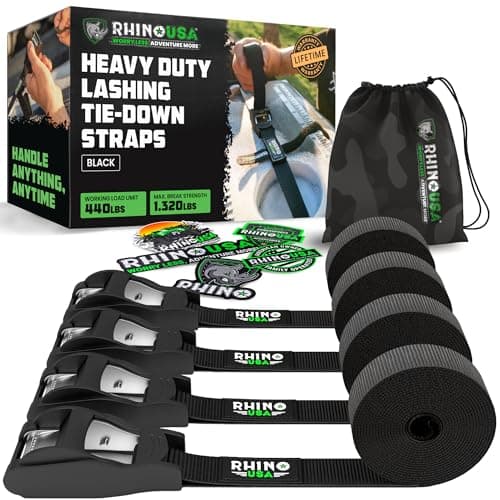 Rhino USA Cam Buckle StrapsOne-inch cam buckle straps in a multipack with a lifetime warranty. Buy more than you think you need and keep a set in the truck. | Best value cam straps | 8.4 |
Prices checked October 17, 2026. Product photographs come from Amazon where the listing is matched, and are representative stock images otherwise. Affiliate disclosure.
#1 · Best strap for the hull
NRS Heavy-Duty Tie-Down Straps
Spring-loaded cam buckles with a padded cover, in fixed lengths, sized for boats and boards rather than for a flatbed.
- Mechanism
- Spring-loaded cam
- Buckle
- Padded cover
- Lengths
- Several fixed lengths
- Best on
- Kayaks, boards, cargo boxes, soft bags
- Fits
- Every vehicle and every boat
What works
- A cam buckle cannot generate enough force to deform a hull, which a ratchet easily can
- Padded buckle cover keeps the hardware off the gel coat and the paint
- Several fixed lengths, so you are not managing yards of spare webbing
- The right tool for everything soft or hollow that you will ever carry
What doesn’t
- No live Amazon listing matched this model, so we show no price for it
- Not enough tension for a dense, heavy, hard load — use a ratchet there
- Hand tension needs re-checking as the webbing settles
- Fixed lengths mean buying the right one rather than one for everything
Our scoring
8.6overall
#2 · Best bow and stern lines
Malone SpeedLine Bow/Stern Tie-Downs
Ratcheting bow and stern lines with hood loops included — the second, independent restraint that is the step people skip.
- Adjustment
- Ratcheting
- Includes
- Hood loops
- Fits
- Any vehicle, hood loops included
- Note
- Independent of the hull straps by design
What works
- Gives you a restraint that does not share a failure path with the hull straps
- Hood loops included, so you have an anchor point on a truck with few of them
- Ratcheting adjustment makes fine tension easy at the bow
- Compact enough to live in the truck permanently
What doesn’t
- No live Amazon listing matched this model, so we show no price for it
- Over-tensioning a bow line can deform a hull — snug, not tight
- Extra step that is easy to talk yourself out of
Our scoring
8.6overall
#3 · Best value cam straps
Rhino USA Cam Buckle Straps
One-inch cam buckle straps in a multipack with a lifetime warranty. Buy more than you think you need and keep a set in the truck.
- Type
- Cam buckle
- Width
- 1 inch
- Sold as
- Multipack
- Warranty
- Lifetime
What works
- A multipack means you always have a spare, which is how straps actually get used
- Cam buckles cannot over-tension a hull
- Lifetime warranty on a consumable item
- Cheap enough to leave a set in the bed permanently
What doesn’t
- One inch is right for boats and wrong for heavy freight
- Cam buckles work loose faster than ratchets and need a re-check
- No padded cover, so mind where the buckle lands
Our scoring
8.4overall
Step by step
Step 1
Drop the tailgate and clear the bed
Lower the tailgate and remove anything that could slide into the hull. If you have a bed mat or a moving blanket, lay it where the hull will sit — a bare steel or plastic bed liner will scuff a boat over a few hundred miles.
Step 2
Load the boat hull-down, bow against the bulkhead
Slide the kayak in hull-down with the bow forward against the front of the bed, so braking pushes the boat into the bulkhead rather than out of the truck. Hull-down spreads the weight and keeps the boat stable; on edge it will want to roll.
Step 3
Run it on the diagonal if the bed is short
In a short bed, put the bow into one front corner and let the stern sit over the opposite corner of the open tailgate. The diagonal buys you a surprising amount of effective length and keeps the overhang inboard of the truck's width.
Step 4
Strap down in two places to real anchor points
Run cam straps over the hull to factory bed anchors or stake pockets, one strap forward and one aft. Snug, not crushing — a cam buckle is the correct tool here precisely because it cannot generate enough force to deform the hull. Never strap to the tailgate cables.
Step 5
Add bow and stern lines as a second independent restraint
Run a line from the boat's bow grab handle forward to a frame point or hood loop, and from the stern to a rear anchor. These exist so that a single strap failure does not release the boat, which is the whole reason they matter.
Step 6
Flag the overhang and check your state's rule
Attach a bright red or orange flag to the furthest point of the stern. How much overhang is permitted and how it must be marked is set by state law and varies, so check the rule for the states you will drive through.
Step 7
Drive ten minutes, then stop and re-check everything
Webbing stretches and a boat settles in the first few miles. Pull over, push the boat to confirm it has not moved, re-tension every strap, and confirm the flag is still attached.
The short-bed problem, and the diagonal
A short bed is around five and a half feet and a recreational kayak is commonly ten to twelve. The tailgate adds roughly another foot and a half when it is down. The arithmetic does not close, so the boat will overhang — the question is how to make that overhang well behaved.
The diagonal is the trick. Put the bow into one front corner of the bed and let the stern run out over the opposite corner of the lowered tailgate. Three things improve at once: the effective length available is longer than the bed, the stern sits inboard of the truck’s width rather than sticking out behind the center, and the boat is wedged in two directions instead of one.
Bow forward, always. The hard stop at the front of the bed should take the braking load. A boat loaded stern-first is held in only by its straps, and straps are the thing that can fail.
Two boats go in nose to tail, not side by side. Side by side they rub and the straps have to work around two hulls. Nose to tail, with a blanket between them, carries better and straps more simply.
If this is a weekly trip rather than an occasional one, the hardware answer is a bed extender or a bed rack that gets the boat up level, and our truck setup roundup covers that. For a few trips a year, the diagonal and four straps is genuinely the right answer.
What to strap to, and what not to
| Point | Use it? | Why |
|---|---|---|
| Factory bed tie-down anchors | Yes | Designed and rated for cargo loads |
| Stake pockets | Yes, with a proper anchor | Structural, but use a fitting rather than a bare hook |
| Frame points under the front bumper | Yes, for a bow line | Structural, and the correct place for a bow line |
| Bolt-on hood loops | Yes, for a bow line | Made for exactly this and included with good line kits |
| Tailgate cables or the tailgate itself | No | Not a load path in the direction a strap pulls |
| Bed rail covers and plastic trim | No | Cosmetic parts, not anchors |
The distinction that matters: an anchor is a point the manufacturer designed to take a load. Everything else is something you are hoping will. NHTSA treats unsecured cargo as a genuine road hazard rather than a nuisance, and a boat that comes off a truck at highway speed is the worst version of that.
Use cam straps or hand-tensioned straps over a hull, never a ratchet. A ratchet can generate far more force than a plastic or composite hull will tolerate, and the damage shows as a permanent flat spot. Our ratchet versus cam comparison covers which tool for which load, and the cam strap roundup covers what to buy.
Bed or roof: which is actually better
For a pickup owner this is a real choice, so here it is honestly.
| In the bed | On the roof or a bed rack | |
|---|---|---|
| Lifting | Waist height — the easiest there is | Overhead, or a slide up a rack |
| Weight limit | Bed payload — generous | Roof dynamic limit — small |
| Hardware needed | Straps only | Bars, cradles or a bed rack |
| Bed still usable? | No, the boat is in it | Yes, fully |
| Overhang | Yes, needs flagging | Usually less or none |
| Fuel | Lower — the boat sits in the bed | Higher — the boat is in the airflow |
The bed wins on effort, weight and cost. The rack wins on keeping the bed free and avoiding overhang. If you need the bed for camping gear on the same trip, that settles it — and the boat goes up. Otherwise, the bed is the better answer for most trips.
For the roof version of the method, including the bow and stern line sequence, see our kayak tie-down guide. If lifting is the problem rather than the method, our load-assist rack roundup is the page for that.
The two mistakes that lose boats off trucks
One: trusting one restraint. Two hull straps that both run to the same pair of anchors share a failure path. Bow and stern lines do not — they run to the front and rear of the vehicle and they would still be holding if a hull strap let go. This is the step people skip because the boat already looks secure, and it is the step that matters.
Two: not marking the overhang. A dark stern sticking four feet past the tailgate is nearly invisible to the driver behind you at dusk. A bright flag costs almost nothing. How much overhang is permitted and how it must be marked is set by state law and varies, so look up the rule for the states you will drive through rather than assuming the one you know applies everywhere.
Two smaller ones worth avoiding. Do not leave the cockpit open to the rain for a long drive — a cockpit cover or even a dry bag stops you arriving with a boat full of water and weight. And do not strap over a hatch or a deck fitting; run the strap over solid hull.
Then the habit that catches everything: drive ten minutes, pull over, and re-check. Push the boat to confirm nothing has moved, re-tension every strap, and look at the flag. Our general tie-down guide covers the order of operations for everything else in the bed.
Common questions
How do you haul a kayak in a truck bed?
Can you haul a kayak in a short bed truck?
Do you need a bed extender for a kayak?
What should you strap a kayak to in a truck bed?
Should you use ratchet straps on a kayak?
Is it better to carry a kayak in the bed or on the roof?
Sources
Not sure it fits your car?
Our vehicle pages carry the published roof load limit, the roof type by model year, and what actually mounts to it — cited, and honest about what the manufacturer does not publish.
Read next
The Best Kayak Racks for Trucks
Why the bed beats the roof on a pickup, when you need an extender, and racks for when the bed is full.
How to Tie Down a Kayak
The full sequence including bow and stern lines, correct tension, and the pre-drive checks.
The Best Load-Assist Kayak Racks
Load-assist and slide-on kayak carriers ranked by how much of the lift they actually remove.
Ratchet vs Cam Buckle Straps
Mechanical advantage versus hand tension — and which load each one belongs on.