Kayak Racks
The Best Load-Assist Kayak Racks
If the boat is heavier than your shoulders, the rack is the wrong place to economize. These are the ones that do the lifting with you.

Roof & Route is funded by affiliate commission. If you buy through a link on this page we may earn a commission at no extra cost to you. It never decides what we recommend or the order we recommend it in — read the full disclosure.
The load-assist rack to buy is the Thule Hullavator Pro. It takes roughly 40 lb of the boat’s weight on gas struts and lowers the cradle up to about 40 inches down the side of the vehicle, so you load at hip height beside the car instead of lifting over the roof. If that is more rack than the problem needs, the Yakima ShowDown does the same trick at lower cost, and the Yakima SweetRoll or Malone DownLoader let you slide the boat on from the back of the car — which solves most of the difficulty for a fraction of the money.
The honest framing first, because this is a category where people overbuy and underbuy in equal measure. A load-assist rack is for one specific situation: the boat is heavier than you can safely press over your head, or the roof is higher than your shoulders. A fishing kayak on an SUV is the textbook case. A light recreational boat on a sedan is not — you need a cradle and a technique, not a mechanism.
There are three ways to remove the lift, and they cost very different amounts. A drop-down carrier brings the cradle to you. A slide-on saddle lets you put the bow on the rear bar and push. A load bar or roller gives you a pivot at the back of the roof. The sections below tell you which of the three your situation actually calls for.
Two things govern every option here. The first is your crossbar spread — drop-down carriers need both bars and a specific spread, and our spread guide covers how to measure it. The second is your vehicle’s published dynamic roof load, which includes the carrier and the boat together; our weight limits guide has the arithmetic, and a heavy fishing kayak plus a heavy carrier gets close to it on a lot of cars.
Quick picks
Tap any row to jump to the full write-up below. Scores are our editorial judgment on published specifications — not a star rating, and not a product we claim to have tested.
| # | Product | Best for | Score | Price |
|---|---|---|---|---|
| 1 | 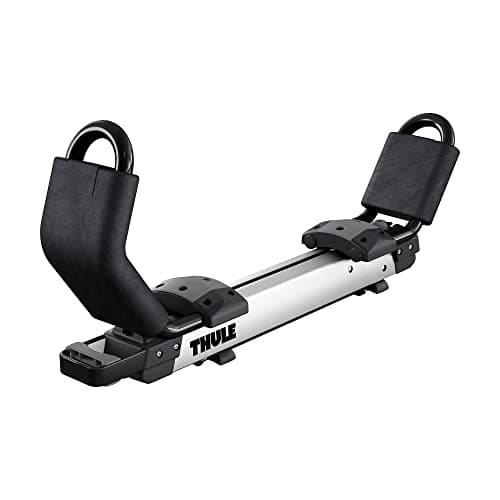 Thule Hullavator ProGas struts take about 40 lb of the boat and the cradle drops up to roughly 40 inches down the side of the car. Nothing else removes as much of the lift. | Best load assist overall | 8.8 | |
| 2 |  Yakima ShowDownThe cradle slides out and down the side of the vehicle, so the lift happens beside the car rather than above it. | Best lower-cost load assist | 8.3 | |
| 3 | 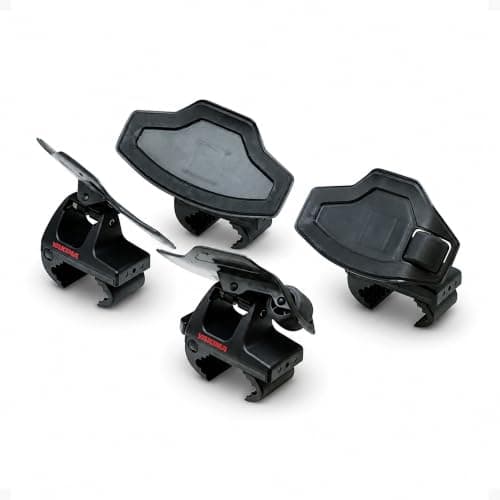 Yakima SweetRollRollers at the back, cradles at the front: put the bow up, walk the boat forward, done. The cheapest real fix for a tall roof. | Best slide-on saddle | 8.4 | |
| 4 | 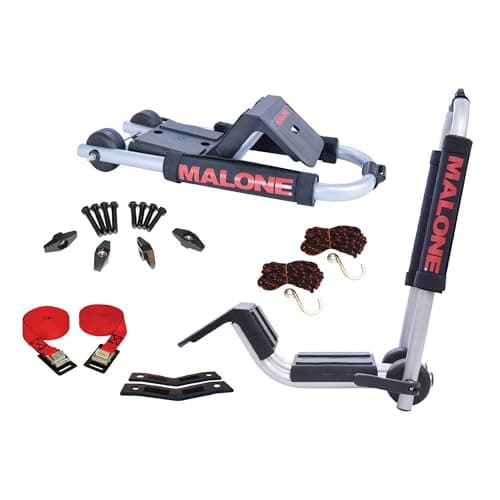 Malone DownLoaderA folding J-cradle with straps and bow and stern lines included, which drops flat when empty so the bars stay quiet. | Best folding J-cradle for a lighter boat | 7.9 |
Prices checked October 17, 2026. Product photographs come from Amazon where the listing is matched, and are representative stock images otherwise. Affiliate disclosure.
#1 · Best load assist overall
Thule Hullavator Pro
Gas struts take about 40 lb of the boat and the cradle drops up to roughly 40 inches down the side of the car. Nothing else removes as much of the lift.
- Assistance
- Takes roughly 40 lb of the boat's weight
- Lowering
- Drops up to about 40 inches to the side
- Capacity
- One boat
- Mounting
- Crossbars, both bars
- Included
- Integrated straps
What works
- You load at hip height beside the car, not over your head
- Roughly 40 lb of assistance is the difference between possible and not for many paddlers
- Integrated straps, so there is nothing to forget or lose
- Turns a two-person job into a one-person job, which is why boats get used
What doesn’t
- The most expensive way to carry one kayak
- Heavy itself, and that weight counts against your roof load limit
- One boat only — a second needs a second carrier and the bar space for it
- Needs a proper crossbar spread across both bars
Our scoring
8.8overall
#2 · Best lower-cost load assist
Yakima ShowDown
The cradle slides out and down the side of the vehicle, so the lift happens beside the car rather than above it.
- Type
- Load-assist carrier
- Loading
- Cradle slides out and down the side
- Capacity
- One boat
- Mounting
- Crossbars
What works
- Brings the loading point down beside the vehicle, which is the whole job
- Costs less than the Hullavator for a similar approach
- Works for boards as well as boats
- Fits the Yakima bar and tower system most paddlers already own
What doesn’t
- No live Amazon listing matched this model, so we show no price for it
- No gas-strut assistance, so you still carry the boat's weight — you just carry it lower
- One boat only
- Adds its own weight to a roof limit that may already be tight
Our scoring
8.3overall
#3 · Best slide-on saddle
Yakima SweetRoll
Rollers at the back, cradles at the front: put the bow up, walk the boat forward, done. The cheapest real fix for a tall roof.
- Capacity
- One boat, hull down
- Loading
- Slide on from the rear
- Hull support
- Full, cradled
- Carrying angle
- Flat, hull down
- Bar width used
- Most or all
What works
- Lets you lift one end at a time instead of the whole boat at once
- Full hull-down support, which is the gentlest way to carry a composite boat
- Far cheaper than any drop-down carrier
- No mechanism to maintain or seize
What doesn’t
- Uses most or all of the bar width, so a second boat is unlikely
- You still take half the weight at the rear bar
- Hull-down carrying has more frontal area than a J-cradle
Our scoring
8.4overall
#4 · Best folding J-cradle for a lighter boat
Malone DownLoader
A folding J-cradle with straps and bow and stern lines included, which drops flat when empty so the bars stay quiet.
- Type
- Folding J-cradle
- Capacity
- One boat
- Folding
- Folds down when empty
- Included
- Cam straps, bow and stern lines
What works
- Folds flat between trips, so no noise and no clearance problem
- Straps and bow and stern lines included — a complete kit, not a part
- J-cradles use less bar width, so two boats are realistic
- Much cheaper than a load-assist mechanism
What doesn’t
- A J-cradle means lifting the boat up and over, which is what you came here to avoid
- Not a load-assist product — included for the lighter-boat case only
- Carrying on edge catches more crosswind than hull-down
Our scoring
7.9overall
How much lift each one actually removes
The assistance column quotes only published figures. Where a manufacturer publishes no number, the cell says what the mechanism does rather than inventing a pound figure for it.
| Carrier | Type | Published assistance | Boats | Where you lift |
|---|---|---|---|---|
| Thule Hullavator Pro | Gas-strut drop-down | About 40 lb; lowers up to about 40 in | 1 | Hip height, beside the car |
| Yakima ShowDown | Slide-out drop-down | None published — cradle moves, not the weight | 1 | Lower, beside the car |
| Yakima SweetRoll | Roller and saddle | None — you lift one end at a time | 1 | Rear bar, then push |
| Malone DownLoader | Folding J-cradle | None | 1, and two cradles fit a bar | Over the roof |
Read the last two columns together. The Hullavator is the only one that reduces the weight you handle. The ShowDown and SweetRoll reduce the height you handle it at, which for most people is the actual problem.
Which problem are you solving?
Be specific about this, because it maps cleanly onto the four products above.
| Your problem | What to buy |
|---|---|
| The boat is genuinely too heavy to press overhead | Hullavator Pro — it is the only one that takes weight |
| The boat is manageable but the roof is too high | ShowDown, or a SweetRoll and push it on |
| Loading alone, with a shoulder you are protecting | Hullavator Pro |
| Two boats, both liftable | J-cradles — see the two-kayak roundup |
| One light recreational boat, sedan roof | None of this. Buy a saddle and learn the technique |
If your answer is the last row, our cradle style comparison is the page you want, and the tie-down guide covers the loading sequence that makes a light boat easy. If it is the two-boat row, see the two-kayak roundup.
The free load assist nobody uses
Before you spend on a mechanism, try the technique, because it removes a surprising amount of the problem and costs nothing.
- Lift one end at a time. Stand the boat on its stern at the back of the car, walk the bow up onto the rear bar, then go to the stern and push. You never hold the whole weight.
- Put something slippery on the rear bar. A towel, a pad, or a dedicated roller. The boat should slide rather than drag.
- Load from the side of the car, not the back, if you have help. Two people at the ends is always easier than one person at the middle.
- Use your legs. The overhead press is the dangerous part. Getting the boat to waist height and sliding it is not.
If that works, a SweetRoll is the whole upgrade you need. If it does not — because the boat is a 90 lb fishing kayak, or your roof is at forehead height — then a drop-down carrier is a genuine solution and not an indulgence.
Whatever you end up loading onto, the carry is only safe if the boat is restrained twice: hull straps over the cradles, and independent bow and stern lines to the vehicle. That second restraint is the one people skip, and it is the one that matters when a cradle lets go. Our tie-down guide has the sequence, and the cam strap roundup covers why a ratchet is the wrong tool on a hull.
The roof limit that catches heavy boats
A load-assist carrier is heavy, and a fishing kayak is heavy, and both of them count against the same number: your vehicle’s published dynamic roof load — the weight allowed up there while the car is moving, including the crossbars.
On a lot of cars that figure is around 150 lb. A heavy carrier plus a heavy boat can approach it, and the crossbars and feet are already spending part of it. So do the arithmetic before you buy rather than after: manual figure, minus bars and feet, minus carrier, and what remains is your boat allowance. Our weight limits guide works examples, and our vehicle fit pages carry published limits where the manufacturer publishes them.
If the arithmetic fails, two honest routes remain. A truck bed carries a heavy boat with no roof limit involved — the truck setup roundup and the truck-bed guide cover it. Or a trailer, which is outside what this site covers but is the right answer for the heaviest boats.
Common questions
What is the best load-assist kayak rack?
Do I need a load-assist kayak rack?
How much weight does the Thule Hullavator Pro take?
Can you load a kayak alone without a load-assist rack?
Will a load-assist rack carry two kayaks?
Sources
Not sure it fits your car?
Our vehicle pages carry the published roof load limit, the roof type by model year, and what actually mounts to it — cited, and honest about what the manufacturer does not publish.
Read next
Thule Hullavator Pro Review
What the gas-assist actually does for the lift, what it costs, and who genuinely needs one.
The Best Kayak Racks for SUVs
Kayak carriers for tall SUV roofs, ranked on loading ease, hull protection and capacity.
J-Cradle vs Saddle vs Stacker
Hull protection, boats per bar and loading ease across the three carrier styles.
How to Haul a Kayak in a Truck Bed
The bed-hauling method for a kayak: diagonal loading, four straps, overhang marking, and what the bed rails do not do.