Hitch Carriers
The Best Hitch Cargo Carriers for a Jeep Wrangler
On a Wrangler the receiver is stronger than the roof. The spare tire is what makes choosing a carrier harder than it looks.
Roof & Route is funded by affiliate commission. If you buy through a link on this page we may earn a commission at no extra cost to you. It never decides what we recommend or the order we recommend it in — read the full disclosure.
The pick for a Wrangler is the CURT 18153 folding cargo carrier: a 60-inch steel basket on a folding shank, which is the one feature that makes a carrier livable on a vehicle whose tailgate swings sideways past a spare tire.
Start with why the receiver beats the roof here. A Wrangler’s roof unbolts — the JL manual figure is quoted at 100 lb, and a soft top is rated at nothing at all. The receiver is a 2-inch unit on most modern Wranglers and carries far more, at waist height, and it does not come off with the top in July. For heavy, awkward cargo this is not a close call.
Then the Wrangler-specific problem. The rear spare sits proud of the tailgate, which pushes any hitch-mounted accessory further back than it would sit on a crossover. That extra overhang costs you two things: leverage on the receiver, and swing clearance for a tailgate that opens sideways rather than up. A folding shank fixes the second and a short basket helps the first.
Three numbers to read before you shop: your receiver opening (2 inch on most Wranglers, which is the easy case), your tongue-weight rating from the label on the hitch itself, and the distance from your spare to the ground. Our weight limits guide has the arithmetic, and the Wrangler roof rack picks cover the long-and-light loads a basket cannot take.
Quick picks
Tap any row to jump to the full write-up below. Scores are our editorial judgment on published specifications — not a star rating, and not a product we claim to have tested.
| # | Product | Best for | Score | Price |
|---|---|---|---|---|
| 1 | 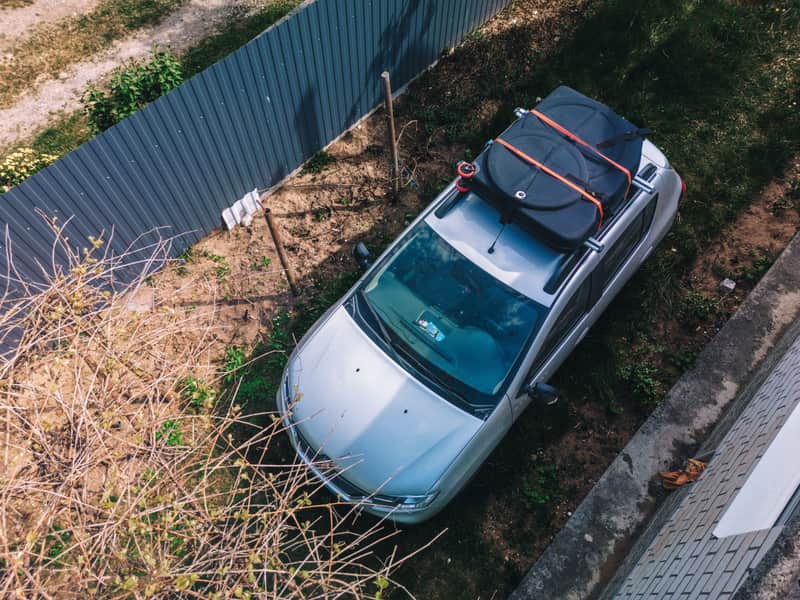 CURT 18153 Folding Cargo CarrierA 60-inch steel basket that tips up out of the way, which is the difference between using your tailgate and unbolting the carrier every time. | Best overall — the folding shank | 8.0 | |
| 2 | 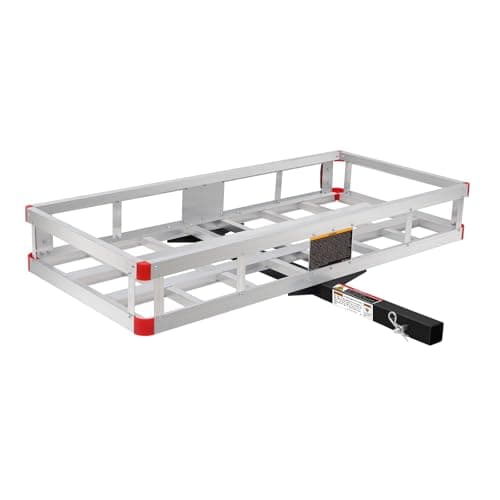 MaxxHaul 70108 Aluminum CarrierAn aluminum tray roughly a third the weight of the steel equivalent, which hands that weight back to the cargo and to your back. | Lightest option | 7.6 | |
| 3 | 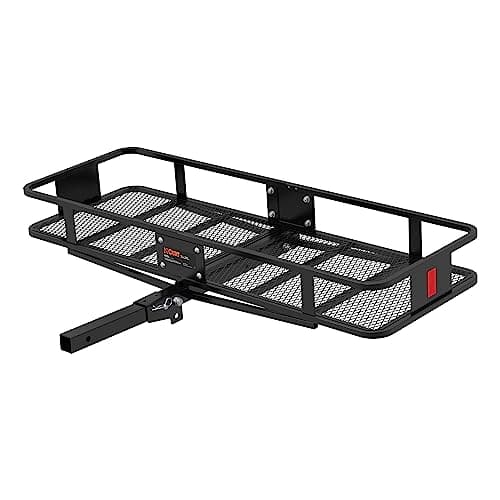 CURT 18151 Cargo CarrierThe fixed-shank version of the same CURT basket — one less hinge to work loose, at less money, if your tailgate path allows it. | Cheapest steel basket worth buying | 7.8 | |
| 4 | 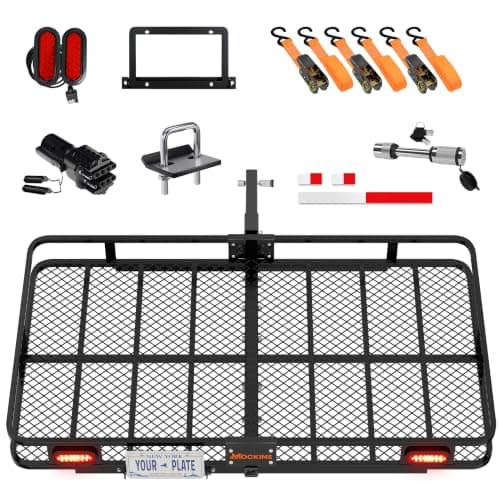 Mockins Hitch Cargo CarrierUsually bundled with a waterproof bag, a net and straps — which is exactly what you were going to buy next anyway. | Buying the whole setup at once | 7.4 |
Prices checked October 12, 2026. Product photographs come from Amazon where the listing is matched, and are representative stock images otherwise. Affiliate disclosure.
#1 · Best overall — the folding shank
CURT 18153 Folding Cargo Carrier
A 60-inch steel basket that tips up out of the way, which is the difference between using your tailgate and unbolting the carrier every time.
- Basket
- 60 inches
- Shank
- Folding
- Material
- Steel
- Why for a Wrangler
- Clears a sideways-swinging tailgate when folded
What works
- Folds up, so the tailgate and the spare carrier still have a path
- Also folds flat for storage, which matters in a single garage
- 60 inches takes coolers, bins and camp kit without stacking
- CURT publishes ratings per part number rather than per product line
What doesn’t
- No live Amazon listing matched this part number, so we show no price for it
- The hinge is the part that wears and the part that rattles
- Heavy steel, and 60 inches of basket behind a spare tire is a lot of overhang
Our scoring
8.0overall
#2 · Lightest option
MaxxHaul 70108 Aluminum Carrier
An aluminum tray roughly a third the weight of the steel equivalent, which hands that weight back to the cargo and to your back.
- Material
- Aluminum
- Weight
- Roughly a third of the steel equivalent
- Shank
- Fixed
- Corrosion
- No rust where salt collects
What works
- Light enough to fit and remove alone, which you will do often on a Wrangler
- Leaves more of the tongue rating for actual cargo
- Aluminum ignores road salt and trail water
- Stands up in a garage corner between trips
What doesn’t
- Fixed shank — the tailgate path is yours to solve
- Costs more than the steel basket it replaces
- Flexes more visibly than steel under a concentrated load
Our scoring
7.6overall
#3 · Cheapest steel basket worth buying
CURT 18151 Cargo Carrier
The fixed-shank version of the same CURT basket — one less hinge to work loose, at less money, if your tailgate path allows it.
- Material
- Steel
- Shank
- Fixed
- Brand
- Long-established towing manufacturer
- Documentation
- Ratings published per part number
What works
- A fixed shank has nothing to rattle or seize
- Powder-coated steel takes trail abuse aluminum does not
- CURT publishes capacity and fitment clearly for the part number
- Usually the cheapest carrier we would put on a Wrangler
What doesn’t
- No fold, so plan the tailgate swing before you buy
- Heavy — the basket spends a real share of the tongue rating
- Steel rusts at any chip you fail to touch up
Our scoring
7.8overall
#4 · Buying the whole setup at once
Mockins Hitch Cargo Carrier
Usually bundled with a waterproof bag, a net and straps — which is exactly what you were going to buy next anyway.
- Material
- Steel
- Usually bundled with
- Waterproof bag, cargo net, straps
- Shank
- Fixed on most variants
- Weather protection
- From the bag, not the basket
What works
- One purchase instead of four
- The bundled bag is the difference between a basket and weather protection
- Cheapest route to a working, covered carrier
What doesn’t
- Bundle contents vary by listing — read what is actually in the box
- Bag and net are adequate rather than good
- Heavy steel with the usual tongue-weight penalty
Our scoring
7.4overall
The spare tire is the whole problem
Every other vehicle on this site has a flat-ish rear end. A Wrangler has a full-size spare bolted to a carrier that is bolted to the tailgate, and the tailgate swings sideways. That changes three things at once.
| What the spare does | Consequence | What fixes it |
|---|---|---|
| Pushes the carrier further back | More leverage on the receiver for the same load | Heavy items hard against the vehicle; a shorter basket |
| Swings with the tailgate | A fixed carrier can block the tailgate path entirely | A folding shank, or a swing-away adapter |
| Blocks the straight-back approach | Loading is awkward from directly behind | Load from the side; keep the basket low and open |
Check the swing path with the tailgate fully open and the carrier fitted — not nearly open, fully. Swing-out tire carriers and other rear-mounted accessories are the thing that catches, and the check takes a minute.
Tongue weight, and why the basket counts
Tongue weight is the total downward load your receiver will accept, and the carrier’s own mass counts against it in full, before a single bag goes in the basket. That is the arithmetic nobody does.
On a Wrangler with a 2-inch Class III receiver you usually have room to spare, so this is less tight than it is on a sedan. But the extra overhang from the spare works against you: the further back the load sits, the more it multiplies. Load heavy items against the vehicle and light, bulky ones at the far end, every time.
Read the label on the hitch itself, not the vehicle’s towing figure — they are different numbers measuring different things, and the towing figure is the bigger and more flattering of the two. Our hitch classes guide has the class-by-class numbers.
Loading a carrier on a Wrangler
- Heavy against the vehicle. Weight at the far end of the basket multiplies the leverage on the receiver, and the spare has already moved everything further back than it should be.
- Strap down, then strap fore-and-aft. Down holds the load in the basket; fore-and-aft stops it migrating on a trail. Both are needed — the sequence is here.
- Keep the plate and lights visible. A basket that hides either is a stop waiting to happen. Most carriers have a plate bracket for exactly this.
- Re-check after twenty minutes. Everything settles once, and that is when straps go slack. On a trail, re-check more often than that.
- Take it off between trips. An empty carrier is still weight, still drag and still something to reverse into.
The roof and the tire carrier, for comparison
A Wrangler has three load paths, which is one more than anything else here. Worth knowing where each one wins.
The receiver takes heavy and awkward: coolers, bins, firewood, recovery gear, camp kit. The roof takes long and light: kayaks, boards, lumber, recovery boards — through a body-mounted platform, not a rail-mount rack, because there are no factory rails. See the Wrangler roof rack picks. The spare tire carrier takes small and dense, through a tire-mounted bag or rack, and it is the only one of the three that costs nothing in drag.
Fuel is the tiebreaker most people ignore. A hitch carrier sits in the vehicle’s wake rather than in clean air above it, so it costs less than a roof load for the same cargo — published testing on rooftop carriers finds a double-digit percentage penalty at highway speed, and a Wrangler’s aerodynamics give you nothing to spare. The roof-or-hitch guide frames the whole decision.
Common questions
Will a hitch cargo carrier clear a Wrangler's spare tire?
Is a hitch carrier better than a roof rack on a Wrangler?
What size receiver does a Wrangler have?
Does the carrier's own weight count against the limit?
Sources
Not sure it fits your car?
Our vehicle pages carry the published roof load limit, the roof type by model year, and what actually mounts to it — cited, and honest about what the manufacturer does not publish.
Read next
The Best Roof Racks for a Jeep Wrangler
Body-mounted platforms that suit a Wrangler's removable top, plus the load-path check that rules out ordinary crossbars.
Hitch Cargo Carrier Weight Limits
The three ratings that cap a hitch carrier load, and why tongue weight usually decides it.
Roof Rack or Hitch Carrier?
Bulky and light goes up top; heavy and dense goes on the back. The full comparison.