Hitch Carriers
The Best Hitch Cargo Carriers for a Subaru Outback
The carrier is the easy part. Whether your Outback's hitch can take one at all is decided by a number on a sticker you have probably never read.
Roof & Route is funded by affiliate commission. If you buy through a link on this page we may earn a commission at no extra cost to you. It never decides what we recommend or the order we recommend it in — read the full disclosure.
For most Outbacks the pick is the MaxxHaul 70108 aluminum carrier, for one reason: it is roughly a third the weight of the equivalent steel basket, and on a car with an aftermarket Class I or II hitch every pound of carrier is a pound stolen from a tongue rating that was never generous.
Here is the check that has to happen before any of this matters. Most Outback trims have no factory receiver. A Class I or II aftermarket hitch is a routine bolt-on, and a Class I receiver has a 1-1/4 inch opening — while the overwhelming majority of hitch cargo carriers are built for 2 inch.
So go and look. Measure the opening, then read the tongue-weight rating printed on the hitch label itself — not the car’s towing figure, which is a different and much more flattering number. If you have 1-1/4 inch, buy a carrier sold specifically for that size or move the load to the roof, where an Outback is genuinely excellent.
What we will not recommend is a 1-1/4 to 2 inch adapter for a cargo carrier. The adapter adds leverage at exactly the point where the load is already trying to twist the receiver, and it does nothing at all about the tongue-weight rating that was the real limit. Our hitch classes guide has the numbers; the weight limits guide has the arithmetic.
Quick picks
Tap any row to jump to the full write-up below. Scores are our editorial judgment on published specifications — not a star rating, and not a product we claim to have tested.
| # | Product | Best for | Score | Price |
|---|---|---|---|---|
| 1 | 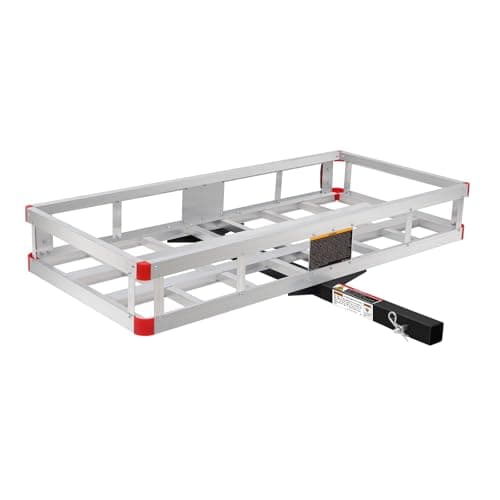 MaxxHaul 70108 Aluminum CarrierAluminum instead of steel — the single most useful property a carrier can have on a car with a Class I or II hitch. | Best for a modest tongue rating | 7.7 | |
| 2 | 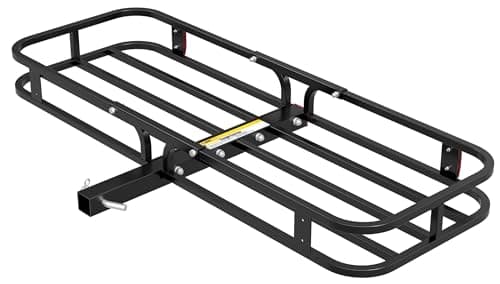 MaxxHaul 70107The long-running budget steel basket: 60 by 20 inches, 500 lb rated, non-folding, and far cheaper than anything else with those numbers. | Cheapest carrier that carries real weight | 7.8 | |
| 3 | 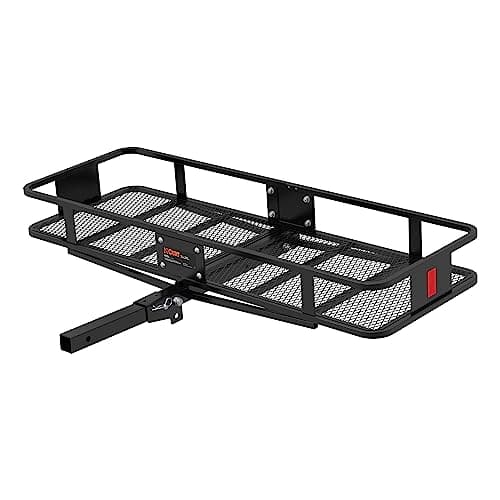 CURT 18151 Cargo CarrierA fixed-shank steel basket from a towing brand that publishes capacity and fitment per part number — which is what you want when the margins are tight. | Best documented steel basket | 7.7 | |
| 4 | 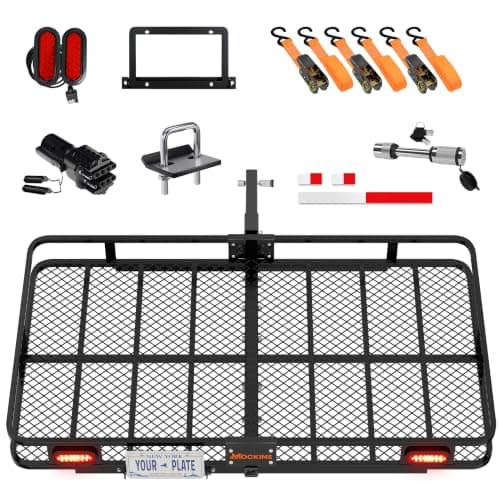 Mockins Hitch Cargo CarrierA steel basket usually bundled with a waterproof bag, a net and straps — the fastest route from nothing to a working, covered carrier. | One purchase, covered load | 7.4 |
Prices checked October 12, 2026. Product photographs come from Amazon and are refreshed with the prices. Affiliate disclosure.
#1 · Best for a modest tongue rating
MaxxHaul 70108 Aluminum Carrier
Aluminum instead of steel — the single most useful property a carrier can have on a car with a Class I or II hitch.
- Material
- Aluminum
- Weight
- Roughly a third of the steel equivalent
- Shank
- Fixed
- Why it suits an Outback
- Less of a modest rating spent on the carrier
What works
- Light enough that one person fits and removes it without help
- Leaves more of a modest tongue rating for actual cargo
- Aluminum ignores the road salt that collects under a wagon
- Easy to stand in a garage corner between trips
What doesn’t
- Costs more than the steel basket it replaces
- Deflects more visibly than steel under a concentrated load
- No folding hinge, so the tailgate path is yours to check
Our scoring
7.7overall
#2 · Cheapest carrier that carries real weight
MaxxHaul 70107
The long-running budget steel basket: 60 by 20 inches, 500 lb rated, non-folding, and far cheaper than anything else with those numbers.
- Basket
- 60 x 20 inches
- Rated
- 500 lb (carrier rating, not your hitch's)
- Material
- Powder-coated steel
- Shank
- Fixed, non-folding
What works
- The cheapest honest basket in the category by a clear margin
- 500 lb carrier rating is more than any Outback hitch will allow anyway
- Simple fixed construction with nothing to seize
- 60 x 20 inches holds a genuinely useful amount
What doesn’t
- The carrier rating is irrelevant — your hitch's tongue rating is the real limit
- Heavy steel spends a big share of a Class I or II rating empty
- Does not fold, so the tailgate is awkward with it fitted
Our scoring
7.8overall
#3 · Best documented steel basket
CURT 18151 Cargo Carrier
A fixed-shank steel basket from a towing brand that publishes capacity and fitment per part number — which is what you want when the margins are tight.
- Material
- Steel
- Shank
- Fixed
- Brand
- Long-established towing manufacturer
- Documentation
- Ratings published per part number
What works
- CURT publishes per-part-number ratings, so you can do the arithmetic honestly
- Powder-coated steel survives winters
- No hinge means nothing to rattle
What doesn’t
- Heavy — a real bite out of a Class I or II rating
- No fold, and an Outback hatch opens high and wide
- Steel rusts at any chip you do not touch up
Our scoring
7.7overall
#4 · One purchase, covered load
Mockins Hitch Cargo Carrier
A steel basket usually bundled with a waterproof bag, a net and straps — the fastest route from nothing to a working, covered carrier.
- Material
- Steel
- Usually bundled with
- Waterproof bag, cargo net, straps
- Shank
- Fixed on most variants
- Weather protection
- From the bag, not the basket
What works
- One purchase instead of four
- The bag is what turns a basket into weather protection
- Cheapest route to a covered load
What doesn’t
- Bundle contents vary by listing — read what is in the box
- Bag and net are adequate rather than good
- Heavy steel, same tongue-weight penalty as any steel basket
Our scoring
7.4overall
Check the receiver before you check the basket
An Outback is a car, not a small SUV, and its hitch is usually something somebody bolted on afterwards. That makes the receiver the deciding factor rather than an afterthought.
| What to read | Where it is | Why it decides the purchase |
|---|---|---|
| Receiver opening | Measure it, or read the hitch label | Most carriers only fit 2 inch; many Outback hitches are 1-1/4 |
| Tongue weight rating | Sticker on the hitch itself | Carrier mass counts against it in full |
| Rear overhang | Tape measure, bumper to basket end | Changes handling, parking and plate visibility |
| Hatch swing | Open it fully with the carrier fitted | An Outback hatch opens high and wide and catches short shanks |
The Class I case is the one that ends the conversation. A 1-1/4 inch receiver with a low tongue rating is not a carrier problem you can shop your way out of — no basket is light enough to fix a rating that small. That is the point at which the roof becomes the answer.
The ground clearance surprise
An Outback sits higher than a sedan and lower than an SUV, which puts a loaded basket in an awkward middle. Here is the measurement people skip: measure the height of the empty basket floor, then load it and measure again.
The suspension squats and the basket drops with it. If the loaded figure is down around six inches, you will catch it on a steep driveway, a speed bump or a boat ramp — and you will catch it hard, because there is a few hundred pounds of leverage behind it.
The fix is not a different carrier, it is less weight at the far end of the basket. Heavy items hard against the vehicle, light bulky items at the back. That reduces both the squat and the leverage at once.
When an Outback should use the roof instead
This site generally argues for the hitch over the roof, because a hitch carrier sits in the vehicle’s wake rather than in clean air and costs less fuel for the same cargo. The Outback is the clearest exception on the whole site.
It has factory rails on every trim, a low roof you can reach from the ground, and published load figures Subaru actually prints. Meanwhile its hitch is an aftermarket part that may be a Class I. When the receiver is the weak link and the roof is the strong one, use the roof.
Start at the Outback roof rack picks — note the argument there for replacing the factory integrated crossbars before loading a full box — then the cargo box roundup. If you have no hitch at all, fitting one purely to carry luggage rarely pays: the hitch plus the carrier costs more than a roof setup that also carries bikes and boats.
Loading, and the things that go wrong
- Heavy against the vehicle. Weight at the far end multiplies the leverage on a receiver that is already the weak point on this car.
- Strap down, then fore-and-aft. Down holds the load in; fore-and-aft stops it migrating. Both, every time — the sequence is here.
- Keep the plate and lights visible. Most carriers include a plate bracket because this is a real stop.
- Re-check after twenty minutes. Loads settle once and that is when straps go slack.
- Take it off between trips. Even in the wake, an empty basket is weight, drag and something to reverse into.
A cargo net over the basket is worth the ten dollars the first time a shoe does not leave at 60 mph. The cargo net picks cover the basket sizes.
Common questions
Will a hitch cargo carrier fit a Subaru Outback?
Can I use a 1-1/4 to 2 inch adapter for a cargo carrier?
Hitch carrier or roof box on an Outback?
Does the carrier's own weight count against the tongue rating?
Sources
Not sure it fits your car?
Our vehicle pages carry the published roof load limit, the roof type by model year, and what actually mounts to it — cited, and honest about what the manufacturer does not publish.
Read next
The Best Roof Racks for a Subaru Outback
Aftermarket bars that beat the Outback's factory integrated crossbars, and Subaru's limit by model year.
Hitch Classes Explained
Classes, receiver sizes and tongue weight ratings — and why tongue weight is the number that matters.
The Best Cargo Carriers for Cars
Hitch cargo carriers that suit a car rather than a truck, plus the receiver check to do first.