Bike Racks
The Best Roof Bike Racks
If the crossbars are already up there, this is the cheapest way to free up the whole back of the car. The catch is a tape measure, not a budget.
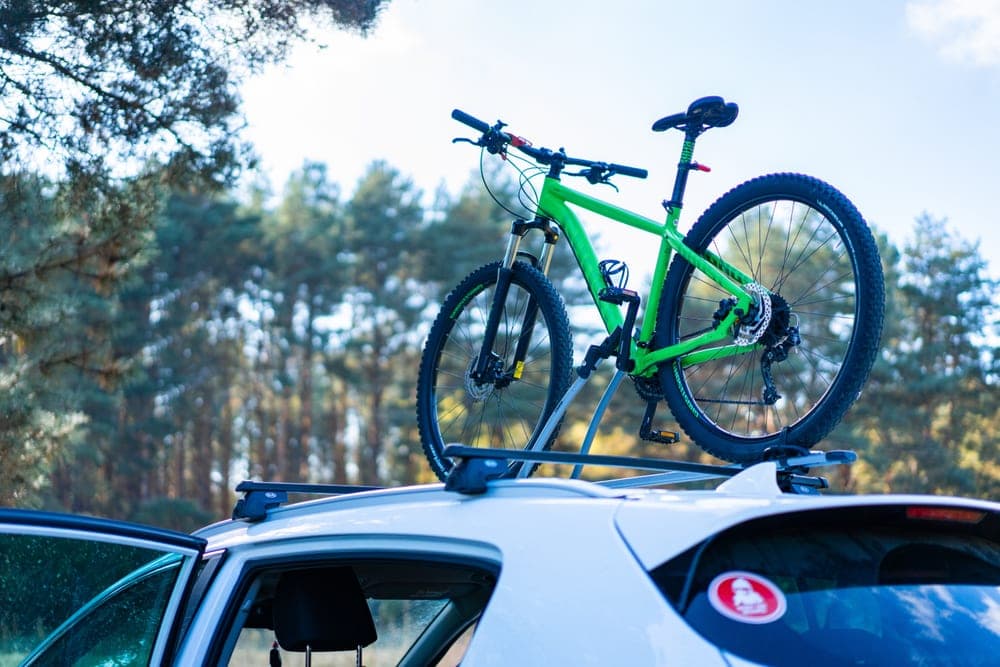
Roof & Route is funded by affiliate commission. If you buy through a link on this page we may earn a commission at no extra cost to you. It never decides what we recommend or the order we recommend it in — read the full disclosure.
A roof carrier is the one bike rack that leaves the back of your car completely alone. The tailgate opens, the trunk is reachable, the license plate and lights are never covered, and nothing hangs off the back when you reverse into a parking space. For a family car already loaded front to back, that is often the whole argument.
It is also the only route with a hard prerequisite. A roof carrier mounts to crossbars — not to the roof, and not to roof rails. If your car has bare rails with nothing bridging them, the carrier is the last thing you buy rather than the first; roof racks and crossbars covers what a complete bar system actually costs.
Assuming the bars are already up there, three published numbers decide this and none of them is price. Crossbar spread — the front-to-back gap between your two bars — is the one that eliminates options, because every carrier states a minimum and plenty of roofs are shorter than it. Wheel and tire range decides whether a child’s bike or a fat tire fits without buying an adapter. And the per-bike weight rating decides whether your bike is on the table at all — which, for anything electric, it is not.
We ranked on those three plus security and value. Every carrier below is a current model we confirmed was in stock at a US retailer while writing, and every figure quoted is the published manufacturer or retailer specification. We have not tested these ourselves and do not pretend otherwise.
Quick picks
Tap any row to jump to the full write-up below. Scores are our editorial judgment on published specifications — not a star rating, and not a product we claim to have tested.
| # | Product | Best for | Score | Price |
|---|---|---|---|---|
| 1 |  Yakima HighRoadTakes a 4-inch fat tire with no adapter and spans an unusually wide range of crossbar spreads, which is why it fits more cars and more bikes than anything else here. | Best overall | 8.5 | |
| 2 | Thule UpRideThe only carrier here rated from 20-inch wheels up to 29, which makes it the single answer that covers a child's bike and an adult mountain bike on the same roof. | Widest wheel-size range | 8.4 | |
| 3 | Yakima FrontLoaderPublished down to a 16-inch crossbar spread, which is the number that makes a roof carrier possible on a hatchback or a compact sedan at all. | Shortest crossbar spread | 8.0 | |
| 4 | Thule ProRide XTClamps the down tube instead of the front wheel, which is the right answer for a commuter with fenders or any bike a wheel tray will not take. | Best frame-clamp carrier | 7.9 | |
| 5 | Thule FastRideThe front wheel comes off and the fork bolts straight to the bar, which puts the bike lower than anything else here and takes several pounds out of the overhead lift. | Lowest profile, lightest lift | 7.3 |
We do not publish prices, because they change daily — every link goes to the current price on Amazon. Product photographs are representative stock images, not the exact unit. Affiliate disclosure.
#1 · Best overall
Yakima HighRoad
Takes a 4-inch fat tire with no adapter and spans an unusually wide range of crossbar spreads, which is why it fits more cars and more bikes than anything else here.
- Mounting
- Front wheel clamp, no frame contact
- Published bike limit
- 45 lb road / 27 lb off-road
- Wheels and tires
- 26-29 in wheels, 23 mm-4.0 in tires
- Crossbar spread
- 18-40 in
What works
- Handles fat-bike tires natively, with no accessory to buy
- The widest published crossbar spread window of the carriers here
- Front wheel stays on and the frame is never touched
- Takes the heaviest bike of any pick on this page
What doesn’t
- Starts at 26 in wheels, so a small child's bike needs a different carrier
- SKS lock cores are a separate purchase on the base version
- T-slot bars need a SmarT-Slot kit on top of the carrier price
Our scoring
8.5overall
#2 · Widest wheel-size range
Thule UpRide
The only carrier here rated from 20-inch wheels up to 29, which makes it the single answer that covers a child's bike and an adult mountain bike on the same roof.
- Mounting
- Front wheel clamp, no frame contact
- Published bike limit
- 44 lb
- Wheels and tires
- 20-29 in wheels, tires to 3 in (5 in with adapter)
- Crossbar spread
- 24-43 in
What works
- Rated down to 20 in wheels, so one carrier covers the whole family
- Cable lock for the bike and a lock to the bar are both included
- No frame contact at all, which suits carbon and unusual tube shapes
- Front wheel does not come off
What doesn’t
- The most expensive carrier on this page
- Needs 24 in of crossbar spread, which rules out short roofs
- Tires over 3 in need the Fatbike Adapter, sold separately
Our scoring
8.4overall
#3 · Shortest crossbar spread
Yakima FrontLoader
Published down to a 16-inch crossbar spread, which is the number that makes a roof carrier possible on a hatchback or a compact sedan at all.
- Mounting
- Front wheel clamp, no frame contact
- Published bike limit
- 40 lb at 18 in spread / 30 lb at 16 in
- Wheels and tires
- 20-27.5 in to 3 in tires; 29 in to 2.7 in
- Carrier weight
- 14.3 lb
What works
- The shortest published crossbar spread of the mainstream carriers
- Lightest of the wheel-on trays here, so fitting it is a one-person job
- Fits factory, aero and Yakima StreamLine bars with the hardware in the box
- Usually the cheapest of the wheel-on carriers
What doesn’t
- At the 16 in minimum spread the published bike limit drops to 30 lb
- Maximum 48 in wheelbase, shorter than the other trays here
- 29 in wheels are capped at a 2.7 in tire, so it is not a fat-bike carrier
Our scoring
8.0overall
#4 · Best frame-clamp carrier
Thule ProRide XT
Clamps the down tube instead of the front wheel, which is the right answer for a commuter with fenders or any bike a wheel tray will not take.
- Mounting
- Down-tube clamp, both wheels strapped
- Published bike limit
- 44 lb (Thule); some retailers list 40 lb
- Frame tubes
- 22-80 mm
- Carrier weight
- 11 lb
What works
- Lightest upright carrier here at 11 lb, which matters on an overhead fit
- Takes bikes a wheel tray rejects, including fendered commuters
- Mounts to Thule systems, round bars and most factory racks
- Published bike limit matches the premium wheel-on trays
What doesn’t
- The clamp contacts the frame, so we would not use it on carbon
- Published bike limit disagrees between Thule and some retailers
- Tires capped at 3 in, so no fat bikes
Our scoring
7.9overall
#5 · Lowest profile, lightest lift
Thule FastRide
The front wheel comes off and the fork bolts straight to the bar, which puts the bike lower than anything else here and takes several pounds out of the overhead lift.
- Mounting
- Fork mount, front wheel removed
- Published bike limit
- 40 lb
- Carrier weight
- 7.3 lb
- Axles
- 9 mm quick-release included; thru-axle adapter extra
What works
- By far the lightest and lowest-profile carrier on this page
- Lowest list price of the five, and widely discounted
- Lifting a bike without its front wheel is a noticeably smaller lift
- Locks to the crossbar
What doesn’t
- You remove the front wheel every single time, and have to stow it
- A thru-axle bike needs an adapter before this works at all
- Maximum 3 in tire and a 1250 mm wheelbase
Our scoring
7.3overall
Measure your crossbar spread first
This is the step almost nobody takes and the one that decides whether a carrier will physically bolt to your car. Crossbar spread is the front-to-back distance between the centers of your two crossbars. Open a door, put a tape measure on the roof, and write the number down.
Now compare it to the published minimums, because they are further apart than you would expect. The Yakima FrontLoader is rated down to 16 inches. The Yakima HighRoad needs 18. The Thule UpRide needs 24. A short roof on a hatchback or compact sedan genuinely cannot take a carrier that wants 24 inches, and buying one anyway means a return.
Two further things catch people out. A carrier mounted at the bottom of its spread range is often derated — the FrontLoader drops from 40 lb to 30 lb at a 16-inch spread, which can be the difference between carrying your bike and not. And factory bars that are fixed in place cannot be slid to suit the carrier, so on those cars your measurement is final. Our roof rail and bar types guide explains which systems let you move the bars and which do not.
Wheel-on, frame clamp or fork mount
Wheel-on. A tray clamps the front wheel and straps the rear. Nothing touches the frame, which is why it has become the default and why it is the only kind we would put a carbon bike in. Three of the five picks above work this way.
Frame clamp. An arm grips the down tube and both wheels strap to the tray. It takes bikes a wheel tray will not — fendered commuters, unusual wheel sizes, bikes with cargo mounts — and it is the lightest of the upright designs. The trade is a clamp sitting on your frame, which is a real consideration on carbon and a non-issue on aluminum or steel.
Fork mount. The front wheel comes off and the fork attaches to the bar. The bike sits lowest, the lift is lightest, and the price is lowest. In exchange you remove and stow a wheel at both ends of every trip, and a modern thru-axle bike needs an adapter before the carrier works at all.
Practical version: wheel-on unless you have a specific reason not to. A fork mount is a genuinely good buy for one quick-release bike that lives on the car; it is a daily annoyance for anything else.
Per-bike weight, and why e-bikes are out
The carriers here publish limits between 30 and 45 lb per bike. A typical adult mountain bike is around 30 lb and a road bike is well under that, so for most people this number never comes into play.
Electric bikes are a different question and the answer is short: not on the roof. A full-power e-MTB can be 70 lb, which is above every limit on this page, and that is before you consider lifting 70 lb over your head. If you have an e-bike, the roof is not an option you are choosing against — it is closed. Read our e-bike rack picks instead; they are hitch racks for exactly this reason.
There is a second limit sitting above the carrier’s. Your car has a published dynamic roof load, and the crossbars, the carriers and the bikes all count against it together. Two carriers and two bikes is roughly 100 lb before the bars, which is closer to the limit than most people assume. Our roof load limits guide has the published figures and names the document each one came from.
How many bikes actually fit
One carrier carries one bike. That is the biggest practical difference between the roof and the alternatives, and it is a cost difference as much as a capacity one: a second bike means a second carrier at full price, not a cheap add-on.
Whether two carriers fit side by side comes down to bar length and handlebar width. Two adult bikes on a typical crossbar is tight but usually works if you face them in opposite directions so the bars and pedals interleave. Three is realistic only on a long bar on a wide vehicle.
Which is the honest case for looking elsewhere once you are past two bikes. A single hitch platform takes two and expands to four for far less than four roof carriers, loads at knee height and costs less fuel — see the best hitch bike racks and our four-bike options. The roof wins on access and frame safety, not on scaling up.
What it costs you in noise and fuel
A bike on the roof is the worst aerodynamic load you can give a car. It sits at the highest point, in clean fast air, and it is shaped like a net. This is the real running cost of the roof route, and it is worth knowing before you buy rather than after.
Two things reduce it meaningfully. Take the carrier off when you are not using it — an empty tray still costs you, and every carrier here comes off in a couple of minutes. And if you are buying bars at the same time, an aero bar is quieter than a square one by a margin you will notice at highway speed. Our fuel economy guide and wind noise guide cover what the published testing found, including the figures we could not verify.
Garage clearance, and the mistake that costs the most
A bike on the roof adds roughly four feet to your car’s height. Not four inches. Garage doors, drive-through canopies, parking structures and low branches all become genuine hazards, and this mistake is expensive in a way no other rack mistake is — it takes out the bike, the carrier and the roof of the car at once.
Every long-term roof carrier owner has a system. A note taped to the dashboard, a reminder on the garage remote, a habit of saying it out loud before starting the engine. Pick one and use it from the first trip, not after the first near miss.
Automatic car washes are the other clearance problem, and the answer there is almost always to take the carrier off first. Our car wash guide covers which wash types tolerate a rack and which do not.
Security, honestly
Every carrier here can be locked to the crossbar, and the wheel-on trays can also lock the bike to the carrier. Check what is actually in the box: the Thule UpRide includes its cable lock, while Yakima’s SKS lock cores are a separate purchase on the base versions, so the locked configuration costs more than the sticker price suggests.
Either way, treat these as deterrents. A cable through a wheel stops an opportunist and nothing more, and a bike on a roof is more visible and more exposed than one behind a tailgate. Fine for a coffee stop. Not fine overnight in a hotel parking lot — bring the bikes inside, or bring a real lock and let the carrier locks be the second layer.
Common questions
Do I need crossbars for a roof bike rack?
What crossbar spread does a roof bike rack need?
Can you put an e-bike on a roof rack?
Do you have to take the front wheel off?
How many bikes can you carry on a roof?
Does a roof bike rack hurt gas mileage?
Sources
Not sure it fits your car?
Our vehicle pages carry the published roof load limit, the roof type by model year, and what actually mounts to it — cited, and honest about what the manufacturer does not publish.
Read next
Hitch vs Trunk vs Roof Bike Rack
The three ways to carry a bike, compared on cost, loading, capacity and fuel.
The Best Hitch Bike Racks
Platform hitch racks ranked on fit range, weight rating, loading and security.
The Best Roof Racks for SUVs
Crossbars for SUVs with raised rails, flush rails or a bare roof — and how to tell which you have.
Are Roof Racks Noisy? And How to Stop It
What makes a roof rack whistle, and the fixes that actually work, in order of effectiveness.