Bike Racks
Hitch vs Trunk vs Roof Bike Rack
Your car narrows this down more than your budget does. Here is how to work out which of the three you can actually choose between.
Roof & Route is funded by affiliate commission. If you buy through a link on this page we may earn a commission at no extra cost to you. It never decides what we recommend or the order we recommend it in — read the full disclosure.
There are three places a bike can go on a car, and most advice treats the choice as a preference. It usually is not. Your vehicle eliminates one or two of them before you have an opinion.
No receiver rules out hitch racks. No crossbars makes the roof expensive. A rear spoiler or a hatch you need constant access to makes a trunk rack awkward. Work out what is actually available to you first, and then the comparison below is short.
Quick picks
Tap any row to jump to the full write-up below. Scores are our editorial judgment on published specifications — not a star rating, and not a product we claim to have tested.
| # | Product | Best for | Score | Price |
|---|---|---|---|---|
| 1 |  Kuat Sherpa 2.0Best loading, best capacity, best on fuel — and the only one that needs a receiver you may not have. | The hitch route | 8.0 | |
| 2 |  Saris Bones EXCheapest, most universal, stores in a closet — and asks the most care of your paint and your frame shape. | The trunk route | 7.7 | |
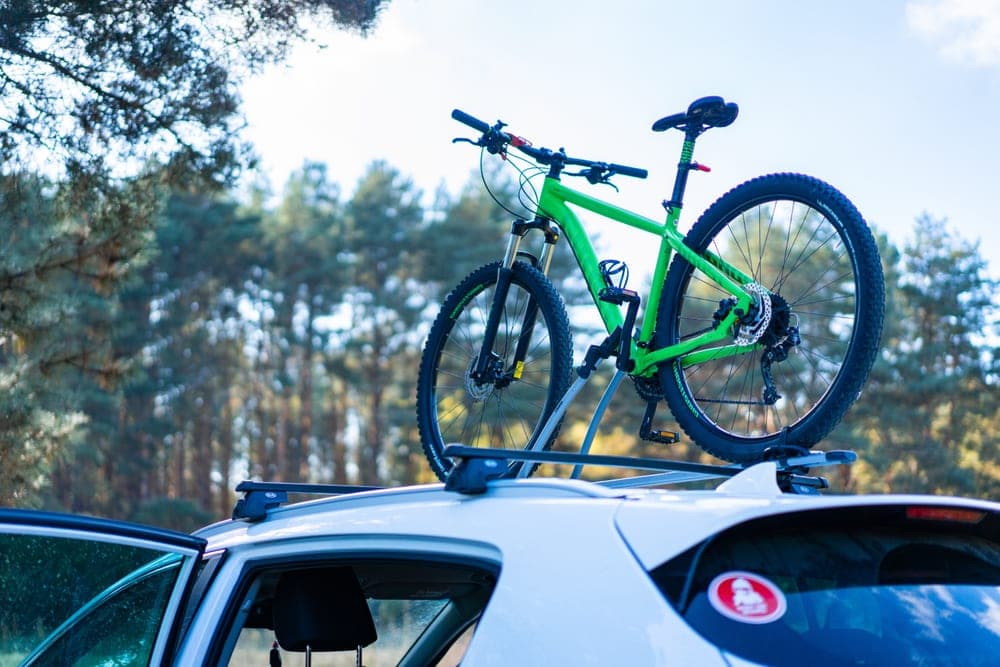
| 3 | Yakima HighRoadKeeps the back of the car free and never touches the frame — at the cost of an overhead lift and real fuel. | The roof route | 7.6 |
Prices checked September 25, 2026. Product photographs are representative stock images, not the exact unit. Affiliate disclosure.
#1 · The hitch route
Kuat Sherpa 2.0
Best loading, best capacity, best on fuel — and the only one that needs a receiver you may not have.
- Loading height
- Knee height
- Frame contact
- None
- Capacity
- 2, expandable on some racks
- Needs
- 2-inch receiver
What works
- Easiest loading of the three by a wide margin
- No frame contact and no overhead lift
- Least fuel penalty of the three
What doesn’t
- Needs a receiver
- Highest up-front cost
- Blocks the tailgate unless tilted
Our scoring
8.0overall
#2 · The trunk route
Saris Bones EX
Cheapest, most universal, stores in a closet — and asks the most care of your paint and your frame shape.
- Loading height
- Waist height
- Frame contact
- Top tube
- Capacity
- Up to 3
- Needs
- Nothing
What works
- By far the lowest cost of entry
- Fits cars that have nothing to mount to
- Folds flat for storage
What doesn’t
- Straps and pads sit on paint
- Bikes hang by the top tube
- Trunk inaccessible while loaded
Our scoring
7.7overall
#3 · The roof route
Yakima HighRoad
Keeps the back of the car free and never touches the frame — at the cost of an overhead lift and real fuel.
- Loading height
- Above head height
- Frame contact
- None
- Capacity
- 1 per carrier
- Needs
- Crossbars
What works
- Tailgate and trunk stay completely usable
- Nothing touches the frame
- Bikes are out of the way when reversing
What doesn’t
- Lifting a bike overhead, every time
- Highest fuel penalty of the three
- Garage clearance becomes a genuine hazard
Our scoring
7.6overall
The three, side by side
Cost. Trunk is cheapest by a distance. Roof is cheap if you already have crossbars and expensive if you do not. Hitch is the most expensive up front and the best value if you carry bikes often.
Loading. Hitch is easiest — knee height, no lift. Trunk is a waist-height lift onto arms. Roof is an overhead lift, which rules it out for some people entirely and for heavier bikes generally.
Capacity. Hitch platforms take two and expand to four. Trunk racks take two to three. Roof carriers take one per crossbar position, so two or three depending on bar length — and each one costs you again.
Fuel. Roof is worst, because the bike sits in clean air at the highest point of the car. Hitch is best, because the bikes sit in the low-pressure wake behind the vehicle. Trunk is between the two. Our fuel guide covers what the published testing found.
Access. Roof leaves the tailgate completely free. Hitch racks tilt, which is a step but a quick one. Trunk racks must come off, which in practice means the trunk is closed for the trip.
How to decide in two minutes
Answer these in order and you will usually have your answer.
- Do you have a 2-inch receiver? If yes and you carry bikes more than a few times a year, buy a hitch platform rack and stop reading.
- Do you already have crossbars? If yes and you can lift a bike overhead, a roof carrier is cheap and keeps the back of the car free.
- Neither? A trunk rack is the answer. It is not a compromise so much as the product designed for your situation.
- E-bikes? Hitch only. The weight rules out the other two — see our e-bike picks.
The mistakes people make with each
Hitch: buying the rack before checking the receiver’s size and tongue weight rating.
Trunk: fitting over a dirty car, and not buying a top tube adapter for a frame that needs one.
Roof: driving into a garage. It happens to almost everyone eventually, and it is expensive in a way the other two are not. Put a note on the dashboard.
Common questions
Which bike rack is best?
Which bike rack uses the least fuel?
Can I use a roof bike rack on any car?
Sources
Not sure it fits your car?
Our vehicle pages carry the published roof load limit, the roof type by model year, and what actually mounts to it — cited, and honest about what the manufacturer does not publish.
Read next
The Best Hitch Bike Racks
Platform hitch racks ranked on fit range, weight rating, loading and security.
The Best Bike Racks Without a Hitch
Trunk racks and roof carriers for cars with no receiver, and what each costs your paint.
Do Roof Racks Affect Gas Mileage?
What the published tests measured, why an empty rack still costs you, and how to cut the loss.
The Best Bike Racks for Electric Bikes
Racks rated for e-bike weight, ramps that remove the lift, and the hitch arithmetic to do first.