Bike Racks
The Best Mountain Bike Racks
Dropper posts, carbon frames and 2.6 inch tires broke the old clamp-the-top-tube racks. These are the carriers that hold a modern mountain bike by its wheels instead.
Roof & Route is funded by affiliate commission. If you buy through a link on this page we may earn a commission at no extra cost to you. It never decides what we recommend or the order we recommend it in — read the full disclosure.
For most mountain bikers the pick is the Kuat Piston Pro X: hydraulic pistons clamp the tires, so nothing touches the frame, and loading is faster than anything else in the category. If that is more rack than your budget wants — and it is a lot of rack — the Thule T2 Pro XTR does the same job for less, and the RockyMounts MonoRail does it for less again.
The reason this page exists separately from our general hitch bike rack roundup is that mountain bikes broke the assumptions the old racks were built on. A rack that clamps the top tube assumes there is a straight, round, metal top tube to clamp. On a modern trail bike there often is not: the tube is shaped, it may be carbon, and the seatpost it sits near is a dropper with internal hydraulics you do not want a strap arm loading.
So the first filter is not price or capacity. It is does this rack touch the frame at all. Every pick below except one holds the bike by its wheels. The four numbers that decide the rest — tire width, wheelbase, wheel size and weight per bike — are in the section under the picks, and they are worth two minutes with a tape measure before you spend anything.
Quick picks
Tap any row to jump to the full write-up below. Scores are our editorial judgment on published specifications — not a star rating, and not a product we claim to have tested.
| # | Product | Best for | Score | Price |
|---|---|---|---|---|
| 1 | 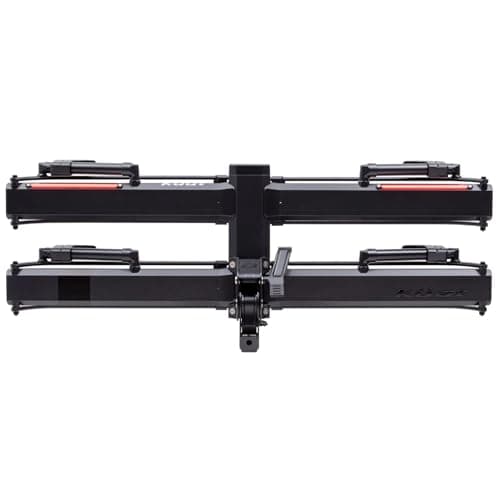 Kuat Piston Pro XHydraulic pistons that clamp the tires rather than the frame — the fastest loading in the category, and the most relaxed thing you can buy if your bike is carbon. | Best overall for modern trail bikes | 8.7 | |
| 2 | 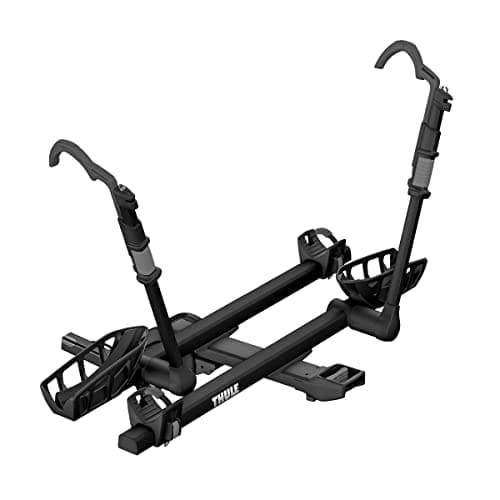 Thule T2 Pro XTRPublished for tires up to 5 inches and wheelbases to 50 inches, with no frame contact and a tilt lever that works loaded — the default answer for a reason. | Widest tire range without adapters | 8.5 | |
| 3 | 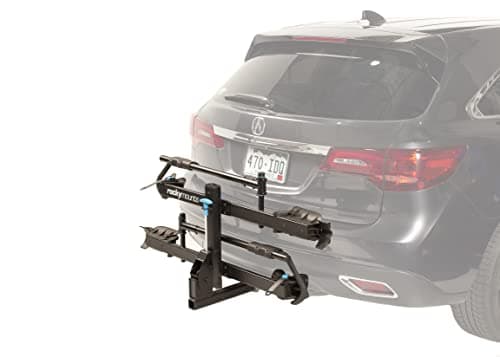 RockyMounts MonoRailA front-wheel-mount platform whose own listing names road, mountain, fat tire and e-bikes — the cheapest rack here that never touches a frame. | Best value frame-free rack | 8.3 | |
| 4 | 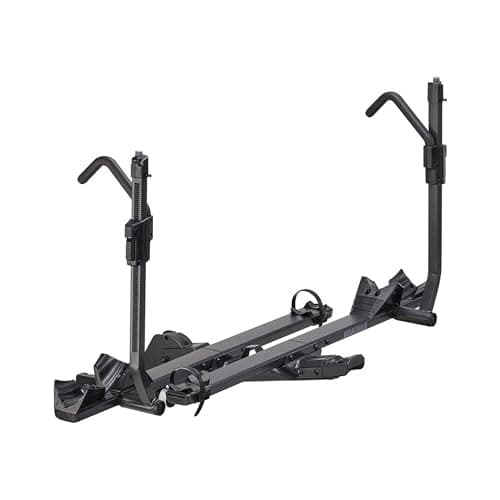 Yakima StageTwo70 lb per bike is the highest rating of the mainstream platform racks, which is what puts a full-power e-MTB on a rack that is not e-bike-specific. | Heavy bikes and e-MTBs | 8.6 | |
| 5 | 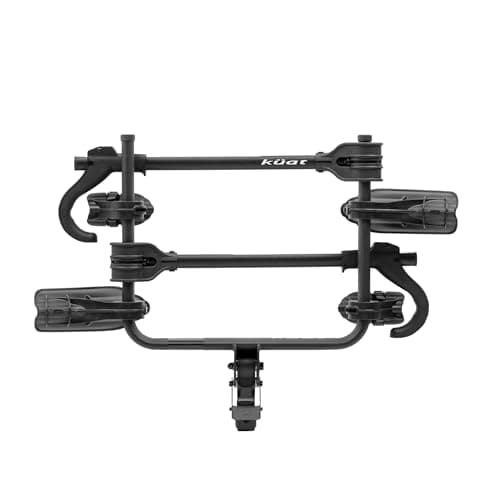 Kuat Transfer v2Steel instead of aluminum keeps the price down, and the add-on takes it to three bikes — the sensible family answer rather than the enthusiast one. | Cheapest way into a Kuat platform | 7.8 | |
| 6 | 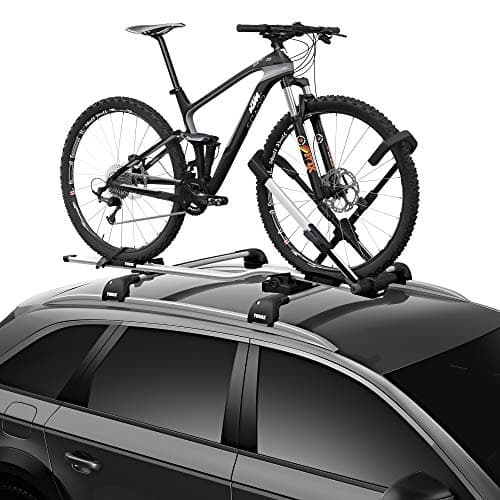 Thule UpRideA roof tray that clamps the front wheel and never contacts the frame, for 20 to 29 inch wheels — the answer when the car has crossbars but no receiver. | No hitch, one bike, frame-free | 7.7 |
Prices checked October 17, 2026. Product photographs come from Amazon and are refreshed with the prices. Affiliate disclosure.
#1 · Best overall for modern trail bikes
Kuat Piston Pro X
Hydraulic pistons that clamp the tires rather than the frame — the fastest loading in the category, and the most relaxed thing you can buy if your bike is carbon.
- Type
- Platform, 2 bikes
- Clamping
- Hydraulic tire clamps, no frame contact
- Receiver
- 2 inch
- Extras
- Integrated lighting available
- Finish
- Kashima-coated pistons
What works
- Nothing touches the frame, so carbon, odd tube shapes and dropper posts are all a non-issue
- The fastest rack here to load once it is set up — one motion per wheel
- Handles a very wide range of wheel and tire sizes without adapters
- Build and security hardware are the best in the category
What doesn’t
- By far the most expensive rack on this page
- Heavy enough that fitting it to the hitch single-handed is a genuine lift
- 2 inch receiver only, so a Class I or II car is out
- Stock on the live listing is routinely thin, so it is not always a same-week purchase
Our scoring
8.7overall
#2 · Widest tire range without adapters
Thule T2 Pro XTR
Published for tires up to 5 inches and wheelbases to 50 inches, with no frame contact and a tilt lever that works loaded — the default answer for a reason.
- Type
- Platform, 2 bikes
- Tire width
- Up to 5"
- Wheelbase
- Up to 50"
- Wheel size
- 20 - 29"
- Per-bike rating
- 60 lb on a 2" receiver, 50 lb on 1.25"
- Rack weight
- 52 lb
What works
- 5 inch tire clearance covers plus-size and fat bikes with nothing bought extra
- Sold in both 1.25 and 2 inch versions, which few frame-free racks are
- Tilts away from the car on a lever you can reach with bikes loaded
- Mature design with the deepest spares and dealer support in the category
What doesn’t
- 60 lb per bike is the lowest ceiling of the hitch racks here — a heavy e-MTB will exceed it
- 52 lb of rack to lift onto the hitch, and it does not get lighter
- Premium price, and the four-bike add-on is a second premium purchase
- The 1.25 inch version drops to 50 lb per bike, which is tight for a long-travel bike
Our scoring
8.5overall
#3 · Best value frame-free rack
RockyMounts MonoRail
A front-wheel-mount platform whose own listing names road, mountain, fat tire and e-bikes — the cheapest rack here that never touches a frame.
- Type
- Platform, 2 bikes
- Clamping
- Front wheel mount, no frame contact
- Tire width
- Up to about 5 inches
- Receiver
- 2 inch
- Expansion
- Add-on available for a third bike
What works
- Frame-free holding at a price well under the premium three
- Takes wide tires natively rather than through an adapter kit
- Straightforward, serviceable build with no fragile cleverness
- Usually the best-stocked of the frame-free racks
What doesn’t
- Hardware and finish are a visible step below Kuat and Thule
- The tilt mechanism is cruder and needs more room to operate
- Smaller dealer network if you need a part in five years
- No 1.25 inch option
Our scoring
8.3overall
#4 · Heavy bikes and e-MTBs
Yakima StageTwo
70 lb per bike is the highest rating of the mainstream platform racks, which is what puts a full-power e-MTB on a rack that is not e-bike-specific.
- Type
- Platform, expandable
- Per-bike rating
- 70 lb
- Receiver
- 2 inch
- Weight
- About 66 lb
- Locks
- SKS locks, tilt lever
What works
- The highest per-bike ceiling here, by 10 lb over the Thule
- Staggered trays stop two sets of wide bars fighting each other
- Expandable, so a third and fourth bike does not mean a new rack
- Tilts far enough for most tailgates with bikes on
What doesn’t
- About 66 lb, which is the heaviest rack on this page to fit and store
- 2 inch receiver only
- Physically large — behind a small crossover it is very obvious
- The 4-bike configuration needs a properly rated Class III hitch, not just a 2 inch hole
Our scoring
8.6overall
#5 · Cheapest way into a Kuat platform
Kuat Transfer v2
Steel instead of aluminum keeps the price down, and the add-on takes it to three bikes — the sensible family answer rather than the enthusiast one.
- Base
- 2 or 3 bikes
- Material
- Steel
- Clamping
- Front wheel arm
- Receiver
- 2 inch
- Expansion
- Add-on available
What works
- The cheapest route into Kuat's platform range
- Steel construction shrugs off trailhead parking lot abuse
- Expandable rather than a fixed two-bike dead end
- Tamper-resistant mounting hardware as standard
What doesn’t
- Heavier than the aluminum racks, which costs you tongue weight
- Fewer refinements — the arm needs a firmer hand than the Piston's pistons
- Tire clearance is narrower than the T2 Pro XTR or MonoRail
- Tops out below four bikes in some configurations
Our scoring
7.8overall
#6 · No hitch, one bike, frame-free
Thule UpRide
A roof tray that clamps the front wheel and never contacts the frame, for 20 to 29 inch wheels — the answer when the car has crossbars but no receiver.
- Type
- Roof tray, 1 bike
- Clamping
- Front wheel arm, no frame contact
- Wheel size
- 20 - 29"
- Needs
- Crossbars
- Wheel removal
- Not required
What works
- Frame never touches the carrier, same as the good hitch racks
- Bike goes on complete — no wheel off, no fork mount faff
- Leaves the tailgate and the hitch free for everything else
- Fits fat tires and full-suspension frames without an adapter
What doesn’t
- You are lifting a 35 lb trail bike over your head, repeatedly
- Needs crossbars, which is a real cost if the car has none
- One bike per carrier, so a second bike doubles the bars you need
- Garage clearance becomes a live, expensive issue
Our scoring
7.7overall
Why frame clamps stopped working
The cheap, universal bike rack design holds a bike by its top tube. An arm reaches out from the mast, a cradle sits under the tube, a strap goes over. It is a design from an era when every bike had a straight steel or aluminum top tube in roughly the same place.
A current mountain bike breaks that in three ways at once. The top tube is often dramatically sloped and shaped, so a cradle meant for a round tube contacts on an edge. The frame may be carbon, where a clamping load in the wrong place is a repair bill rather than a scratch. And the seatpost is a dropper — a hydraulic cartridge with a cable or hose running into it — which is the last thing you want a strap arm pressing against while the car moves.
There is a fourth, less dramatic problem: full-suspension bikes do not hang level. A bike slung by its top tube on a hanging rack swings, and the thing it swings into is the next bike, or your tailgate.
The racks on this page all solve it the same way — they hold wheels. A tray takes the weight, and either an arm reaches over the front tire or a clamp closes onto it. Nothing loads the frame, the bike sits where you put it, and a carbon frame is no longer something you think about on every drive.
The exception worth naming honestly: a hanging trunk rack is still the cheapest way to move a bike, and for a steel hardtail with a round top tube it is fine. Our no-hitch picks cover that route, and hitch vs trunk vs roof compares the three positions on cost, access and risk.
The four measurements that decide fit
Published rack specifications are unusually honest in this category, because they are mostly geometry. Four numbers decide whether your bike fits, and you can get all four in two minutes.
1. Tire width. Trail bikes now routinely run 2.4 to 2.6 inches, plus bikes 2.8 to 3.0, fat bikes 4 to 5. The T2 Pro XTR is published to 5 inches and the MonoRail’s own listing names fat tires; cheaper trays are often built around 2.5 inches and need an adapter kit beyond it. Measure the tire you actually run, not the one the bike shipped with.
2. Wheelbase. This is the one people skip, and it is the one that bites on long modern enduro bikes. A size XL 29er with a slack head angle can run past 50 inches from axle to axle — the T2 Pro XTR’s published maximum. Measure center of front axle to center of rear axle.
3. Wheel size. Most trays publish a 20 to 29 inch range, which covers everything from a kid’s bike to a 29er. It matters if you are carrying a 16 or 18 inch kid’s bike, which can fall through or sit badly in a tray built for adult wheels.
4. Weight per bike. A modern alloy full-suspension trail bike is often in the 32-37 lb range and a full-power e-MTB can be 50-55 lb. The T2 Pro XTR’s published 60 lb per bike on a 2 inch receiver covers the first comfortably and the second with little margin; the StageTwo’s 70 lb is the one with headroom. Weigh your bike — bathroom scales, hold bike, subtract — rather than trusting a catalog figure.
Then one number that is about your car rather than your bike: the total the rack plus bikes puts on the receiver. Hitch carrier weight limits explains why the tongue rating, not the rack rating, is the one that binds, and hitch classes explained covers which receivers can take a four-bike setup at all.
Shuttle days, mud and the trailhead
Specs decide what fits. These are the things that decide whether you are still happy with the rack in year three.
Tilt that works loaded. Every rack here tilts. What varies is whether you can operate the lever with two bikes on and the car on a slope, and how much clear space behind the car the tilt needs. At a busy trailhead you often do not have that space. The T2 Pro XTR’s lever and the StageTwo’s are reachable without crouching under a bike; cheaper mechanisms usually are not.
Mud and grit in the mechanism. A rack that lives on the car through a winter collects everything the road throws. Hydraulic and ratchet mechanisms both survive it; what kills them is salt left on over a summer. Rinse the rack when you rinse the bike.
Security is a delay, not a defense. Integrated cable locks and a locking hitch pin stop an opportunist walking off with a bike at a gas station. They do not stop anybody with a cable cutter and thirty seconds. Treat the lock as the reason not to leave bikes on the rack overnight, rather than permission to.
Pedals, bars and the car behind. Two bikes facing opposite ways on a non-staggered tray will fight over handlebar space, and the fix is turning one bar set or buying a rack with staggered trays in the first place. Check the rear bike’s pedal position relative to your taillights before the first drive.
The rack’s own weight. Fifty-plus pounds of rack is a two-handed lift at an awkward height. If it is going on and off frequently, that matters as much as any spec on the box — and it is the quiet argument for leaving a platform rack on the car and accepting the fuel cost, which our mpg guide quantifies for the roof and explains for the hitch.
If the car has no receiver
Everything above except the UpRide needs a hitch, and plenty of cars do not have one. Three honest options, in the order we would consider them.
- Fit a hitch. Unglamorous, and usually the right answer if you will carry bikes for years. A receiver is also what every other carrier on this site mounts to, so it is not a single-purpose purchase.
- Roof tray, frame-free. The Thule UpRide clamps the front wheel and takes the complete bike, so the frame stays untouched — the same principle as the good hitch racks, at the cost of lifting a trail bike over your head and losing garage clearance forever. Our roof rack picks cover the rest of that category.
- Hanging trunk rack, with caveats. Cheapest by far, and genuinely fine for a hardtail with a round metal top tube. For a carbon full-suspension bike with a dropper, it is the one we would not use.
If the bikes are electric rather than analog, the ceiling moves again and the picks change — the e-bike roundup is the page for that, because a 70 lb bike eliminates most of this list on weight alone.
Common questions
What is the best rack for a carbon mountain bike?
Will a mountain bike rack take fat tires?
How long a bike will fit on a platform rack?
Can I put an e-MTB on these racks?
Hitch or roof for mountain bikes?
Do I need a Class III hitch for a bike rack?
Sources
Not sure it fits your car?
Our vehicle pages carry the published roof load limit, the roof type by model year, and what actually mounts to it — cited, and honest about what the manufacturer does not publish.
Read next
Thule T2 Pro XTR Review
What the T2 Pro XTR's published figures actually mean for your bike, and the two racks that beat it on weight ceiling and on price.
The Best Hitch Bike Racks
Platform hitch racks ranked on fit range, weight rating, loading and security.
The Best Bike Racks for Electric Bikes
Racks rated for e-bike weight, ramps that remove the lift, and the hitch arithmetic to do first.
Hitch vs Trunk vs Roof Bike Rack
The three ways to carry a bike, compared on cost, loading, capacity and fuel.