Bike Racks
Thule T2 Pro XTR Review
The platform rack this site keeps ranking near the top — reviewed properly, including the weight ceiling that rules it out for e-bikes and the two rivals that beat it on specific jobs.
Roof & Route is funded by affiliate commission. If you buy through a link on this page we may earn a commission at no extra cost to you. It never decides what we recommend or the order we recommend it in — read the full disclosure.
The Thule T2 Pro XTR is the rack most people end up comparing everything else against, and the reason is not marketing. It holds bikes by their wheels rather than their frames, it is published for tires up to 5 inches, and it is sold in both 1.25 and 2 inch receiver versions — a combination surprisingly few racks offer at once.
It is also expensive, 52 lb to lift onto a hitch, and capped at 60 lb per bike. Those three facts are what this review is about, because the useful question is never “is it good.” It is which specific buyer should spend this much, and which should buy something else.
Short version: if you carry normal bikes — analog trail bikes, gravel bikes, kids’ bikes, a fat bike — and you want one rack to still be working in ten years, this is the one. If your bikes are electric, the ceiling will catch you. If you want the same frame-free holding for substantially less, there is a rack that does it.
Quick picks
Tap any row to jump to the full write-up below. Scores are our editorial judgment on published specifications — not a star rating, and not a product we claim to have tested.
| # | Product | Best for | Score | Price |
|---|---|---|---|---|
| 1 | 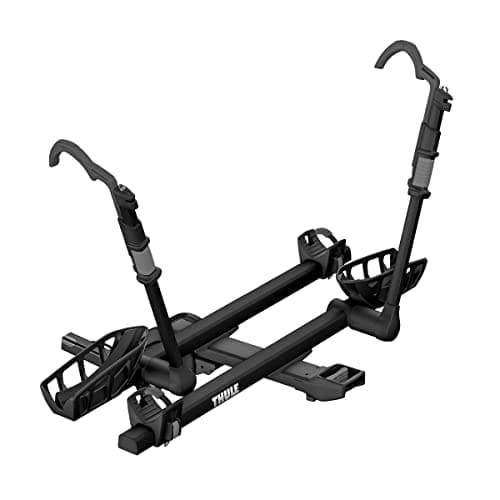 Thule T2 Pro XTRFrame-free holding, a 5 inch tire allowance and both receiver sizes — the most broadly capable mainstream platform rack, as long as no bike on it is over 60 lb. | Riders with varied, non-electric bikes | 8.5 |
Prices checked October 17, 2026. Product photographs come from Amazon and are refreshed with the prices. Affiliate disclosure.
#1 · Riders with varied, non-electric bikes
Thule T2 Pro XTR
Frame-free holding, a 5 inch tire allowance and both receiver sizes — the most broadly capable mainstream platform rack, as long as no bike on it is over 60 lb.
- Type
- Platform, 2 bikes
- Capacity
- 120 lb total on 2" (60 lb per tray); 100 lb on 1.25" (50 lb per tray)
- Tire width
- Up to 5"
- Wheelbase
- Up to 50"
- Wheel size
- 20 - 29"
- Rack weight
- 52 lb
- Bike spacing
- 12.5"
What works
- No frame contact at all — the bike is held by its wheels
- 5 inch tire allowance covers plus and fat tires with nothing bought extra
- Offered for both 1.25 and 2 inch receivers, which most frame-free racks are not
- Tilts away from the vehicle on a lever you can reach with bikes loaded
- Bikes lock to the rack and the rack locks to the receiver as standard
- Integrated wheels for moving it around the garage, which at 52 lb is not a gimmick
What doesn’t
- 60 lb per bike on a 2 inch receiver, and only 50 lb on the 1.25 inch version — an e-MTB will exceed it
- 52 lb is a heavy, awkward lift onto a hitch at bumper height
- Expensive, and the two-bike add-on to reach four is a second expensive purchase
- 12.5 inch spacing still means handlebars negotiate with each other on wide-bar bikes
- A dedicated e-bike rack or the Yakima StageTwo beats it outright on weight ceiling
Our scoring
8.5overall
What the published numbers actually mean
Thule publishes the figures that decide this purchase, which is more than many brands in this category do. Here is what each one means in practice rather than on a spec sheet.
120 lb total, 60 lb per tray, on a 2 inch receiver. On the 1.25 inch version that drops to 100 lb total and 50 lb per tray. The per-tray figure is the one to read. Two 35 lb alloy trail bikes are comfortably inside it. One 55 lb e-MTB is not comfortably inside anything, and on the 1.25 inch version it is simply over the limit.
Tire width up to 5 inches. This is the specification that quietly earns the price. Most racks are built around a 2.5 inch tire and sell a fat-bike adapter kit. The XTR takes a 2.6 inch trail tire, a 3.0 inch plus tire and a 4.8 inch fat tire on the same tray with no parts bought and nothing swapped.
Wheelbase up to 50 inches. Measure axle center to axle center. Most bikes are nowhere near it; a size XL modern enduro bike can be. This is the single most common reason a rack that “should fit” does not.
Wheel size 20 to 29 inches. Covers a 20 inch kid’s bike through a 29er. Smaller kids’ bikes — 16 and 18 inch wheels — are outside the published range and sit badly in the tray.
52 lb rack weight, 12.5 inch bike spacing. The first is what you lift. The second is the gap between bikes, and it is why two bikes with 800 mm bars still need one turned or offset. Thule fits integrated wheels so you can roll the rack around a garage rather than carry it, which matters more than it sounds like it should.
The frame-free thing is the point
The XTR holds each bike by its front wheel. An arm comes up and over the tire, ratchets down onto it, and a strap secures the rear wheel in the tray. At no point does anything contact the frame.
On a steel hybrid this is a nicety. On a modern mountain bike it is the product: a carbon frame has places where a clamping load is a repair, a sloping shaped top tube gives a cradle nothing flat to sit on, and a dropper post is a hydraulic cartridge you do not want a strap arm pressed against for four hours of highway vibration.
It also removes the per-bike fiddling that makes people abandon a rack. There is no “which adapter bar do I need for the full-suspension one.” Every bike loads the same way, which means the teenager can load their own bike without supervision.
The trade is loading height and lifting. The bike has to come up onto a tray at roughly knee height and the front wheel has to go where the arm expects it. That is still dramatically easier than a roof rack, but it is not nothing with a heavy bike — our comparison of the three positions covers how that scales with bike weight.
The 60 lb ceiling, and who it rules out
This is the honest weakness, and it is worth being blunt about because it is the single most common reason to buy a different rack.
Sixty pounds per bike on a 2 inch receiver sounds generous until you price up what people are actually carrying. A full-power e-MTB with a 750 Wh battery sits in the low fifties, and a heavy cargo-style e-bike can be in the seventies. Add a water bottle, a frame bag and a lock and you are at or past the number on a rack that costs as much as a wheelset.
On the 1.25 inch version it is worse: 50 lb per tray rules out most electric bikes outright and leaves little room on a long-travel analog bike with heavy rubber.
Two racks solve this directly. The Yakima StageTwo publishes 70 lb per bike — ten pounds is the difference between “within spec” and “hoping nobody weighs it.” A purpose-built e-bike carrier goes further still and usually adds a ramp, which is the other thing a 55 lb bike makes you want. Our e-bike rack picks cover that properly.
And a reminder that applies to every rack on this site: the per-bike rating is the rack’s limit, not your car’s. Rack plus bikes has to sit inside your vehicle’s tongue weight rating too, which the hitch weight limits guide works through.
Living with 52 pounds of rack
Spec sheets do not capture the part of rack ownership that actually wears on you, which is handling the rack itself when there are no bikes involved.
Fifty-two pounds, held at arm’s length, lined up with a receiver at bumper height, is a genuinely awkward lift. Most owners solve it by leaving the rack on the car — which is fine, costs some fuel, and means the folded rack is part of your parking geometry permanently. The integrated wheels help with the garage half of the problem.
The tilt lever is the feature you use every single trip, and it is one of the better ones in the category: reachable with bikes loaded, without crouching under a top tube. Check that you have clear space behind the car before you rely on it at a trailhead, because tilt needs room the parking space may not have.
Locks are built in — bikes to the rack, rack to the receiver. Treat them as what they are: enough delay to protect a coffee stop, not enough to leave bikes on a rack overnight at a motel.
The long-game argument for buying Thule at this price is spares. This is a mature design with a deep dealer and parts network, and the parts that wear — straps, knobs, lower assemblies — are orderable years later. If a rack is a decade-long purchase, that is worth real money, and it is the part that cheaper racks genuinely do not match.
What to buy instead, and when
Three honest alternatives, each of which beats the XTR at something specific.
Kuat Piston Pro X — if you want faster and do not mind the price. Hydraulic pistons clamp the tire rather than a ratcheting arm, which is quicker and even more tolerant of odd bikes. It costs considerably more and is a heavier lift. We rank it first for mountain bikes in the mountain bike rack roundup.
Yakima StageTwo — if any bike is heavy. Seventy pounds per bike, staggered trays so wide bars do not fight, and expandable. It is around 66 lb itself and 2 inch receiver only, but if the weight ceiling is your binding constraint, the decision is already made.
RockyMounts MonoRail — if you want the same principle for less. Front-wheel mount, no frame contact, wide tires, add-on available for a third bike. The hardware and finish are a step down and the tilt is cruder, but it does the actual job for a lot less money.
And the case for sticking with the XTR: you have a mixed garage of non-electric bikes, you want one rack rather than a rack per bike type, and you intend to keep it long enough that parts availability is a real consideration. That is a large share of families, and it is why this rack keeps winning roundups.
Verdict
The T2 Pro XTR is the most broadly capable mainstream platform rack you can buy, and the only thing stopping it being a blanket recommendation is weight — both the 60 lb per bike it accepts and the 52 lb it weighs.
Buy it if you carry two non-electric bikes of varied shapes and sizes, you value a rack that never touches a frame, and you want the parts network that comes with the brand. The 1.25 inch version exists, which makes it one of the few genuinely good frame-free options for a car with a smaller receiver — just respect the lower 50 lb per-tray figure.
Do not buy it if any bike in your household is electric, if your budget would be better spent on a MonoRail plus something else, or if you need four bikes on day one — in which case price the complete four-bike setup before you commit, because the add-on changes the sum substantially. Our four-bike picks compare that route against the alternatives.
Common questions
How much weight can the Thule T2 Pro XTR carry per bike?
Does the T2 Pro XTR fit fat bikes?
Is there a 1.25 inch version of the T2 Pro XTR?
Can you carry four bikes on a T2 Pro XTR?
Will the T2 Pro XTR carry an e-bike?
How heavy is the Thule T2 Pro XTR itself?
Sources
Not sure it fits your car?
Our vehicle pages carry the published roof load limit, the roof type by model year, and what actually mounts to it — cited, and honest about what the manufacturer does not publish.
Read next
The Best Mountain Bike Racks
Frame-free platform racks ranked on tire width, wheelbase, per-bike weight and loading, with the roof option for cars with no receiver.
The Best Hitch Bike Racks
Platform hitch racks ranked on fit range, weight rating, loading and security.
Kuat vs Thule vs Yakima Bike Racks
Three premium platform brands compared on rating, fit range, loading and price.
The Best Bike Racks for 4 Bikes
Racks that genuinely take four bikes, and the tongue weight and overhang limits that bite first.