Guides
Buying Your First Roof Rack: The Order to Do It In
Nobody buys a roof rack. They buy rails or feet, then bars, then straps, then a carrier — and doing it out of order is what makes it expensive.

Roof & Route is funded by affiliate commission. If you buy through a link on this page we may earn a commission at no extra cost to you. It never decides what we recommend or the order we recommend it in — read the full disclosure.
The direct answer: a first roof rack is four purchases in a fixed order — the thing that attaches to the car, the bars, the straps, then the carrier. Buy them in that order and each one constrains the next correctly. Buy the carrier first, which is what everyone does, and you will end up with a box that does not fit the bars you then buy.
Start by establishing what your car has, because that decides purchase one and nothing else does. Go outside and look along the roof edge. A rail with a gap you can hook a finger under is a raised rail — the easiest case, and nearly every system has a rail-mount kit for it. A rail sitting flat on the roof with no gap is a flush rail, which needs a different and non-interchangeable part. No rail at all is a bare roof, which needs a clamp-on foot pack plus a vehicle-specific fit kit — workable, just pricier.
The second thing to understand before you spend anything: rails and bars are different objects doing different jobs. Side rails run front to back and carry nothing on their own. A carrier needs bars running side to side. “My car already has roof rails” usually means you still need crossbars, and that is the most common misunderstanding in this whole category.
The picks below are the honest starting points at three budgets, plus the one accessory worth buying before any carrier. After them, the sequence in full and the two things beginners reliably overbuy.
Quick picks
Tap any row to jump to the full write-up below. Scores are our editorial judgment on published specifications — not a star rating, and not a product we claim to have tested.
| # | Product | Best for | Score | Price |
|---|---|---|---|---|
| 1 | 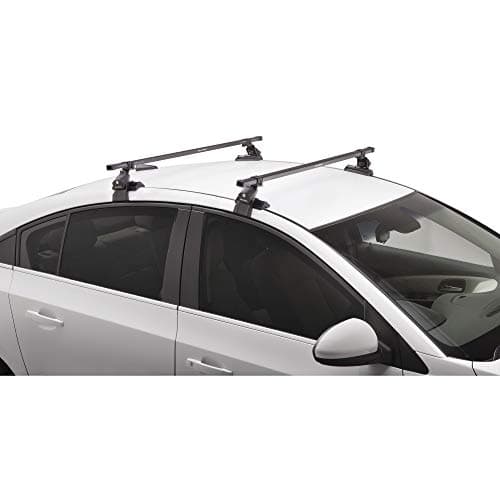 SportRack Complete Roof Rack SystemAn all-in-one kit for a car that already has raised side rails — one purchase, nothing to get wrong, and the lowest price we would recommend. | Cheapest honest first bars | 7.4 | |
| 2 | 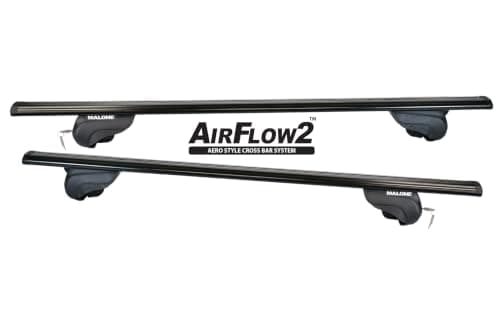 Malone AirFlow2A complete aero crossbar system at well under brand-name money, designed around boats — the sweet spot for a first proper rack. | Best first aero system | 7.7 | |
| 3 | 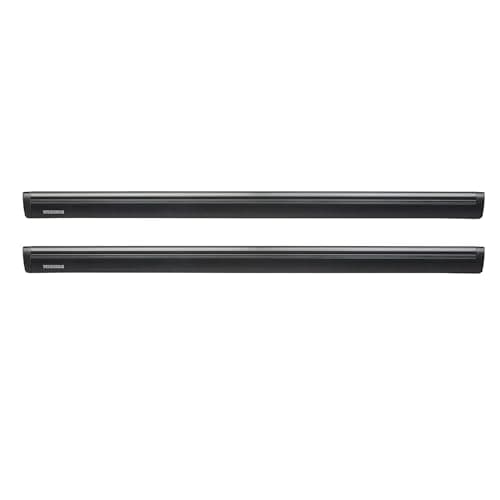 Yakima JetStreamA wing bar with a full-length top channel and a tower range covering every rail type — the interface worth buying into if you expect to add carriers. | Best bars to grow into | 8.4 | |
| 4 | 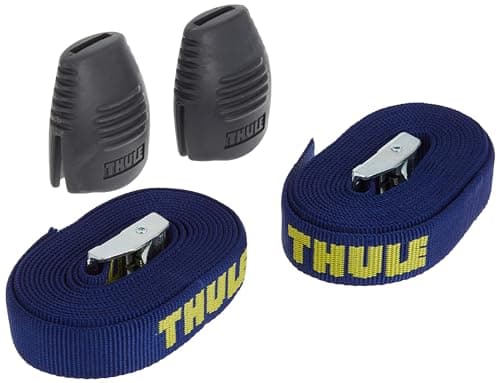 Thule Load StrapsCam straps with a rubber buckle guard, sized for roof-rack loads — hand tension only, which is exactly right over a painted roof or a hull. | Buy these before any carrier | 8.4 |
Prices checked October 12, 2026. Product photographs come from Amazon and are refreshed with the prices. Affiliate disclosure.
#1 · Cheapest honest first bars
SportRack Complete Roof Rack System
An all-in-one kit for a car that already has raised side rails — one purchase, nothing to get wrong, and the lowest price we would recommend.
- Type
- Complete crossbar kit
- Requires
- Raised side rails
- Brand
- Thule's value label
- Includes
- Bars and rail-mount feet
What works
- One order gets you from bare rails to usable bars
- No separate foot pack or fit kit to choose incorrectly
- Backed by Thule's value brand rather than an anonymous seller
- Cheap enough that it is not a painful mistake if you later want aero bars
What doesn’t
- Noisier and heavier than any aero bar
- Lower rating than the premium bars — check it against your intended load
- Limited accessory compatibility compared with Thule or Yakima proper
- Useless if you have flush rails or a bare roof
Our scoring
7.4overall
#2 · Best first aero system
Malone AirFlow2
A complete aero crossbar system at well under brand-name money, designed around boats — the sweet spot for a first proper rack.
- Type
- Aero crossbar system
- Sold as
- Complete system, bars and feet together
- Brand focus
- Paddlesport
- Best for
- A first rack you will keep
What works
- Aero bars and feet in one order, so nothing is missing when it arrives
- An aero profile is a genuine step up in noise over any square bar
- Built around carrying boats, which is a common first use
- Cheaper than the equivalent Thule or Yakima build
What doesn’t
- Smaller accessory ecosystem than the big two
- Thinner long-term dealer and spares support
- Confirm fit for your exact model and year before ordering
Our scoring
7.7overall
#3 · Best bars to grow into
Yakima JetStream
A wing bar with a full-length top channel and a tower range covering every rail type — the interface worth buying into if you expect to add carriers.
- Type
- Wing-profile aluminum bar
- Interface
- Full-length top channel
- Sold as
- Fixed lengths plus a separate tower kit
- Accessory range
- Yakima's full catalog
What works
- Full-length channel means accessories slide anywhere along the bar
- Tower range covers raised rails, flush rails and bare roofs
- Deep accessory catalog, so one bar set serves bikes, boats and boxes
- Normally undercuts the Thule equivalent for the same job
What doesn’t
- Two purchases — bars and towers — and the towers are the part to get right
- Costs more than a complete budget kit
- Buying into one brand's accessory pricing for the life of the bars
Our scoring
8.4overall
#4 · Buy these before any carrier
Thule Load Straps
Cam straps with a rubber buckle guard, sized for roof-rack loads — hand tension only, which is exactly right over a painted roof or a hull.
- Type
- Cam buckle strap
- Guard
- Rubber buckle guard
- Tension
- Hand only, by design
- Fits
- Any bar, because it wraps rather than clamps
What works
- Makes bare bars immediately useful before you own a single carrier
- A cam buckle cannot over-tension the way a ratchet can
- Buckle guard stops metal marking paint or a hull
- Fits every bar interface, so it is never the wrong purchase
What doesn’t
- Hand tension is wrong for heavy rigid loads — use ratchets there
- Webbing degrades in sunlight over years
- Costs more than a generic strap for a guard and a known length
Our scoring
8.4overall
The four purchases, in order
| Order | What it is | What it decides | How to get it wrong |
|---|---|---|---|
| 1 | Foot pack, towers or rail kit | Whether anything attaches to your car at all | Ordering raised-rail parts for a flush-rail car |
| 2 | Crossbars | Which accessories you can ever buy, and how much noise you live with | Choosing on price and inheriting a dead-end interface |
| 3 | Cam straps | Whether the bars are useful before you own a carrier | Buying ratchets instead, and crushing something |
| 4 | One carrier | What you can actually haul | Buying it first, then finding it does not fit the bars you choose |
Steps one and two are often sold together as a “complete system” and that is a good thing for a first purchase: it removes the one decision beginners get wrong. The premium brands sell them separately because experienced owners want to mix bars and feet. If this is your first rack, a complete kit is not a compromise.
Do I need crossbars covers the rails-versus-bars question in full, and the rail type guide shows the three roofs with the test for each.
The two measurements to take before ordering
Both take a tape measure and two minutes, and both are the reason returns happen.
Bar length. Crossbars come in fixed lengths and the right one is set by your roof width, not by what you want to carry. Too long and it overhangs the car, catches your head and makes noise; too short and some carriers will not clamp. Measure across the roof between the rails and buy the length the fit guide gives for your vehicle.
Crossbar spread. Once the bars are on, measure center-to-center from the front bar to the rear bar. That number is what a cargo box’s mounting range has to cover and it is the figure the box manufacturer will ask you for. On rail-mount feet you can change it; on vehicle-specific flush-rail bars you largely cannot. The spread guide has the method and the failure modes.
A third number you should read rather than measure: your published roof load limit, in the manual. It is a total — bars, feet, carrier and cargo. Most crossovers publish 150-176 lb and some are much lower. Check yours on the fit pages and read the weight limits guide before you choose a carrier size.
The two things beginners overbuy
Carrier size. The instinct is to buy the biggest box that fits, and the constraint is weight rather than volume. A large hard box is already 40-50 lb empty, which on a 150 lb roof leaves under 100 lb for everything inside. A mid-size box that you fill is better than a large one you cannot legally load. The sizing guide works it through.
A second carrier. Buy one, use it for a season, and find out what actually annoys you. People who buy a box and a basket and a bike mount at once almost always use one of the three. The exception is straps — you cannot have too many straps and they are the cheapest part of the whole setup.
And one thing beginners underbuy: a wind fairing is not the first answer to noise. If the noise started when you fitted bars, check for an empty accessory mount left on the bar, a bar set too narrow, and end caps missing — all free to fix. The wind noise guide has the diagnosis order before you spend anything.
When not to buy a rack at all
Worth saying honestly on a page aimed at first-time buyers. Three cases where the answer is not a rack.
- Twice a year, soft bags. A waterproof roof bag works on a bare roof, costs a fraction of bars plus a box, weighs almost nothing and folds into a cupboard. The bag picks cover it, and soft roof racks cover the pads route for boards.
- Once, for one trip. Renting a box is cheaper than owning one and we did the arithmetic.
- The load is heavy rather than bulky. Coolers, tools, water, firewood. A roof is the wrong place and a bigger box does not help. If you have a 2-inch receiver, a hitch carrier is lower, easier to load and costs less fuel — the comparison is here.
If none of those three describe you, buy the bars. A rack is the purchase that turns one car into several, and the people who regret it are mostly the ones who bought the carrier first.
Common questions
What do I need to buy for my first roof rack?
My car already has roof rails. Do I still need crossbars?
Should I buy a complete kit or bars and feet separately?
What size cargo box should a first-time buyer get?
Sources
Not sure it fits your car?
Our vehicle pages carry the published roof load limit, the roof type by model year, and what actually mounts to it — cited, and honest about what the manufacturer does not publish.
Read next
Do I Need Crossbars for a Roof Rack?
Rails versus crossbars, how to tell what you have, and the one case where rails alone work.
Roof Rail Types: Flush, Raised, Fixed Point and Bare
Four roof types, the hand test that tells them apart, and which fit kit each needs.
What Size Crossbars Do I Need?
How to measure crossbar spread and length, and what each carrier type needs.
The Best Roof Racks for Cars Without Rails
Clamp-on systems for a bare roof, what a fit kit does, and the honest cost of getting started.