Kayak Racks
The Best J-Cradle Kayak Racks
A J-cradle halves the roof space a kayak uses and raises how high you have to lift it. That single trade decides whether this is your carrier or not.

Roof & Route is funded by affiliate commission. If you buy through a link on this page we may earn a commission at no extra cost to you. It never decides what we recommend or the order we recommend it in — read the full disclosure.
The verdict first. The J-cradle to buy is the Thule Hull-a-Port Pro, and it is also the cheapest pick on this page — it publishes a 75 lb load capacity, converts from a J for one boat to a stacker for two, arrives assembled, folds flat, and comes with the load straps and the bow and stern lines for one boat in the box. If loading is your sticking point, the Malone DownLoader is the one with a boarding ramp built into the cradle.
A J-cradle is a space decision before it is a boat decision. Standing a kayak on its side across your bars uses roughly half the width a flat saddle set needs. That is what lets a mid-size car carry two boats, or a boat and a bike, or a boat and a cargo box. If your roof only ever carries one kayak and nothing else, you are paying for a benefit you will not use.
What it costs you is lift height. The cradle holds the boat up at an angle, so the gunwale you have to clear sits higher than any saddle. On a sedan that is fine. On a tall crossover with a heavy plastic boat it is the single thing that decides whether the kayak gets used on a Tuesday evening or only on holiday.
On the figures below: every capacity, dimension and bar compatibility claim comes from the current Amazon listing for that exact part, read on 2026-11-28. One of these four carriers does not publish a load figure at all, and that is called out on its card rather than filled in from a sibling model.
Quick picks
Tap any row to jump to the full write-up below. Scores are our editorial judgment on published specifications — not a star rating, and not a product we claim to have tested.
| # | Product | Best for | Score | Price |
|---|---|---|---|---|
| 1 | 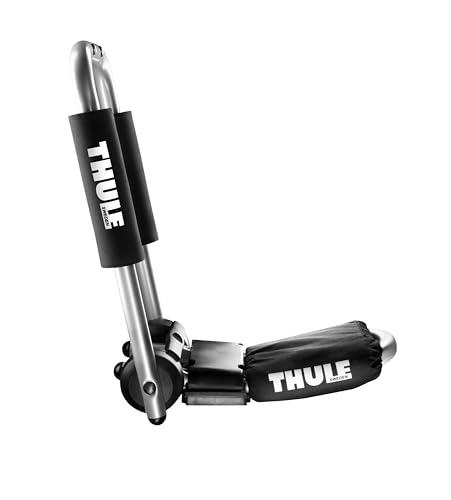 Thule Hull-a-Port ProThe value Hull-a-Port does everything the dearer one does, publishes the load figure the dearer one does not, and puts the straps and bow and stern lines in the box. | Best overall, and the budget pick | 8.7 | |
| 2 | 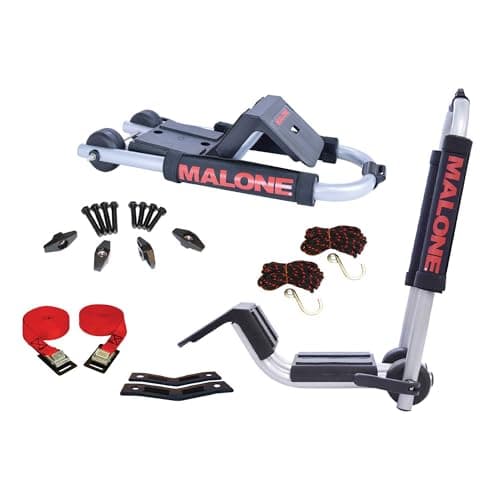 Malone DownLoaderA folding J-cradle with a boarding ramp built into the frame, so the hull has something to ride up rather than being cleared in one movement. | Easiest to load — the cradle has a boarding ramp | 8.5 | |
| 3 | 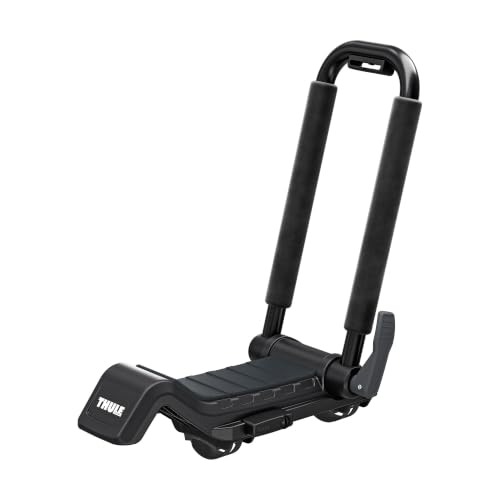 Thule Hull-a-Port XTRThe upmarket Hull-a-Port: same J-to-stacker conversion, plus strap management and the ability to lock to the load bars. The irritation is that it publishes no load figure. | Best if you want it locked to the bars | 8.2 | |
| 4 | 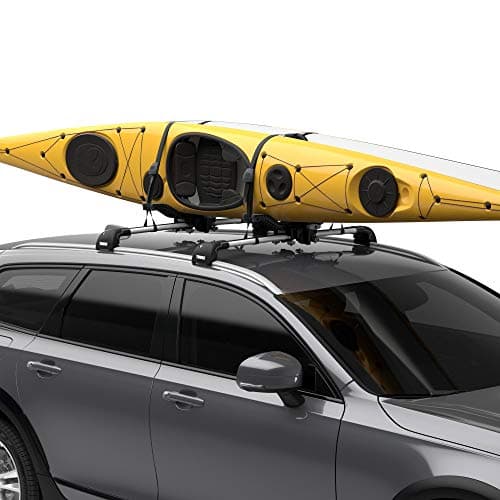 Thule CompassA four-mode carrier that does J, saddle, stacker and paddleboards, with the only published load figure on this page above 75 lb. | Best if you want a J and a saddle in one part | 8.3 |
Prices checked November 28, 2026. Product photographs come from Amazon and are refreshed with the prices. Affiliate disclosure.
#1 · Best overall, and the budget pick
Thule Hull-a-Port Pro
The value Hull-a-Port does everything the dearer one does, publishes the load figure the dearer one does not, and puts the straps and bow and stern lines in the box.
- Published load capacity
- 75 lb
- Positions
- J-cradle for one boat, stacker for two
- Mounting
- Universal, fits all types of load bars
- Included
- Load straps with buckle bumpers, bow and stern tie-downs for one boat
- Listed weight
- 10.07 lb
What works
- A published 75 lb load capacity, which two of the other three carriers here do not give you at any price
- Dual position: a J for one boat today, a two-boat stacker when the second kayak arrives, with no second purchase
- Universal mounting is published to fit all load bar types, so round factory bars are not a problem
- Straps, buckle bumpers and bow and stern lines for one boat are included, and it arrives fully assembled
What doesn’t
- Thule's One Key lock cylinders are sold separately, so it arrives with nothing securing it to the bars
- 75 lb is a real ceiling — a loaded fishing kayak can be at or over it
- No loading aid of any kind: this is a lift, and a J-cradle lift is the highest kind
- The straps supplied cover one boat, so carrying two means buying a second set
Our scoring
8.7overall
#2 · Easiest to load — the cradle has a boarding ramp
Malone DownLoader
A folding J-cradle with a boarding ramp built into the frame, so the hull has something to ride up rather than being cleared in one movement.
- Published load capacity
- 75 lb
- Loading aid
- Built-in boarding ramp
- Bar types
- Round, square and most factory oval rails (Jawz, 60 mm and 70 mm bolts)
- Dimensions
- 17 x 6 x 19.5 in
- Included
- Cam load straps with buckle protectors, bow and stern lines
What works
- The boarding ramp is a genuine difference, not a marketing line — the boat rides up the frame instead of being lifted over the top of the cradle
- Folds down when empty, which recovers overhead clearance and cuts the noise between trips
- Jawz hardware with both 60 mm and 70 mm bolts covers round, square and most factory oval rails out of the box
- Oversized padding, cam straps with buckle protectors and bow and stern lines all included, and it is compatible with Malone's Telos load assist if you want more help later
What doesn’t
- Same 75 lb published ceiling as the Hull-a-Port Pro, so a heavy fishing boat is still marginal
- Single position — no stacker conversion, so two boats means two carriers
- The folding joint and the ramp are more mechanism to keep clean than a plain cradle
- Cam straps are included but a second boat needs its own set
Our scoring
8.5overall
#3 · Best if you want it locked to the bars
Thule Hull-a-Port XTR
The upmarket Hull-a-Port: same J-to-stacker conversion, plus strap management and the ability to lock to the load bars. The irritation is that it publishes no load figure.
- Positions
- J-cradle for one boat, stacker for two
- Strap handling
- Integrated StrapCatch
- Security
- Locks to load bars with One Key cylinders (sold separately)
- Folds
- Upright folds flat when not in use
- Listed weight
- 12.5 lb
What works
- It locks to the load bars, which the DownLoader and the plain cradles do not — the difference between leaving it on all season and taking it off
- StrapCatch holds the strap while you position the boat, which is the small thing you appreciate loading alone in a parking lot
- Dual position J-to-stacker, fully assembled, and the upright folds flat when empty
- Thule build and parts support, which matters on a part that lives outdoors
What doesn’t
- Thule does not publish a load capacity for the XTR on the current listing — the cheaper Hull-a-Port Pro does, which is an odd way round
- The One Key cylinders that provide the locking are a separate purchase, so the headline feature costs extra
- 12.5 lb listed, the heaviest plain J-cradle here
- No straps or bow and stern lines listed as included, unlike the Pro and the DownLoader
Our scoring
8.2overall
#4 · Best if you want a J and a saddle in one part
Thule Compass
A four-mode carrier that does J, saddle, stacker and paddleboards, with the only published load figure on this page above 75 lb.
- Published load capacity
- 130 lb
- Max hull width
- 36 in
- Modes
- J or saddle (1 kayak), stacker (2), saddle (2 SUPs)
- Weight
- 20 lb
- Mounting
- Universal, tool-free; folds flat
What works
- 130 lb published capacity and a published 36 in hull width, which between them cover the wide, heavy fishing kayaks the 75 lb cradles do not
- Switches between J and saddle, so you can run it on edge when the roof is busy and flat when it is not
- Carries two boats in stacker mode or two paddleboards flat
- Folds flat and installs tool-free on any rack system
What doesn’t
- 20 lb is double the weight of a plain cradle, and it all counts against your vehicle's roof load
- A four-mode carrier is a compromise in each mode — the J upright is shallower than a dedicated cradle
- No loading aid: no ramp, no rollers
- Tall when left in J mode, with the garage-clearance problem that implies
Our scoring
8.3overall
When a J is the right carrier, and when it is not
Buy a J if your roof has other work to do. One boat on edge leaves room beside it for a second kayak, a bike carrier or a narrow cargo box. That is the entire reason this carrier type exists, and if you are the person with two boats and a mid-size car it is not close.
Buy a J if you store the carrier on the car. Three of the four here fold flat when empty, which keeps the noise down and means you are not bolting hardware on before every trip.
Do not buy a J if the lift is your limit. A cradle holds the boat high and you have to clear the upright. On a tall vehicle, with a heavy boat, loading alone, a J is the hardest carrier on this site to use — kayak saddles or a load-assist rack are the honest answers there.
And do not buy a J for a fragile hull on a long drive. On edge, strap tension works on one gunwale and the hull takes the load across a narrower band than it would lying flat. For a rotomolded plastic rec boat this is a non-issue. For composite or thermoformed boats, flat is kinder.
The lift problem, and the three ways round it
A boarding ramp. The DownLoader builds one into the cradle frame: you get the bow up, rest the hull on the ramp and push. It is the only carrier on this page with a loading aid included, and on a crossover it is the difference that matters.
A second pair of hands. Still the fastest method ever invented, and the reason people with J-cradles tend to paddle with other people.
A load assist, bought separately. The DownLoader is published as compatible with Malone's Telos load assist. If you already know the lift will stop you, the carriers on best load-assist kayak racks start from that problem instead of adding a part to solve it.
One thing worth saying plainly: the height you have to clear depends on your car far more than on the cradle. The same J-cradle is unremarkable on a hatchback and genuinely difficult on a lifted truck. Measure from the ground to the top of the fitted upright before you decide — kayak racks for trucks covers the tall-vehicle case.
Bar fit, and what is actually in the box
Bar fit is the easy part with J-cradles. Both Hull-a-Ports publish universal mounting for all load bar types, and the DownLoader ships Jawz hardware with 60 mm and 70 mm bolts to suit round, square and most factory oval rails. The Compass is published as universal and tool-free. This category is far less fussy about factory bars than saddles are.
What is in the box is the uneven part. The Hull-a-Port Pro includes load straps with buckle bumpers and bow and stern tie-downs for one boat. The DownLoader includes cam straps with buckle protectors and bow and stern lines. The Hull-a-Port XTR lists neither. So the price gap between the Pro and the XTR is wider in practice than it looks on the shelf, because one of them needs straps adding.
Locking is the other uneven part. The XTR locks to the bars with One Key cylinders, sold separately. The Pro lists the same One Key compatibility. Neither arrives secured, and nor does the DownLoader. If you intend to leave the carrier on the car in a city, budget for cylinders — roof box security applies the same logic to boxes.
Carrying two boats, and the weight that stops you
Both Hull-a-Ports convert from a J to a two-boat stacker, and the Compass has a stacker mode too. That makes the second boat a strap purchase rather than a hardware purchase, which is the main argument for a dual-position cradle over a single one.
Then do the weight sum before you commit. Two recreational plastic kayaks can be 110-120 lb together. Add a 10-12 lb carrier and 15 lb of crossbars and you are around 140 lb, which is at or over the published roof load of a good many small crossovers. The carrier is not the limit; the car is. Roof rack weight limits has the arithmetic and the best racks for two kayaks covers the hardware if two is the plan from the start.
And whichever cradle you choose, the straps do the actual work. Cam buckle straps over the hull, never ratchets, plus bow and stern lines every time — how to tie down a kayak has the method, including why you want a half twist in each exposed span.
Common questions
What is the best J-cradle kayak rack?
How much weight can a J-cradle kayak rack hold?
Is a J-cradle or a saddle better for one kayak?
Do J-cradles fit factory crossbars?
Can you carry two kayaks on one J-cradle?
Sources
Not sure it fits your car?
Our vehicle pages carry the published roof load limit, the roof type by model year, and what actually mounts to it — cited, and honest about what the manufacturer does not publish.
Read next
The Best Kayak Saddles
Saddle-style kayak carriers compared on hull support, how the boat gets up there, bar compatibility and what each maker actually publishes.
J-Cradle vs Saddle vs Stacker
Hull protection, boats per bar and loading ease across the three carrier styles.
The Best Kayak Racks for Two Kayaks
Stackers and paired J-cradles for two boats, and the weight arithmetic that decides it.
How to Tie Down a Kayak
The full sequence including bow and stern lines, correct tension, and the pre-drive checks.