Kayak Racks
The Best Kayak Saddles
A saddle set is what you buy when the boat matters more than the roof space. The hull lies flat and fully supported, and the good ones let you load from behind the car instead of over your head.

Roof & Route is funded by affiliate commission. If you buy through a link on this page we may earn a commission at no extra cost to you. It never decides what we recommend or the order we recommend it in — read the full disclosure.
The verdict first. The saddle set we would buy is the Yakima SweetRoll, because it is the one that solves the real problem: it has rollers at the rear, so you lift the bow onto them and push the boat forward rather than pressing the whole thing overhead. The budget pick is the Malone SeaWing — and the Amazon listing we link is the SeaWing/Stinger combo, which puts a rear load-assist V-block in the box for less than the roller sets cost.
A saddle carries the kayak the way the water does. The boat sits hull-down, flat, with its weight spread across four padded contact points instead of balanced on one edge. That matters for two reasons. A composite or thermoformed hull held on its side under strap tension for six hours can take a set; held flat, it cannot. And a flat boat is a low boat, which is worth real money in wind noise, fuel and garage clearance.
The trade is roof space. A saddle set uses the full width of one boat across your bars. A J-cradle stands the boat on edge and uses roughly half of it, which is why two boats on a small car is a J or a stacker job, not a saddle job.
So there are only three questions on this page. How does the hull get supported — fixed pads, pivoting saddles or a V? How does the boat get up there — rollers, glide pads, a stinger, or your arms? And will it clamp to the bars you actually have — because round factory bars rule out more carriers than anything else in this category.
On the figures below: every dimension, capacity and bar-compatibility claim here comes from the current Amazon listing for that exact part, read on 2026-11-28. Two of these four carriers do not publish a boat weight limit at all, and where that is the case this page says so instead of inventing one.
Quick picks
Tap any row to jump to the full write-up below. Scores are our editorial judgment on published specifications — not a star rating, and not a product we claim to have tested.
| # | Product | Best for | Score | Price |
|---|---|---|---|---|
| 1 | 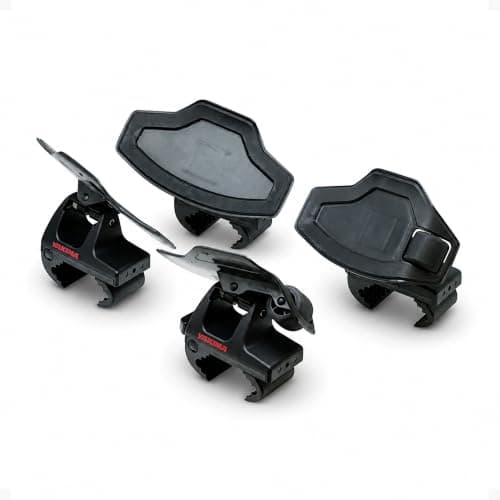 Yakima SweetRollFour saddles with rollers built into the rear pair, so one person lifts the bow, sets it down and pushes. The loading problem is the problem worth paying to solve. | Best overall — rollers at the back | 8.6 | |
| 2 | 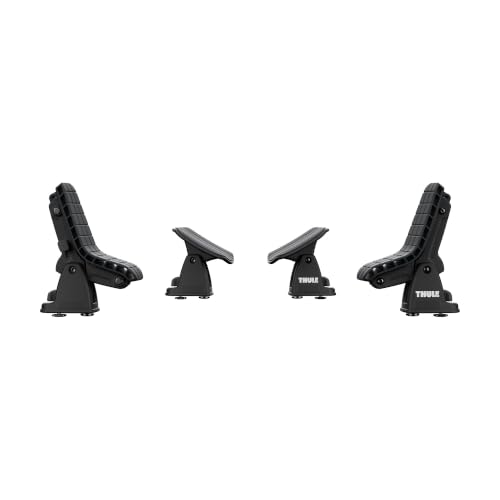 Thule DockGlideTwo independently pivoting saddles with an angle-setting lever, so the pads lie along the hull instead of pressing into it. The pick for a hard-chined or unusually rounded boat. | Best for an awkward hull shape | 8.4 | |
| 3 | 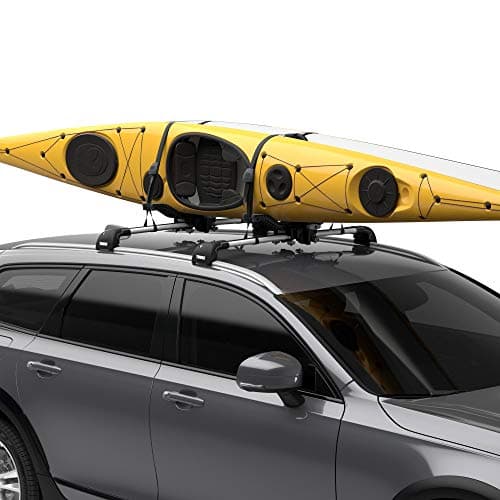 Thule CompassA four-mode carrier with the only published load figure in this group. Saddle mode for one boat, J for one, stacker for two, or two paddleboards lying flat. | Best if the plan might change — saddle, J or stacker | 8.3 | |
| 4 | 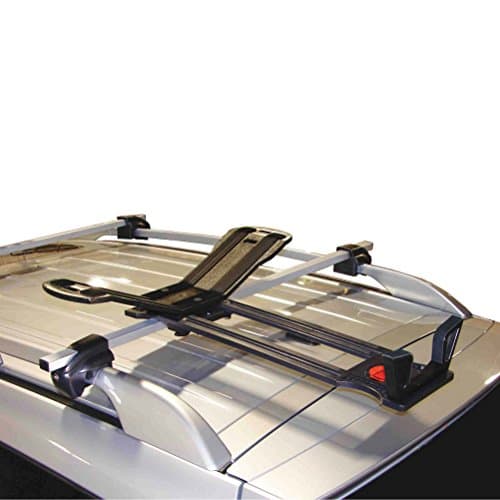 Malone SeaWingA low V-style saddle pair that happens to be sold as the SeaWing/Stinger combo, so a rear load-assist V-block, the straps and the bow and stern lines are all in the box. | Budget pick — and the listing includes the load-assist Stinger | 8.2 |
Prices checked November 28, 2026. Product photographs come from Amazon and are refreshed with the prices. Affiliate disclosure.
#1 · Best overall — rollers at the back
Yakima SweetRoll
Four saddles with rollers built into the rear pair, so one person lifts the bow, sets it down and pushes. The loading problem is the problem worth paying to solve.
- Saddles
- 2 front, 2 rear with integrated rollers
- Bar types
- Round, square, factory and aero
- Install
- Tool-free, fully assembled
- Included
- Heavy-duty straps, bow and stern tie-downs
- Listed weight
- 7.71 lb
What works
- The rear rollers are the whole point — the bow goes on at waist height and the boat slides forward, which is a different job from lifting 60 lb above your head
- The listing describes a spring-loaded base that adjusts to the boat as it loads, so the saddles find the hull rather than you aiming for them
- Published to fit all four bar types including round factory bars, which is the fit most carriers struggle with
- Bow and stern tie-downs are in the box, so the kit is complete on arrival
What doesn’t
- Yakima does not publish a boat weight limit on the current listing — if your boat is heavy, you are working without a stated number
- The HoodAnchor for cars with no accessible tow point is sold separately, and many crossovers need one
- Rollers are moving parts on a roof: grit and salt get into them and they want rinsing
- The dearest of the plain saddle sets here
Our scoring
8.6overall
#2 · Best for an awkward hull shape
Thule DockGlide
Two independently pivoting saddles with an angle-setting lever, so the pads lie along the hull instead of pressing into it. The pick for a hard-chined or unusually rounded boat.
- Saddles
- Two independent pivoting saddles
- Adjustment
- Angle-setting lever
- Bar types
- Thule systems, round bars, most factory racks
- Included
- Load straps with buckle bumpers, bow and stern tie-downs
- Listed weight
- 5.95 lb
What works
- The pivoting saddles plus the angle lever are published to conform to a limitless range of hull shapes — this is the carrier for a boat that does not sit flat on fixed pads
- Load straps come with buckle bumpers, which is the detail that keeps a steel cam buckle off a gel-coat hull
- The lightest carrier on this page at under 6 lb listed, which matters on a car with a small roof allowance
- Mounts through T-track and flip-fit brackets, so it covers Thule bars, round bars and most factory racks
What doesn’t
- Glide pads, not rollers: easier than a straight lift, but not as easy as pushing a boat over bearings
- Thule does not publish a load capacity for this carrier on the current listing
- The bracket choice depends on your exact bar, so check which one your bars need before ordering
- No lock cores, and none are offered for it on this listing
Our scoring
8.4overall
#3 · Best if the plan might change — saddle, J or stacker
Thule Compass
A four-mode carrier with the only published load figure in this group. Saddle mode for one boat, J for one, stacker for two, or two paddleboards lying flat.
- Published load capacity
- 130 lb
- Max hull width
- 36 in
- Modes
- J or saddle (1 kayak), stacker (2), saddle (2 SUPs)
- Weight
- 20 lb
- Mounting
- Universal, tool-free; folds flat
What works
- 130 lb published load capacity — the only number of its kind on this page, and the figure to point at if your boat is heavy
- Takes a published 36 in hull, which covers wide fishing kayaks that a narrow saddle set will not
- One purchase covers saddle, J-cradle and stacker, so a second boat later does not mean a second carrier
- Folds flat when empty, which keeps the noise and the garage problem down between trips
What doesn’t
- 20 lb is by far the heaviest carrier here, and every pound of it comes off your roof allowance before the boat does
- A carrier that does four jobs does none of them quite as well as the dedicated part — in saddle mode the pads are shallower than a true saddle set
- No rollers or glide pads, so loading is a lift
- Left standing in J mode it is a tall object on your roof and a genuine garage-clearance risk
Our scoring
8.3overall
#4 · Budget pick — and the listing includes the load-assist Stinger
Malone SeaWing
A low V-style saddle pair that happens to be sold as the SeaWing/Stinger combo, so a rear load-assist V-block, the straps and the bow and stern lines are all in the box.
- Capacity
- 1 kayak, max 75 lb
- Max hull width
- 32 in
- SeaWing saddles
- 6 x 27.5 x 4.5 in, polycarbon
- Stinger V-block
- 10.5 x 24 x 4 in, self-aligning
- Included
- 2 Jawz mounting blocks, 2 x 11 ft cam straps, 2 bow and stern tie-downs
What works
- The cheapest honest route to flat hull-down carrying, and the only pick here that publishes BOTH a weight limit and a hull width
- The listing is the Stinger combo, so the rear self-aligning V-block that lets you set the bow down and slide is included rather than extra
- Jawz universal mounting blocks cover round, square and most factory bars
- Complete kit — cradles, V-block, extension frame, straps, bow and stern lines and hardware
What doesn’t
- A Stinger is not a roller: the boat slides over a fixed V-block, which is easier than a lift but still friction
- 75 lb published limit rules out heavy tandems and some loaded fishing boats
- One boat only, with no stacker or J option
- 15.85 lb listed with the extension frame fitted, so it is not the light choice despite being the cheap one
Our scoring
8.2overall
What a saddle does that a J-cradle does not
It supports the hull across its shape, not its edge. Four pads under a hull spread the load over a wide footprint. A J-cradle puts the boat on its side and holds it at two points along one gunwale, with strap tension pulling down on the other. For a rotomolded plastic rec boat, neither matters much. For a thermoformed or composite hull, or for a long drive in summer heat, flat and supported is the kinder option.
It keeps the boat low. A saddle adds a few inches of height. A J-cradle adds a foot or more and presents the hull to the wind side-on. That shows up as noise on the highway and as a real number at the pump — our roof rack gas mileage page has the mechanics.
And it lets the boat slide. This is the part people underestimate until the first time they do it alone. A flat carrier with rollers or a V-block at the back turns loading into two movements at waist height. A J-cradle loads from the side, at shoulder or head height, in one committed lift.
What you give up is width. One saddle set equals one boat across the bars. If two boats are ever going up there, carrying two kayaks is the page to read, and a stacker or a pair of Js is the hardware.
Rollers, glide pads, a stinger or your arms
Every saddle set on this page carries a boat perfectly well. They differ in how the boat gets up there, and that is the difference you will feel every single trip.
Rollers (SweetRoll). The rear pair turn. You rest the bow on them, walk to the stern and push. The boat rolls forward onto the front saddles. This is the easiest method on this page and the reason it is our top pick.
Glide pads (DockGlide). Slick fixed pads the hull slides over rather than rolls on. Less effort than a dead lift, more than a roller, and nothing to seize up.
A stinger or V-block (SeaWing combo). A self-aligning block that sits behind the rear bar and catches the bow, so the boat pivots and slides instead of being lifted whole. The cheap way to buy most of the benefit.
Nothing (Compass in saddle mode). You lift. On a sedan with a 40 lb boat that is a non-issue. On a tall crossover with a 70 lb fishing kayak it is the thing that decides whether the boat gets used.
If loading is the whole problem for you, note that a saddle set is not the only answer: load-assist kayak racks covers the lift-assist carriers that bring the cradle down to you.
The bar question: round, square, factory or aero
This is where kayak carrier shopping goes wrong, and it is worth two minutes before you buy. Go and look at your crossbars. Are they round tubes, square bars, a flat factory bar molded into the roof rails, or an aero wing with a slot along the top?
The SweetRoll listing publishes fit for all four. The SeaWing uses Jawz blocks, which cover round, square and most factory bars. The DockGlide mounts through T-track and flip-fit brackets, which covers Thule systems, round bars and most factory racks — but which bracket you need depends on your bar, so confirm before ordering. The Compass is published as universal and tool-free.
Factory bars are the usual trap. Wide, flat, molded factory crossbars are not a standard shape, and a clamp designed for a 1 in round tube may simply not close around one. If your factory bars defeat the carrier you want, the cheaper fix is usually new crossbars rather than a different boat carrier — aero crossbars and crossbar spread and length cover that decision.
And check your spread. Saddles want the front and rear pads a reasonable distance apart to stop the boat pivoting. A short roof with bars close together supports a long sea kayak poorly no matter which saddles you bolt on.
Published limits, and the limit that actually binds
Two of the four carriers here publish a boat weight limit: the Compass at 130 lb and the SeaWing at 75 lb. Yakima publishes none for the SweetRoll on its current listing and Thule publishes none for the DockGlide. We have said so on each card rather than borrowing a number from a different model.
In practice the carrier is rarely the binding limit. Your car is. A published roof load is a total: the crossbars, the carrier and the boat all count against it. A 7 lb carrier plus 15 lb of crossbars plus a 65 lb fishing kayak is 87 lb before a paddle goes up, and plenty of small crossovers publish 150 lb or less. Roof rack weight limits works through the arithmetic, and the Crosstrek fit guide is a good worked example of how little headroom a small car leaves.
Then there is the strap question. A saddle set holds the boat; the straps keep it there. Use cam buckle straps over the hull, never ratchets — hand tension cannot deform a hull and a lever can. Bow and stern lines are not optional either, and three of the four carriers here include them. How to tie down a kayak has the technique and bow and stern tie-downs covers the lines and the anchor points if your car has no tow hook.
Common questions
Are kayak saddles better than J-cradles?
Do kayak saddles fit round factory crossbars?
Which kayak saddle is easiest to load alone?
How much does a kayak saddle carrier hold?
Do I still need bow and stern lines with saddles?
Sources
Not sure it fits your car?
Our vehicle pages carry the published roof load limit, the roof type by model year, and what actually mounts to it — cited, and honest about what the manufacturer does not publish.
Read next
The Best J-Cradle Kayak Racks
J-style kayak carriers compared on published load, the lift height, what folds flat and which bars each one clamps to.
J-Cradle vs Saddle vs Stacker
Hull protection, boats per bar and loading ease across the three carrier styles.
The Best Load-Assist Kayak Racks
Load-assist and slide-on kayak carriers ranked by how much of the lift they actually remove.
How to Tie Down a Kayak
The full sequence including bow and stern lines, correct tension, and the pre-drive checks.