Tie-Downs
The Best Bow and Stern Tie-Downs
Two straps over the hull hold the boat down. The bow and stern lines are what stop it rotating — and on most cars built this decade you have to buy somewhere to clip them.

Roof & Route is funded by affiliate commission. If you buy through a link on this page we may earn a commission at no extra cost to you. It never decides what we recommend or the order we recommend it in — read the full disclosure.
For most people the lines to buy are the Ayaport ratcheting rope tie-downs — a pair of thin lines with a pulley at one end that tension without tools and stow in a door pocket. If your car has nothing on the front to clip to, the Seamander bow and stern kit bundles the lines with the anchor loops. For an anchor you will still be using in ten years, the Thule 530 Quick Loop Strap is the one; the Cajun Tie Downs hood loops do the same job for a fraction of it. If you would rather use webbing than rope, Malone’s 15-foot cam straps are long enough to reach, and Rhino USA’s cam straps are the hull straps these lines are backing up.
Here is why this is a separate purchase from the straps you already own. The two straps that run over a kayak and around the crossbars stop it moving up and sideways. They do very little about rotation — the boat pivoting around the bars in a crosswind or in the pressure wave of a passing truck — and nothing at all if a crossbar, a foot or a fit kit lets go. Bow and stern lines fix both. They triangulate the load to the car’s structure, and they are the reason a failed rack usually ends with a boat on the hood rather than a boat in the next lane.
They matter most on exactly the vehicles most people drive. A short bar spread gives a long boat less to brace against, so a sedan or a hatchback needs them more than a wagon does — see crossbar spread and length for why. And the second problem is newer than the first: modern cars mostly have no accessible metal tie-down point at the front or the rear. No tow hooks, no bumper eyelets, nothing but plastic. That is what hood loops are for, and it is why half of this page is about anchors rather than lines.
Quick picks
Tap any row to jump to the full write-up below. Scores are our editorial judgment on published specifications — not a star rating, and not a product we claim to have tested.
| # | Product | Best for | Score | Price |
|---|---|---|---|---|
| 1 | 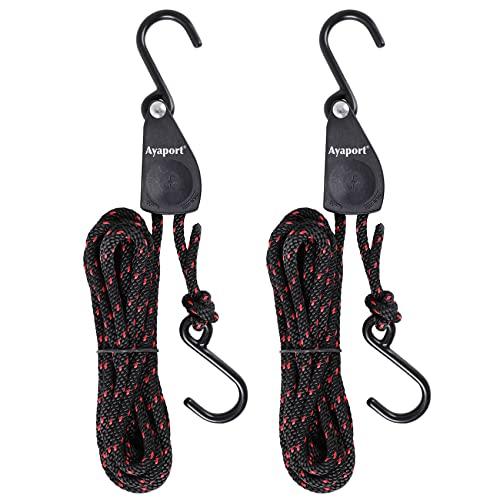 Ayaport Kayak Rope Tie Down 14ftThin rope with a ratcheting pulley at the hull end — fast to tension, easy to stow, and cheap enough that there is no excuse for not having a pair in the car. | Best bow and stern lines overall | 8.4 | |
| 2 | 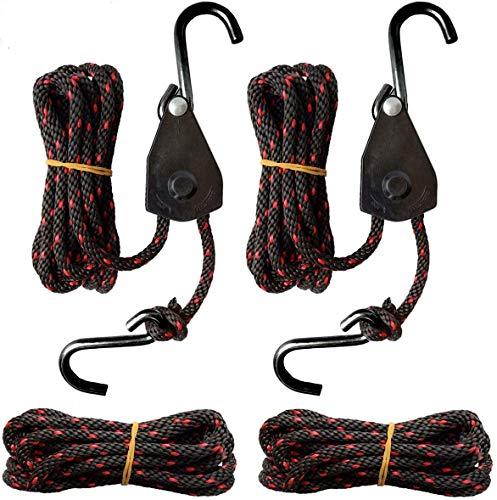 Seamander Kayak Bow & Stern Tie Down StrapsLines and the hood and trunk anchor loops in one box, which solves the whole problem for a car with no tow hooks in a single purchase. | Best complete kit | 8.2 | |
| 3 | 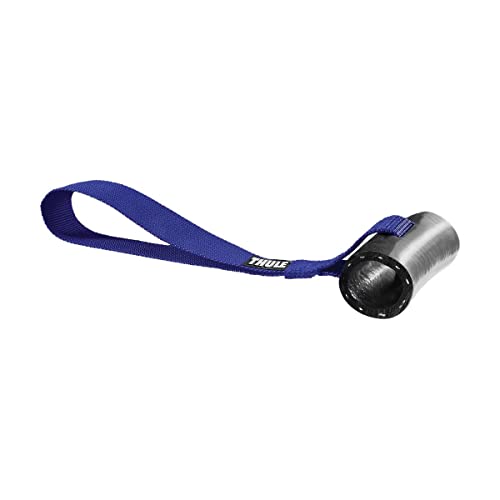 Thule 530 Quick Loop StrapWebbing loops that trap under the hood or trunk lid and give a bow line something real to pull against — the part that outlasts every line you clip to it. | Best anchor loops | 8.3 | |
| 4 | 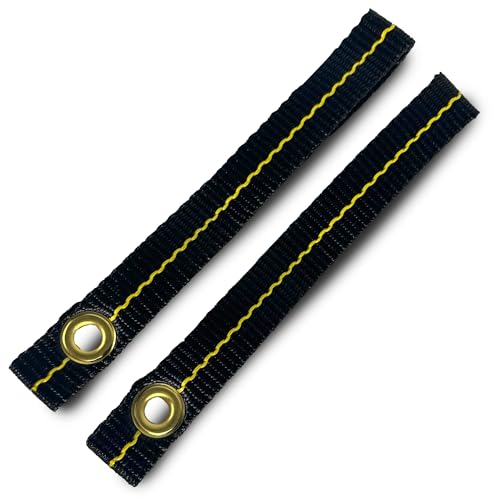 Cajun Tie Downs Hood Loop Anchor StrapsThe same under-hood idea with a stitched metal eyelet instead of a webbing loop, made in the USA and priced where you buy two pairs without thinking about it. | Best budget anchors | 8.1 | |
| 5 | 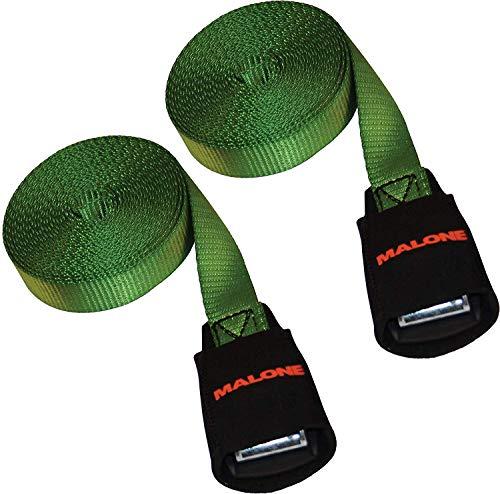 Malone 15 ft Cam Buckle Load StrapsFifteen feet of 1-inch cam strap from a paddlesport brand — long enough to serve as a bow line, and incapable of the over-tensioning a pulley makes easy. | Webbing instead of rope | 8.3 | |
| 6 | 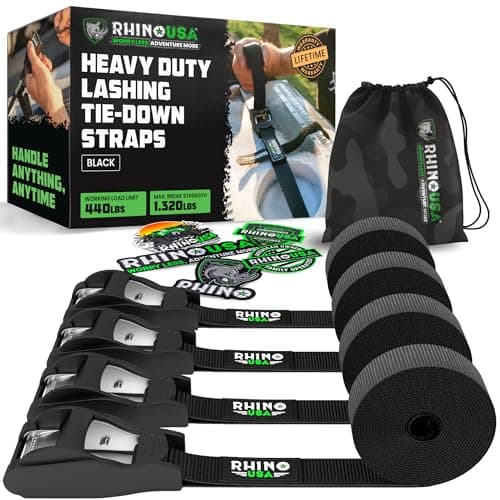 Rhino USA Cam Buckle StrapsCam straps for the two lines that go over the boat — hand tension only, which is exactly what you want crossing a painted or composite hull. | The hull straps these back up | 8.5 |
Prices checked November 11, 2026. Product photographs come from Amazon and are refreshed with the prices. Affiliate disclosure.
#1 · Best bow and stern lines overall
Ayaport Kayak Rope Tie Down 14ft
Thin rope with a ratcheting pulley at the hull end — fast to tension, easy to stow, and cheap enough that there is no excuse for not having a pair in the car.
- Type
- Rope with ratcheting pulley
- Length
- 14 ft
- Sold as
- Pair
- Ends
- Hook one end, pulley the other
- Use
- Bow and stern lines only — not hull straps
What works
- Tensions by hand in seconds, with no tool and no threading
- Thin rope coils into a door pocket rather than living in the trunk
- Long enough to reach from a bow toggle to a hood loop on a long car
- Cheap enough to keep a second pair in the other vehicle
What doesn’t
- A pulley multiplies your force, so it is possible to over-tension and deform a light hull — snug, not tight
- Thin rope concentrates load on a small area; keep it off gelcoat edges and use the boat's own toggles
- The hooks want something metal to grab, so on most cars you are buying anchor loops too
- No brand support behind it if a part fails in a year
Our scoring
8.4overall
#2 · Best complete kit
Seamander Kayak Bow & Stern Tie Down Straps
Lines and the hood and trunk anchor loops in one box, which solves the whole problem for a car with no tow hooks in a single purchase.
- Type
- Lines plus anchor loops
- Tensioning
- Pulley with locking tension
- Includes
- Two lines and quick hood or trunk loops
- Published fit
- Kayaks 8 to 14 ft
What works
- One purchase covers both halves of the job — the line and somewhere to clip it
- The included loops are the part most people do not know they need until the boat is on the roof
- Locking pulley holds tension while you walk around and do the other end
- Priced where it is reasonable to buy a set for each car in the family
What doesn’t
- The published length guidance tops out around 14 ft of boat; a long sea kayak may want longer lines
- Bundled loops are lighter-duty than a dedicated webbing anchor
- Same over-tensioning caution as any pulley system — this is a snugging device, not a winch
- Unbranded hardware, so plan on replacing rather than warrantying
Our scoring
8.2overall
#3 · Best anchor loops
Thule 530 Quick Loop Strap
Webbing loops that trap under the hood or trunk lid and give a bow line something real to pull against — the part that outlasts every line you clip to it.
- Type
- Under-hood and under-trunk anchor loop
- Sold as
- Pack of 2
- Mounting
- Trapped by the hood or trunk lid, no tools
- Needed when
- Your car has no accessible tow hook or bumper eyelet
What works
- Thule webbing and stitching, which is the difference you are paying for on a part that holds a boat
- No tools, no drilling, nothing permanent — it lifts out when you are done
- Works on front and rear, so one pack covers both ends of one car
- Soft webbing against paint rather than a metal hook hunting for something to bite
What doesn’t
- Expensive for what is physically two short straps
- Only two loops per pack, so a car that stays rigged front and rear needs the pack and not a single loop
- The hood has to close on the webbing properly — check the seal and the latch every trip
- Does nothing on its own; this is the anchor, not the line
Our scoring
8.3overall
#4 · Best budget anchors
Cajun Tie Downs Hood Loop Anchor Straps
The same under-hood idea with a stitched metal eyelet instead of a webbing loop, made in the USA and priced where you buy two pairs without thinking about it.
- Type
- Under-hood anchor strap with eyelet
- Size
- 1" x 8"
- Sold as
- 2-pack
- Made in
- USA
What works
- A fraction of the premium price for the job most people need done
- Metal eyelet gives a hook or a carabiner a clean, predictable place to sit
- Short enough to tuck away so nothing flaps against the paint at speed
- Cheap enough to leave permanently installed on the car that carries the boat
What doesn’t
- An exposed metal eyelet can mark paint if it is left to swing — tuck it or tape it
- Shorter than a webbing loop, so it is fussier to position on some hoods
- No locking or security function of any kind
- Like every anchor here, it is useless without a line to clip on
Our scoring
8.1overall
#5 · Webbing instead of rope
Malone 15 ft Cam Buckle Load Straps
Fifteen feet of 1-inch cam strap from a paddlesport brand — long enough to serve as a bow line, and incapable of the over-tensioning a pulley makes easy.
- Type
- 1-inch cam buckle webbing strap
- Length
- 15 ft
- Sold as
- Pair
- Also usable as
- Hull straps on a long load
What works
- A cam buckle cannot generate the force a ratchet or a pulley can, which is the right property near a composite hull
- Flat webbing spreads load over a wider area than thin rope does
- Fifteen feet reaches the bow of a long boat over the hood of a long car
- Doubles as a spare hull strap, so nothing in the bag is single-purpose
What doesn’t
- Webbing is bulkier to coil and stow than rope, and holds water longer
- Hand tension only — fine for bow lines, less reassuring if you expect a line to be bar-tight
- Loose tails hum and flap unless you tie or tape them off
- No hook on the end, so you are threading through an anchor loop rather than clipping to it
Our scoring
8.3overall
#6 · The hull straps these back up
Rhino USA Cam Buckle Straps
Cam straps for the two lines that go over the boat — hand tension only, which is exactly what you want crossing a painted or composite hull.
- Type
- 1-inch cam buckle lashing strap
- Length
- 12 ft
- Sold as
- 4-pack
- Published break strength
- 1,320 lb (seller specification)
What works
- Four straps means the two hull straps and a spare pair in one purchase
- Cam buckles cannot over-tension, so a hull cannot be crushed by enthusiasm
- 1-inch webbing is the paddlesport standard width for a reason — it spreads load
- Published break strength is stated on the listing rather than left vague
What doesn’t
- The buckle is bare metal; put a pad, a cloth or the buckle itself on the strap, not on the boat
- Break strength is a seller specification, not an independently verified figure
- Hand tension takes a little practice to judge — snug, with no movement when you push the hull
- These are hull straps; they are not a substitute for bow and stern lines
Our scoring
8.5overall
What we ranked on
Bow and stern lines are judged differently from the straps that go over a load, because they are solving a different problem and they fail in a different way.
1. How it tensions, and whether it can over-tension. This is the first criterion and the one people get wrong. A ratchet or a pulley multiplies your force. That is useful on a steel cargo basket and dangerous on a thin polyethylene or composite hull — a bow line cranked tight can pull a deck out of shape or bend a boat around its own bars. Everything here can do the job at hand tension, and we say so on every pick that is capable of more.
2. Whether it has anywhere to attach. A line is only as good as the anchor at each end. Most cars built in the last fifteen years have no accessible metal point front or rear, so a product that includes or complements an anchor loop beats one that assumes you have tow hooks.
3. What it does to the boat and the car. Thin rope concentrates load; flat webbing spreads it. Bare metal hooks mark paint. Anything that flaps at 70 mph will polish a stripe into your hood by the end of the summer.
4. Whether it survives being left outside. These live in a wet car, get packed away damp, and sit in the sun. UV and salt kill cheap webbing and cheap plastic hardware, and a line that looks fine can have lost most of its strength.
What we did not rank on is break strength. Published break strengths in this category are seller specifications, they are enormous relative to the job, and the real failure is never the webbing — it is the knot, the anchor, or the fact that nobody fitted the line at all.
What a bow line actually does
Picture a kayak on two crossbars with two straps over it. Those straps are doing a good job of stopping the boat lifting and a decent job of stopping it sliding. Now picture a semi passing you at 75 mph. The pressure wave hits one end of a 14-foot lever that is pinned in the middle, and the boat wants to swing. The straps resist that only through friction.
A line from the bow to the front of the car and a line from the stern to the rear turns that lever into a triangle. The boat cannot swing because both ends are tied to the vehicle, not just the middle. That is the whole mechanism, and it is why two cheap lines do more for highway safety than upgrading your hull straps ever will.
The second job is the one nobody likes to think about. If a crossbar, a foot or a fit kit lets go — and they do, usually because the fitting was never torqued or re-checked — the hull straps go with it, because they are wrapped around the bar that just left. The bow and stern lines are attached to the car. They are the reason a rack failure is a frightening noise and a scratched hood instead of a boat crossing the centerline. Our pre-trip roof rack safety check covers the fittings that cause it.
Both jobs apply to anything long and light, not just boats. Ladders, lumber, pipe, a canoe, two paddleboards stacked — if it overhangs the bars by a lot, it wants end lines. Shorter and denser loads generally do not; a cargo box bolted to the bars is a different problem, covered in how to tie down cargo.
Where to anchor on a car that has no tow hooks
This is the question that stops most people, and the answer has four parts. Work down the list and stop at the first one your car actually has.
1. A factory tow or recovery point. Some cars have a threaded recovery eye behind a bumper cover, or a visible hook under the front. If yours does, use it. It is engineered for far more load than a bow line will ever apply.
2. Under-hood anchor loops. The standard answer, and the reason both Thule’s loops and the Cajun pair are on this page. A short webbing strap goes under the hood near a hinge or a strut mount, the hood closes on it, and the loop or eyelet hangs out at the front. Same idea at the back under the trunk lid or the hatch.
3. A structural bolt or a subframe point. Possible, but you are now making a judgment about which bolt is structural, and a wrong guess puts a load into bodywork. We would rather you spent ten dollars on loops.
4. What not to use, ever. Plastic bumper covers, grille slats, a license plate bracket, a trailer wiring bracket, suspension components you can see moving, or anything that routes the line across a brake line, a hose or a wiring harness. And do not put a line through a door opening — a line that runs through a shut door will chafe its own weather seal and can be pinched.
Two details that make the difference between an anchor that works and one that annoys you all summer. First, check that the hood still latches properly with the webbing trapped, and that the seal is not held open — a hood that is not fully latched is a far bigger problem than a loose kayak. Second, tuck or tape the loop when you are not using it. Left to dangle, it will flap at speed, and flapping webbing or a swinging metal eyelet polishes paint.
Rope or webbing, ratchet or cam
Two choices, and both are genuinely a matter of what you are carrying.
Rope with a pulley is faster, lighter and stows smaller. The ratcheting pulley means you can snug a line one-handed while holding the boat with the other, which anyone who has loaded a kayak alone in a parking lot will appreciate. The cost is that it can generate more force than a light hull wants, and thin line concentrates that force on a small patch.
Flat webbing with a cam buckle cannot be over-tensioned by hand in any meaningful way, and spreads its load across an inch instead of a few millimeters. The cost is bulk, water retention and tails that need managing. If your boat is a light composite sea kayak, this is the safer choice; the Malone 15-footers above are long enough to do it.
What we would not use is a steel ratchet strap. Not on a hull and not as a bow line. A ratchet handle gives you enough mechanical advantage to damage a boat without feeling that you are doing it, and the metal hardware is a dent waiting to happen. Ratchets earn their place on steel cargo baskets and hitch carriers, which is where our ratchet strap picks send them. The full argument is in ratchet versus cam buckle.
Whichever you choose, the target tension is the same and it is less than people assume: snug enough that the boat does not move when you push the bow sideways, and no more. The hull straps hold the boat down. The end lines only stop it rotating.
Rigging both ends properly
The order matters, because tensioning the end lines before the hull straps will pull the boat forward or back off its cradles.
- Hull straps first. Two cam straps over the boat and around the crossbars, buckles on the side of the hull rather than on top of it, snugged by hand. Full method in how to tie down a kayak.
- Attach at the boat’s own hard point. Use the bow and stern toggles or carry handles, or a loop of webbing around the grab handle — not a line hooked over a thin deck edge and not through a scupper hole.
- Run the line down and outward, not straight down. A line that drops vertically does almost nothing about rotation. Two lines from the bow out to each side of the car, making a V, is the strongest arrangement; one line straight to a central anchor is the common compromise and is much better than nothing.
- Snug, do not crank. Both ends at hand tension. Then push the bow sideways: the boat should move with the car, not independently of it.
- Deal with the tails. Coil and tie off every loose end. A flapping tail at 70 mph marks paint, and a tail that reaches a wheel is a genuine hazard.
- Re-check after the first few miles. Everything settles. Pull over once, put a hand on each line, and go.
The five mistakes we see most
Using the end lines to hold the boat down. They are not for that. Over-tensioning a bow line pulls the hull down onto the bars and can deform a deck. The hull straps hold the boat; the end lines stop it swinging.
Clipping to plastic. A bumper cover is a cosmetic panel. Under load it flexes, cracks, or tears loose along with the clips holding it, and it will do all three at the worst possible moment.
Skipping them because the trip is short. The failure mode here is a crosswind or a passing truck, and neither cares how far you are going. If the boat is on the roof and the road has a speed limit above 40, fit the lines.
Leaving them on the car year-round. UV destroys webbing and cheap rope. A line that has lived on a hood through two summers is not the line you bought. Store them inside; they cost very little to replace and nothing to inspect.
Forgetting the stern. Half the people who rig a bow line stop there. The stern line is the one that matters when you are overtaken, and it is the easier of the two to attach on most cars because a hatch or trunk lid gives you a convenient place for a loop.
The short version
Buy the Ayaport ratcheting rope lines if you want the simplest thing that works. Snug them by hand, keep them off thin deck edges, and keep a pair in the car permanently.
Buy the Seamander kit if your car has nothing at the front to clip to and you would rather solve the whole problem in one order.
Buy the Thule 530 loops if you want the anchor to be the part you never think about again, and the Cajun loops if you would rather spend the difference on the boat.
Buy the Malone 15-foot cam straps if your hull is light composite and you want webbing and hand tension at both ends.
Buy the Rhino USA 4-pack for the straps that go over the boat, and read the cam buckle strap picks if that is the half you are still missing. If you are choosing a carrier at the same time, our kayak carrier roundup is the place to start, and roof racks for cars covers the bars underneath it.
Common questions
Do I really need bow and stern tie-downs?
Where do you attach a bow line on a car with no tow hooks?
How tight should bow and stern lines be?
Can I use ratchet straps as bow and stern lines?
Is one bow line enough, or do I need two?
Can I leave hood loops installed all the time?
Sources
Not sure it fits your car?
Our vehicle pages carry the published roof load limit, the roof type by model year, and what actually mounts to it — cited, and honest about what the manufacturer does not publish.
Read next
How to Tie Down a Kayak
The full sequence including bow and stern lines, correct tension, and the pre-drive checks.
The Best Cam Buckle Straps
Cam straps for hulls and cargo boxes, why hand tension is the point, and how many to buy.
Ratchet vs Cam Buckle Straps
Mechanical advantage versus hand tension — and which load each one belongs on.
The Best Kayak Racks for SUVs
Kayak carriers for tall SUV roofs, ranked on loading ease, hull protection and capacity.
How to Fit and Check a Roof Rack Safely
The six-point pre-trip rack check, the four real failure modes, and what to retighten when.
The Best Roof Racks for Cars
Complete roof rack systems for sedans, hatchbacks and wagons — matched to the four roof types, with the real total cost of each route.