Kayak Racks
The Best Kayak Roof Racks Under $200
This cap does not buy a worse kayak rack. It picks the carrying style for you — stacker, J-cradle or inflatable — because the saddle sets all start above it.

Roof & Route is funded by affiliate commission. If you buy through a link on this page we may earn a commission at no extra cost to you. It never decides what we recommend or the order we recommend it in — read the full disclosure.
A $200 kayak rack budget does something unusual: it chooses the carrying style for you. Every saddle set we would recommend — the Malone SeaWing, the Yakima SweetRoll, the Thule DockGlide — prices above this cap, so under $200 the real question is whether you want a stacker, a J-cradle or an inflatable soft rack. All three are legitimate. They suit different boats and different numbers of boats, and the cheapest of them is not the worst of them.
If you carry two or more boats, buy a stacker. A vertical post that holds kayaks on edge is the most boats per dollar and per inch of bar in the category, and the Malone Stax Pro2 is the cheapest pick on this page by a wide margin while the Yakima BigStack takes up to four. Boats on edge are also narrower, which is why a stacker is the only way most cars carry three.
If you carry one boat and load alone, buy a J-cradle. The Malone DownLoader and the Thule Hull-a-Port Pro cradle the hull on its side at an angle, which means you lift the bow onto the rear cradle and rotate the boat up rather than pressing it overhead. For one person and one kayak, this is the easiest thing under the cap.
If you have no roof rack at all, buy the inflatable. The Malone HandiRack is two inflatable bars that strap through your door frames. It is not a substitute for crossbars and we are blunt about that below — but it is a genuine way to get one boat to the water a few times a year without buying a rack system first.
On the price cap: every pick here carried a live Amazon price under $200 when this page was published, and the figure on each card is today’s live price rather than a number we typed. Two of the five sit close to the cap, so expect them to cross it occasionally — treat $200 as the bracket we shopped and the card as the current truth.
One thing that does not change with budget: a kayak on a roof needs bow and stern lines, not just the straps over the hull. Every carrier here is a mounting method, and none of them stops a long boat pivoting in a crosswind. How to tie down a kayak is the method, and the best bow and stern tie-downs are the lines we would buy.
Quick picks
Tap any row to jump to the full write-up below. Scores are our editorial judgment on published specifications — not a star rating, and not a product we claim to have tested.
| # | Product | Best for | Score | Price |
|---|---|---|---|---|
| 1 | 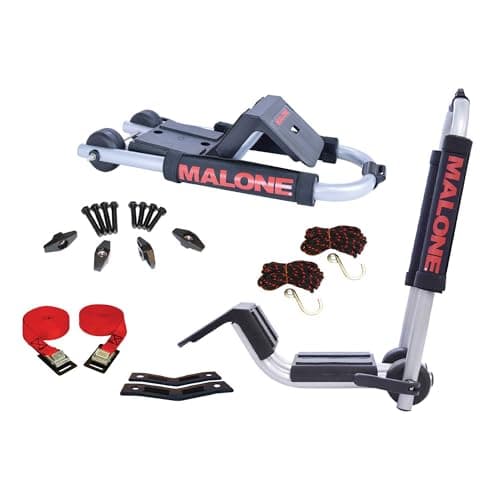 Malone DownLoaderA folding J-cradle that arrives with its straps and bow and stern lines in the box — the shortest distance between a bare set of crossbars and a kayak you can load alone. | Best one-person carrier, one boat | 8.3 | |
| 2 | 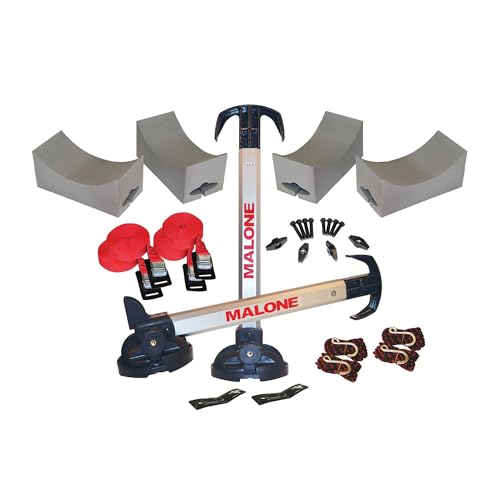 Malone Stax Pro2The cheapest real kayak carrier we would put on a car, and the most boats per dollar: a folding stacker that carries two kayaks on edge with the straps and lines included. | Budget pick, and best for two boats | 7.8 | |
| 3 | 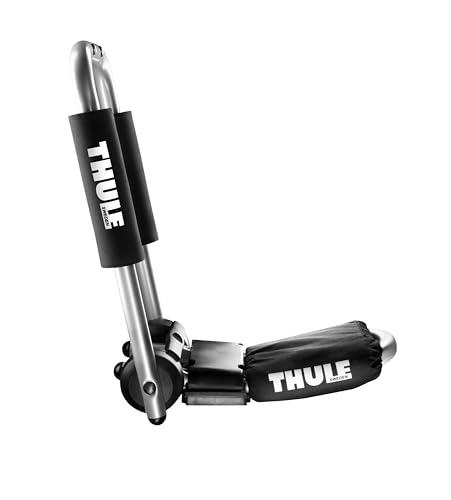 Thule Hull-a-Port ProA J-cradle for one boat that folds out into a two-boat stacker, on universal hardware, with the load straps and bow and stern tie-downs in the box. | Best J-cradle that also converts to a stacker | 8.2 | |
| 4 | 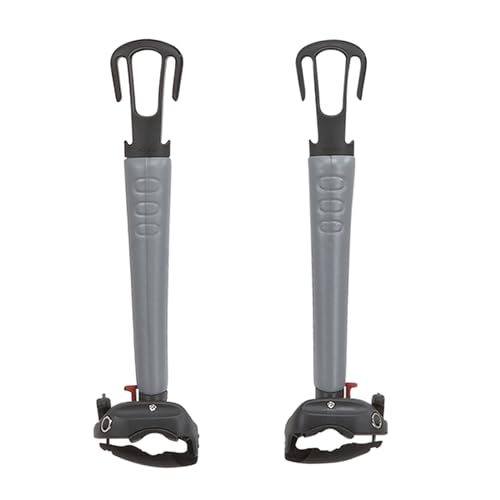 Yakima BigStackA folding stacker post rated for up to four boats on edge — the only pick here that answers a family with more kayaks than people to carry them. | Most boats on one roof | 7.8 | |
| 5 |  Malone HandiRackTwo inflatable bars that strap through the door frames. Not a rack system, and we will not pretend otherwise — but a real way to get one boat to the water on a car with a bare roof. | No roof rack at all | 7.0 |
Prices checked November 27, 2026. Product photographs come from Amazon and are refreshed with the prices. Affiliate disclosure.
#1 · Best one-person carrier, one boat
Malone DownLoader
A folding J-cradle that arrives with its straps and bow and stern lines in the box — the shortest distance between a bare set of crossbars and a kayak you can load alone.
- Style
- J-cradle
- Boats
- One
- Folds
- Yes — flat when not in use
- Included
- Cam straps plus bow and stern lines
- Mounting
- Universal, for round, square and most aero bars
What works
- The cradle angle lets one person lift the bow on and rotate the boat up instead of pressing it overhead
- Folds flat on the bars, so it does not have to come off between trips and does not whistle when empty
- Comes with the straps AND the bow and stern lines, which is a real saving and means nothing is missing on day one
- Mounts to effectively any crossbar shape, including factory bars
What doesn’t
- One boat per cradle set — carrying two means buying two and having the bar width for them
- A J-cradle holds the boat high and on edge, so it adds more wind noise and more loading height than a saddle
- On a tall SUV the raised cradle puts the boat high enough that loading alone gets hard again
- Angled loading is harder on a composite hull than a saddle's flat support; pad the contact points on a fragile boat
Our scoring
8.3overall
#2 · Budget pick, and best for two boats
Malone Stax Pro2
The cheapest real kayak carrier we would put on a car, and the most boats per dollar: a folding stacker that carries two kayaks on edge with the straps and lines included.
- Style
- Vertical stacker
- Boats
- Two on edge
- Folds
- Yes — hinges down flat
- Included
- Four cam straps plus bow and stern lines
- Mounting
- Universal crossbar mount
What works
- By far the lowest price on this page, and it carries two boats rather than one
- Boats on edge take up much less bar width than hulls lying flat, which is what makes two or three boats possible at all
- Folds down flat when empty, so it can live on the bars year-round
- Four straps and the bow and stern lines are in the box — no second order
What doesn’t
- Boats on edge catch crosswind, and a stacker load is the noisiest and draggiest way to carry a kayak
- Hulls lean against each other and against the post, so they need foam or padding on a composite or fragile boat
- Loading is a two-person job in practice: someone holds the boat on edge while the straps go over
- A single kayak on a stacker is a compromise — if you only ever carry one, a J-cradle is the better buy
Our scoring
7.8overall
#3 · Best J-cradle that also converts to a stacker
Thule Hull-a-Port Pro
A J-cradle for one boat that folds out into a two-boat stacker, on universal hardware, with the load straps and bow and stern tie-downs in the box.
- Style
- J-cradle, converts to a two-boat stacker
- Boats
- One, up to 75 lb
- Included
- Load straps plus bow and stern tie-downs for one boat
- Mounting
- Universal, fits all load bar types
- Carrier weight
- About 10 lb
What works
- The only pick here that is both a J-cradle and a stacker, so it covers one boat or two
- Universal mounting design fits all types of load bars, not just Thule's
- Load straps with buckle bumpers plus bow and stern tie-downs are included for one boat
- Folds flat when empty and arrives fully assembled out of the box
What doesn’t
- Straps come for one boat only, so a second boat means a second set
- Lock cylinders are sold separately, so it arrives with no security
- Thule publishes no minimum crossbar spread, which matters most on exactly the short roofs this bracket attracts
- Same J-cradle trade as any J-cradle: more height, more noise, more drag than a saddle
Our scoring
8.2overall
#4 · Most boats on one roof
Yakima BigStack
A folding stacker post rated for up to four boats on edge — the only pick here that answers a family with more kayaks than people to carry them.
- Style
- Vertical stacker
- Boats
- Up to four on edge
- Folds
- Yes
- Mounting
- Roof rack crossbars
- Brand system
- Yakima
What works
- Published for up to four boats, which nothing else at this price approaches
- Folds down when not in use, so it stays on the bars between trips
- Yakima build and spares, which matters on the one component carrying four hulls
- Takes whitewater and sit-on-top boats on edge easily — the shapes saddles struggle with
What doesn’t
- Four boats is a bar-width and roof-weight question before it is a carrier question — check your vehicle's roof limit first, because four kayaks plus a rack is a serious load
- Straps for four boats are a separate purchase and you will need a lot of them
- Boats on edge are the loudest, draggiest configuration, multiplied by four
- Near the top of this bracket, so it is one of the picks most likely to cross the cap
Our scoring
7.8overall
#5 · No roof rack at all
Malone HandiRack
Two inflatable bars that strap through the door frames. Not a rack system, and we will not pretend otherwise — but a real way to get one boat to the water on a car with a bare roof.
- Style
- Inflatable soft rack
- Needs crossbars
- No — this is the crossbars
- Boats
- One, in practice
- Mounting
- Straps through the door frames
- Storage
- Deflates into a bag
What works
- Works on a completely bare roof, which no other pick on this page does
- Packs down into a bag, so it does not live on the car or take garage space
- Costs a fraction of a crossbar system, which matters if the kayak is a two-trips-a-year thing
- Nothing to fit, drill or fit-check — if the car has door frames, it works
What doesn’t
- This is the biggest compromise on the page. A soft rack carries less, less securely, and should be rechecked and re-tensioned at every stop
- Straps run through the door openings, so the doors are shut on webbing and the cabin is not fully sealed
- Not an answer for a frameless-window car, a long highway haul or more than one boat
- Inflatable bars need re-inflating and checking; a soft bar under a load is never as predictable as an aluminum one
Our scoring
7.0overall
What we ranked on at this price
A kayak carrier is judged on how a loaded boat behaves at 70 mph and on how easily one person gets it up there. At $200 those two pull in opposite directions, which is what the ranking is really about.
1. Loading, for one person. The most important criterion, because the rack you dread using is the rack you stop using. A J-cradle is the easiest single-boat load here. A stacker needs a second pair of hands or a lot of practice. That is why the DownLoader ranks above the cheaper Stax Pro2 despite costing more.
2. Hull support and protection. Saddles cradle a hull along its shape, which is why they are the gentlest carrier and also why they are all above this cap. Under $200 the boat is supported on edge or in a J, and on a composite or thin-skinned hull that means padding the contact points. On a rotomolded plastic recreational kayak it means nothing at all.
3. Boats carried per set. One J-cradle, one boat. One stacker, two to four. If you have two kayaks and $200, the stacker is not a compromise — it is the only option that actually solves your problem.
4. Whether it fits your bars. Every pick here mounts to ordinary crossbars with universal hardware, which is a deliberate filter: proprietary-mount carriers at this price limit you to one brand of bar. If you do not have crossbars yet, read do I need crossbars before you buy a carrier at all.
5. What is in the box. Straps and bow and stern lines come included with three of the five picks. That is $30 to $60 of kit, and a carrier without them is not actually cheaper — it is unfinished. We have noted it on every card.
What we did not rank on is published maximum boat weight, except where a pick states one. Almost every carrier at this price is rated above what the boats people own weigh, and your vehicle’s roof limit runs out long before the cradle does. Our weight limits guide explains where to find the number that governs.
Stacker, J-cradle or soft rack: choosing in one minute
How many boats? Two or more, and you are buying a stacker. It is not close: two J-cradle sets cost more than a stacker and need more bar width than most cars have, and boats lying flat take up roughly twice the width of boats on edge.
Loading alone? One boat and nobody to help, and you are buying a J-cradle. The angle is the whole point — the bow goes on the rear cradle first and the boat rotates up. A stacker needs the boat held vertical while you work, which is a two-person move on anything but a short, light kayak.
No crossbars? Then the choice is an inflatable soft rack now or a rack system first. Buy the soft rack if the honest answer is a few short trips a year. Buy bars if the kayak is going to be a habit — a carrier on proper bars is safer, quieter and much faster to load, and the bars then carry everything else you own. Kayak racks for cars without rails is the page for that decision.
Fragile hull? A composite, wood or thin thermoformed boat wants a saddle, and saddles are above this cap. If you are set on staying under $200, a J-cradle with added foam padding at the contact points is the kinder of the two remaining options. Our J-cradle vs saddle vs stacker comparison goes through what each one does to a hull.
Fishing kayak? Weigh it before you buy anything. Loaded sit-on-top fishing kayaks are commonly far heavier than recreational boats, and weight is what rules out both the soft rack and a solo J-cradle load on a tall vehicle. The two J-cradles here both publish 75 lb for one boat, which is the number to check your own hull against first.
What $200 actually costs you, honestly
Three real things, and one that only sounds like a loss.
Saddles, which is the big one. Under the cap you cannot have a set of hull-shaped saddles with rollers, and that is the single most comfortable way to carry one kayak. Saddles support the hull along its curve, load with a slide rather than a lift, and are the quietest carrier of the lot. If your boat is expensive or your roof is tall, the money above this cap is well spent.
Gas-assist loading, which is a different budget entirely. A lift-assist carrier lowers to waist height and takes a large share of the weight. It costs several times this page’s cap and it is the right answer for a heavy boat, a tall vehicle or a bad shoulder. The best load-assist kayak racks covers that category honestly, including who should not bother.
Locks, mostly. Carriers at this price generally do not lock to the bars or lock the boat to the carrier. If the kayak will sit on the car at a trailhead or overnight, that matters and the fix is a cable lock rather than a dearer cradle.
What you do not give up is safety or capability. A correctly mounted stacker or J-cradle with straps over the hull and bow and stern lines to the vehicle is how a very large share of kayaks in the country travel, including plenty that cost more than the car. The tier we exclude is the unbranded cradle sets with no published boat weight, no named mounting compatibility and listings that churn every season.
When to spend more than $200, and when not to
Spend more if the boat is heavy, the vehicle is tall, or you load alone every time. That combination is what lift-assist carriers exist for, and no amount of technique makes a 90 lb fishing kayak onto an SUV roof a pleasant solo job.
Spend more if the hull is composite or thermoformed. Saddles spread the load along the shape of the boat instead of pressing it into a J, and on an expensive hull that is insurance rather than luxury.
Spend less if you have no crossbars and two trips a year planned. The inflatable soft rack is the honest answer and it packs into a bag afterwards.
Spend it on the lines, not the cradle, if you have to choose. Good bow and stern lines and two solid cam straps do more for how a kayak travels than upgrading the cradle under it. A boat that is strapped properly on a cheap stacker is safer than a boat loosely strapped to an expensive saddle.
Shopping by vehicle rather than by price? Our kayak racks for SUVs page starts from roof height and bar spread, and the best kayak racks for two kayaks is the page to read if the stacker argument above is the one that applies to you. If the whole roof is still to buy, the roof racks under $250 bracket is where that money goes first — and if the boats are taking the roof, the family’s luggage has to go somewhere else, which is what hitch cargo carriers under $200 is for.
The short version
One boat, loading alone: the Malone DownLoader. Folds flat, comes complete with straps and lines, and the cradle angle is what makes a solo load possible.
Two boats, or the lowest possible spend: the Malone Stax Pro2. The cheapest real carrier here and it takes two kayaks on edge.
One boat now and maybe two later: the Thule Hull-a-Port Pro, published at 75 lb for one boat and convertible to a two-boat stacker on universal mounting hardware.
Three or four boats: the Yakima BigStack — but check your vehicle’s roof limit before the carrier, because that is what will stop you.
No roof rack at all: the Malone HandiRack, with every caveat on its card taken seriously.
Fragile or expensive hull: none of these is the ideal answer. Save for a saddle set — read J-cradle vs saddle vs stacker and spend above this cap.
Common questions
Can you get a good kayak roof rack for under $200?
Is a J-cradle or a stacker better for one kayak?
How many kayaks can you carry on one car roof?
Do I need bow and stern lines with a cheap kayak rack?
Are inflatable soft roof racks safe for a kayak?
Do these prices stay under $200?
Will these carriers fit my factory crossbars?
Sources
Not sure it fits your car?
Our vehicle pages carry the published roof load limit, the roof type by model year, and what actually mounts to it — cited, and honest about what the manufacturer does not publish.
Read next
The Best Kayak Racks for SUVs
Kayak carriers for tall SUV roofs, ranked on loading ease, hull protection and capacity.
The Best Kayak Racks for Two Kayaks
Stackers and paired J-cradles for two boats, and the weight arithmetic that decides it.
J-Cradle vs Saddle vs Stacker
Hull protection, boats per bar and loading ease across the three carrier styles.
The Best Kayak Racks for Cars Without Rails
Clamp-on bars, inflatable racks and what to avoid when the roof is bare.
How to Tie Down a Kayak
The full sequence including bow and stern lines, correct tension, and the pre-drive checks.
The Best Bow and Stern Tie-Downs
Bow and stern lines and the hood-loop anchors cars need, ranked on how they tension, what they do to a hull, and whether they survive a season outdoors.