Hitch Carriers
The Best Hitch Cargo Carriers Under $200
This is the one carrier category where the budget option is genuinely the sensible option. The question is which receiver you have, and how much weight your car lets you hang off the back of it.
Roof & Route is funded by affiliate commission. If you buy through a link on this page we may earn a commission at no extra cost to you. It never decides what we recommend or the order we recommend it in — read the full disclosure.
Here is the unusual thing about this category, and it is the reason this page exists. In most of the gear on this site, a budget cap costs you something real — a quieter bar, a better latch, a lock that works. A hitch cargo carrier is a welded steel tray that bolts into a square tube. Under $200 you are not buying a lesser version of the idea. You are buying the idea.
What the money does change is size, weight and whether it folds. The cheapest real carrier here is a fixed steel basket that lives on the back of the car until you take it off with two hands. Spend a little more and you get aluminum you can lift one-handed, or a hinge that folds the basket up flat against the bumper so you can still get into a garage.
Before anything else, go and look at your receiver. A 2 inch square opening takes almost everything on this page. A 1-1/4 inch opening — standard on a great many crossovers and nearly every sedan with a dealer-fitted hitch — takes exactly one pick below without an adapter. Getting this wrong is the single most common return in the category, and it takes thirty seconds with a tape measure to avoid. Our hitch classes guide has the measurements and what each class is rated for.
Then find your tongue weight number. Every carrier here advertises 300 or 500 lb. Your vehicle almost certainly does not allow that much hanging off the receiver, and the lower of the two figures always governs. The carrier’s own weight counts against it too, which is the quiet reason an aluminum tray can be worth paying for. Hitch cargo carrier weight limits walks through where to find your figure and how to do the arithmetic.
On the price cap: every pick here carried a live, in-stock Amazon price under $200 when this page was published, and the figure on each card is today’s live price rather than a number we typed. The dearest pick was comfortably under the cap at publication, so this bracket has real headroom — but prices in this category move, and the card is the current truth. We also left one well-regarded carrier off the page entirely because it was quoting a one-to-two month ship estimate. A carrier you cannot have before your trip is not a recommendation.
Quick picks
Tap any row to jump to the full write-up below. Scores are our editorial judgment on published specifications — not a star rating, and not a product we claim to have tested.
| # | Product | Best for | Score | Price |
|---|---|---|---|---|
| 1 | 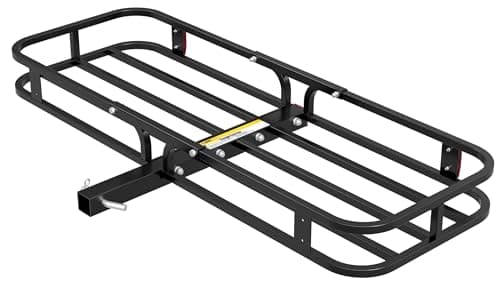 MaxxHaul 70107The long-running budget steel basket. Same 500 lb headline rating as carriers costing four times more, and the cheapest honest way to stop packing the cabin to the roof lining. | Best value, and the one most people should buy | 8.3 | |
| 2 | 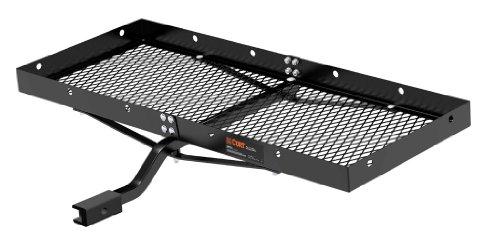 CURT 18110 Steel Tray Cargo CarrierA steel tray built around the small receiver rather than adapted to it, with the 2 inch adapter in the box — the pick for a crossover or sedan whose hitch is 1-1/4 inch. | The only answer for a 1-1/4 inch receiver | 7.9 | |
| 3 | 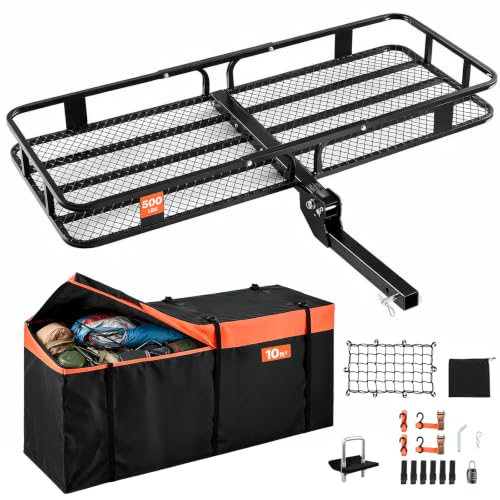 VEVOR 60 x 24 Folding Hitch Cargo CarrierThe most basket for the money on this page: a 60 by 24 inch folding steel tray, rated 500 lb, usually listed with a waterproof bag thrown in. | Biggest floor, and it folds up | 8.2 | |
| 4 | 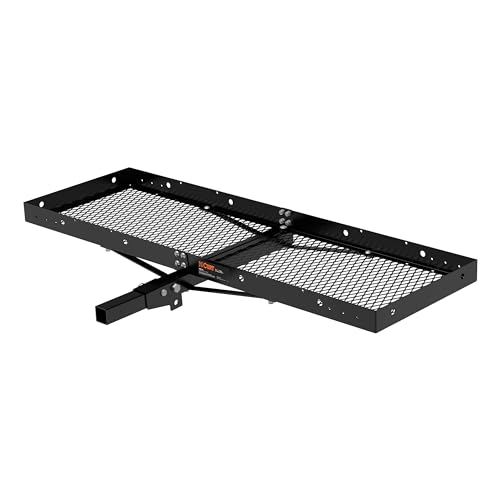 CURT 18109 Tray-Style Cargo CarrierA 60 inch tray with low walls instead of a basket's rails — the right shape when the load is long and flat rather than tall and soft. | Long flat loads, low sides | 7.9 | |
| 5 | 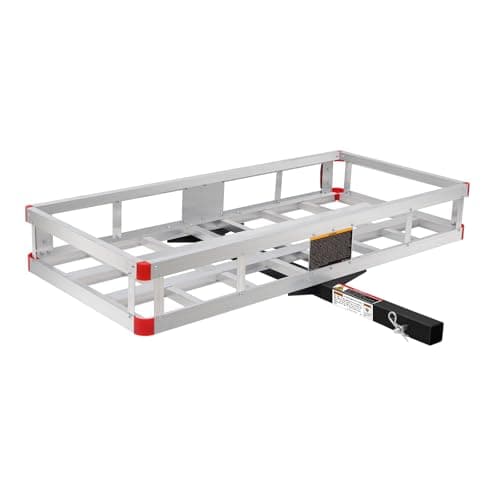 MaxxHaul 70108 Aluminum CarrierAluminum instead of steel at a higher price — you give up four inches of length and get back weight, which on a receiver is the same thing as capacity. | Lightest to lift on and off | 7.7 |
Prices checked November 27, 2026. Product photographs come from Amazon and are refreshed with the prices. Affiliate disclosure.
#1 · Best value, and the one most people should buy
MaxxHaul 70107
The long-running budget steel basket. Same 500 lb headline rating as carriers costing four times more, and the cheapest honest way to stop packing the cabin to the roof lining.
- Basket
- 53 x 19-1/2 inches, per the current listing
- Material
- Powder-coated steel, high side rails
- Rated capacity
- 500 lb
- Receiver
- 2 inch only
- Shank
- Fixed — does not fold
What works
- The lowest price in the category for a carrier with a real brand, a published capacity and a parts history
- High side rails do more work than people expect — they stop a duffel walking sideways under braking
- 500 lb rated, which is far more than almost any car's receiver is allowed to carry, so the basket is never the limit
- Simple welded steel with nothing to seize, hinge or strip; this design has been sold essentially unchanged for years
What doesn’t
- Fixed shank. It does not fold up, so it sticks out behind the car permanently until you unbolt it and store it
- Steel, so it is the heaviest option here, and every pound of carrier is a pound of cargo you cannot load
- 2 inch receiver only — if your opening is 1-1/4 inch this pick is simply not for you
- Published dimensions have varied between listings over the years; measure your hatch arc against the listing in front of you, not against a number from a review
Our scoring
8.3overall
#2 · The only answer for a 1-1/4 inch receiver
CURT 18110 Steel Tray Cargo Carrier
A steel tray built around the small receiver rather than adapted to it, with the 2 inch adapter in the box — the pick for a crossover or sedan whose hitch is 1-1/4 inch.
- Tray
- 48 x 20 inches
- Shank
- 1-1/4 inch, angled
- Rated capacity
- 300 lb
- Receiver
- 1-1/4 inch; 2 inch adapter included
- Included
- Hitch pin and clip
What works
- Fits a 1-1/4 inch receiver natively, which almost nothing else at this price does
- Ships with the 2 inch adapter, so it still works if you change to a vehicle with a bigger opening
- The angled shank lifts the tray, which buys back ground clearance on a driveway lip and ramp angle
- CURT publishes real specifications and sells replacement pins and hardware years later
What doesn’t
- Rated 300 lb, not 500 — and on a 1-1/4 inch Class I or II receiver your vehicle's own limit is likely lower still
- 48 x 20 inches is the smallest floor area on this page; a full-size roof-bag load will overhang it
- Low tray sides rather than a basket's high rails, so soft bags need strapping, not just stacking
- Fixed, non-folding tray — same permanent-overhang trade as the MaxxHaul
Our scoring
7.9overall
#3 · Biggest floor, and it folds up
VEVOR 60 x 24 Folding Hitch Cargo Carrier
The most basket for the money on this page: a 60 by 24 inch folding steel tray, rated 500 lb, usually listed with a waterproof bag thrown in.
- Basket
- 60 x 24 x 6 inches
- Material
- Steel
- Rated capacity
- 500 lb
- Receiver
- 2 inch
- Folds
- Yes — hinges up against the bumper
What works
- The largest floor area here by a clear margin; 24 inches of depth takes a cooler sideways where 19 inches will not
- The folding hinge is the feature that decides whether a carrier lives on the car or in the garage — it is what lets you park indoors
- Six inch side rails, so a tall soft load has something to lean against
- Commonly listed with a waterproof cargo bag included, which is $60 to $100 you do not spend separately
What doesn’t
- Bundle contents vary between listings and over time — read the one in front of you rather than assuming the bag is there
- A folding hinge is one more thing to seize in road salt; grease it in autumn and it is a non-issue
- 60 inches wide is wider than some hatches are tall, so check your reversing camera's view and your parking habits
- VEVOR's spares and support network is nothing like CURT's; treat it as a product, not a system
Our scoring
8.2overall
#4 · Long flat loads, low sides
CURT 18109 Tray-Style Cargo Carrier
A 60 inch tray with low walls instead of a basket's rails — the right shape when the load is long and flat rather than tall and soft.
- Tray
- 60 x 19-1/4 inches
- Style
- Tray — low sides, not a deep basket
- Rated capacity
- 500 lb
- Receiver
- 2 inch
- Material
- Steel
What works
- 60 inches of length for lumber, a folded chair stack, a toolbox or anything that wants to lie down
- Low sides mean nothing to lift a heavy item over — you slide it on rather than hoisting it in
- CURT's published 500 lb rating with the documentation and spares network behind it
- Simpler than a folding carrier, with one fewer moving part to look after
What doesn’t
- Low sides are a genuine limitation for soft, bulky loads: a duffel will try to leave, and a cargo net is not optional
- Does not fold, so it stays proud of the bumper until you unbolt it
- 19-1/4 inches deep is narrower than the big folding baskets, so a wide cooler sits lengthways or not at all
- Stock on this one moves around; check the listing's availability before you plan a trip around it
Our scoring
7.9overall
#5 · Lightest to lift on and off
MaxxHaul 70108 Aluminum Carrier
Aluminum instead of steel at a higher price — you give up four inches of length and get back weight, which on a receiver is the same thing as capacity.
- Tray
- 49 x 22.5 inches
- Material
- Aluminum, high side rails
- Rated capacity
- 500 lb
- Receiver
- 2 inch
- Finish
- Grey, no paint to chip
What works
- Light enough to fit and remove single-handed, which is the difference between a carrier you use and one you leave on
- Aluminum does not rust, so a winter of road salt is a cosmetic event rather than a structural one
- Carrier weight comes straight off your usable tongue weight, so the lighter tray is quietly the bigger one in practice
- 22.5 inches of depth is more than either CURT tray here
What doesn’t
- Costs noticeably more than the steel 70107, and it is four inches shorter — the extra depth does not help a long load
- Aluminum takes a dent where steel takes a scuff; it will show its history sooner
- Does not fold, so it still adds permanent length to the car between trips
- 2 inch receiver only
Our scoring
7.7overall
What we ranked on at this price
A budget page needs different criteria from a best-overall page, because the reader has already set the ceiling and wants to know what they give up. These are the five, weighted for $200.
1. Whether it fits your receiver at all. This is not a ranking criterion so much as a gate. Four of the five picks need a 2 inch opening. One is built for 1-1/4 inch and ships with an adapter for the bigger size. Nothing else about the page matters until you have measured the square hole in your bumper.
2. Usable floor area, not headline capacity. Every carrier here claims 300 or 500 lb and none of them will ever get near it, because your vehicle’s receiver rating runs out first. What actually varies is the size of the tray: 48 x 20 inches and 60 x 24 inches are both “a cargo carrier” and they hold visibly different amounts of family luggage.
3. Carrier weight. The one spec nobody reads and everybody should. Tongue weight includes the carrier, so a heavy steel basket spends your allowance before you have packed anything, and it is also the reason a one-person fit becomes a two-person job. This is the single best argument for aluminum at this price.
4. Whether it folds. A folding carrier hinges up against the bumper, which means a garage, a tighter parking space and a shorter overhang when the carrier is empty. A fixed carrier has to come off to achieve the same thing, and in practice people do not take it off — they just live with the extra length.
5. Hatch and tailgate access. Shank length, shank angle and basket height decide whether your hatch opens over the loaded carrier. Measure the arc before you buy; our hitch carriers for SUVs page covers the measurement, and it is the thing most likely to make an otherwise fine carrier annoying.
What we deliberately did not rank on is published load rating, for the reason above, and we did not rank on brand reputation in isolation. At this price what matters is whether the company publishes real specifications and will still sell you a hitch pin in three years. CURT and MaxxHaul both do. The value brands are judged as products rather than as systems, and the page says so on each card.
The two numbers that decide this, before any product does
Number one: your receiver opening. Put a tape across the square hole. It is either about 1-1/4 inches or about 2 inches, and there is no in between. A 2 inch carrier does not go into a 1-1/4 inch receiver at all, and a 1-1/4 inch shank in a 2 inch receiver needs an adapter sleeve, which is why the CURT 18110 including one in the box is worth real money. Adapters also add leverage and rattle, so native fit beats adapted fit when you have the choice.
Number two: your vehicle’s maximum tongue weight. It is in the owner’s manual or on the hitch’s own sticker, and on a small crossover with a 1-1/4 inch receiver it is commonly a figure far below what any basket on this page advertises. Three things count against it: the carrier, the cargo, and the leverage of hanging that cargo well behind the axle. Practically, you work out what the car allows, subtract the carrier, and the remainder is your luggage budget.
This is also the honest answer to “why is a 500 lb carrier only $70.” The steel tray really can carry 500 lb. Your car probably cannot be asked to hold it there. Neither claim is a lie and only one of them is about you.
One more thing worth knowing before you buy anything on this page: a carrier that extends behind the vehicle can obscure your license plate and your lights depending on how it is loaded, and the rules on that are set locally rather than federally. NHTSA’s equipment pages are the starting point, and are hitch cargo carriers safe covers the practical version — lighting, plate visibility, and the anti-rattle fix that stops the whole assembly knocking.
The carrier is not the whole spend
A $70 carrier is not a $70 setup, and the gap is smaller than the roof-rack equivalent but it is real. Budget for three things.
Something waterproof to put the load in. An open basket is an open basket. You either buy a cargo bag sized to the tray or you accept that everything arrives wet and gritty. This is the main reason the VEVOR pick is good value — the bag is usually in the box. Otherwise, our cargo bags for hitch carriers page covers which shapes actually fit a basket rather than a roof.
Straps, and more than you think. Cam buckle straps for soft loads, ratchet straps for anything heavy and hard, and a net over the top of a basket for the things that work themselves loose. A load on the back of the car is in dirty, turbulent air and it moves more than a roof load does. How to tie down cargo is the method, and the best cam buckle straps are what we would buy for this job.
An anti-rattle hitch tightener. Ten to twenty dollars, and it removes the metallic knock that otherwise accompanies every parking lot speed bump. Some carriers include one; most do not. It is the single cheapest upgrade to how a hitch carrier feels to live with, and it also reduces wear in the receiver itself.
Add those up and a $70 basket becomes a roughly $130 working setup. That is still less than a set of crossbars before you have bought anything to put on them, which is the whole argument for the hitch — see roof rack or hitch carrier for the version of that comparison with fuel and loading height in it.
What $200 actually costs you, honestly
Four things get thinner as the price drops in this category, and only two of them will bother you.
Folding, which matters a lot. At the bottom of the bracket the carrier does not fold, so it adds a foot or two of permanent length to the car. People stop noticing it in a week, right up until a parking garage, a steep driveway or a tight space reminds them. If you park indoors, treat folding as a requirement and not a luxury.
Weight, which matters quietly. Steel is heavy. That shows up twice — once when you lift the thing into the receiver, and once in the arithmetic of what you are allowed to load. It is the one place where paying more buys you more capacity rather than less.
Finish, which matters eventually. Powder coat on cheap steel chips at the shank where the pin goes through, and that is where rust starts. It is a maintenance item, not a failure: touch it up, keep the pin greased. Galvanized and aluminum options shrug this off.
Support, which matters rarely but completely. A value brand sells you a carrier. CURT sells you a carrier and will still have the hitch pin, the clip and the hardware in three years. If the carrier is for a one-week annual trip, the first is fine. If it is going to be part of how your family travels, the second is worth the difference.
What you do not give up at this price is safety. A welded steel tray in a correctly rated receiver, loaded inside the vehicle’s own tongue weight limit and strapped properly, is a safe way to carry luggage regardless of what it cost. The tier we exclude from this page is the carriers with no brand on the listing at all, where the capacity claim has nothing published behind it and the listing itself may not exist in six months. If you buy there anyway, trust the receiver size and ignore the load rating in favor of your owner’s manual.
When to spend more than $200, and when not to
Spend more if the carrier has to take a motorcycle, a mobility scooter, a generator or a loaded toolbox — that is a different product with a different shank and usually a ramp. Our heavy-duty hitch carriers page and carriers with a ramp cover that properly, and nothing on this page is the right tool for it.
Spend more if the carrier will live on the car year-round in a salted climate. Aluminum or galvanized steel, every time, and the premium pays for itself in how the thing looks and works in year three.
Spend less — meaningfully less — if the honest answer is one trip a year and soft luggage. A roof bag strapped to a bare roof costs a fraction of any carrier here. We would rather say that than sell you steel that lives in the garage.
Spend it on the bag and the straps, not the basket, if you have to choose. A $70 basket with a good waterproof bag and proper straps beats a $200 basket with a tarp and bungees, every single time. The basket is the easy part of this problem.
Cross-shopping by vehicle rather than by price? Our cargo carriers for cars page starts from the receiver a sedan or hatchback actually has, and the best aluminum hitch cargo carriers is the page to read if the weight argument above landed. If you are weighing this against the roof instead, the under-$250 bracket on roof racks under $250 is the direct comparison — and if the boats are going up top while the luggage goes on the back, kayak roof racks under $200 is the companion bracket for the other half of the roof.
The short version
2 inch receiver, want the obvious answer: the MaxxHaul 70107. It is the cheapest real carrier here and it does the job the category exists to do.
1-1/4 inch receiver: the CURT 18110, and it is not a close call — it is the only pick here that fits natively, and the 2 inch adapter comes with it.
Need the most space, or need to park in a garage: the VEVOR folding carrier. The biggest floor on the page and the only hinge, usually with a bag included.
Long flat loads: the CURT 18109. Sixty inches of tray with low sides you slide things onto rather than lift over.
Fitting and removing it often, or it lives in salt: the MaxxHaul 70108. Aluminum, lighter to handle, and the weight you save is cargo you get back.
No receiver at all? None of this applies yet. Read roof rack or hitch carrier first, because fitting a hitch to carry luggage is a bigger decision than any product on this page.
Ready to spend a little more? Hitch cargo carriers under $500 is the next bracket up, and it is built around what the extra money buys: floor area, a bundled bag, and a carrier for a 1-1/4 inch receiver.
Common questions
Can you get a good hitch cargo carrier for under $200?
How do I know if my receiver is 1-1/4 inch or 2 inch?
Is a 500 lb cargo carrier really able to carry 500 lb?
Should I buy a folding or a fixed hitch cargo carrier?
What else do I need to buy with a hitch cargo carrier?
Do these prices stay under $200?
Does a hitch cargo carrier hurt fuel economy as much as a roof box?
Sources
Not sure it fits your car?
Our vehicle pages carry the published roof load limit, the roof type by model year, and what actually mounts to it — cited, and honest about what the manufacturer does not publish.
Read next
The Best Hitch Cargo Carriers for SUVs
Hitch carriers for SUVs, ranked — plus the tongue weight figure that really decides your load.
The Best Cargo Carriers for Cars
Hitch cargo carriers that suit a car rather than a truck, plus the receiver check to do first.
The Best Aluminum Hitch Cargo Carriers
Aluminum carriers ranked, plus the tongue-weight arithmetic that decides whether the price premium pays.
Hitch Cargo Carrier Weight Limits
The three ratings that cap a hitch carrier load, and why tongue weight usually decides it.
Hitch Classes Explained
Classes, receiver sizes and tongue weight ratings — and why tongue weight is the number that matters.
The Best Roof Racks Under $250
Crossbar systems with a live price under $250, sorted by whether they arrive complete or need a foot pack on top.