Hitch Carriers
The Best Hitch Cargo Carriers Under $500
The cheapest carriers already work. This bracket is about what the next three hundred dollars buys: size, a weatherproof load, and a carrier for the small receiver.
Roof & Route is funded by affiliate commission. If you buy through a link on this page we may earn a commission at no extra cost to you. It never decides what we recommend or the order we recommend it in — read the full disclosure.
The verdict first. Under $500, the carrier we would buy is the CURT 18151 — a steel tray from a long- established towing manufacturer that publishes its ratings per part number and will still sell you a hitch pin in three years. The budget pick is the MaxxHaul 70108: aluminum instead of steel, roughly a third of the weight of an equivalent steel tray, and every pound of carrier you save is a pound of cargo you get back.
Be clear about what this bracket is for. A hitch cargo carrier is a welded tray that bolts into a square tube, and the cheap ones genuinely work — our carriers under $200 page exists precisely because that is true. So this page is not "the same thing, better". It is an answer to a different question: what does the next three hundred dollars actually buy?
Three things, in order. Size — a bigger floor area, which is what decides whether a cooler fits sideways. A weatherproof load — some carriers in this band arrive with a waterproof bag, a net and straps, which is $60 to $100 you do not spend separately. And fit for a 1-1/4 inch receiver at a size the bargain tier does not cover.
Two numbers come first, as always. Measure your receiver opening — about 1-1/4 inches or about 2 inches, with nothing in between — and find your vehicle's maximum tongue weight, which counts the carrier as well as the cargo. Hitch classes explained covers the first and hitch cargo carrier weight limits covers the second. Every pick below is useless if those two do not line up.
Quick picks
Tap any row to jump to the full write-up below. Scores are our editorial judgment on published specifications — not a star rating, and not a product we claim to have tested.
| # | Product | Best for | Score | Price |
|---|---|---|---|---|
| 1 | 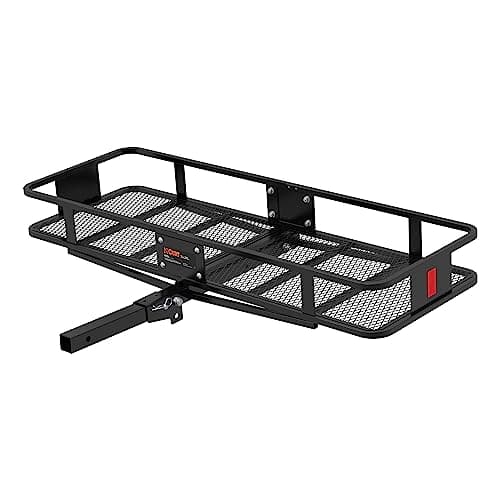 CURT 18151 Cargo CarrierA steel cargo tray from a towing manufacturer that publishes ratings per part number and stocks the hardware for years. The sensible middle of this bracket. | Best under $500 — the one with documentation behind it | 8.1 | |
| 2 | 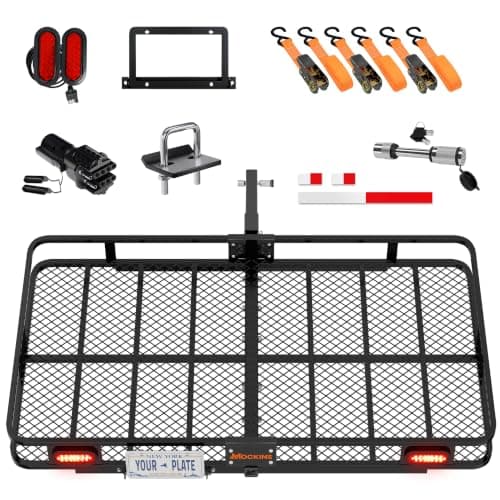 Mockins Hitch Cargo CarrierA steel carrier usually bundled with a waterproof bag, a cargo net and straps. The bag is what makes an open basket actually usable, and here it is in the box. | Arrives as a complete setup | 7.8 | |
| 3 | 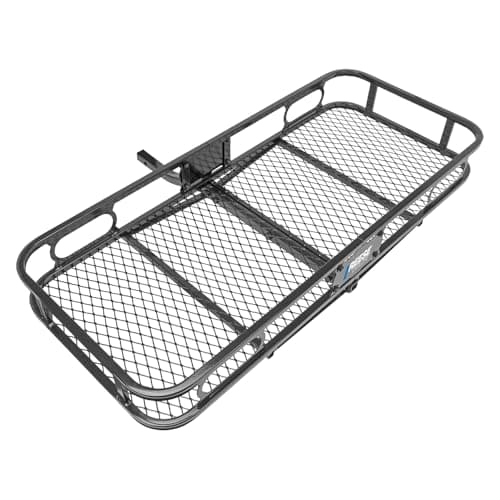 Reese Towpower Rambler 63155An alloy steel basket built for the small receiver — 48 by 20 inches of usable floor, rated 300 lb as a carrier, and 39 lb empty, from an established towing name. | A 1-1/4 inch receiver, with a real brand behind it | 7.6 | |
| 4 | 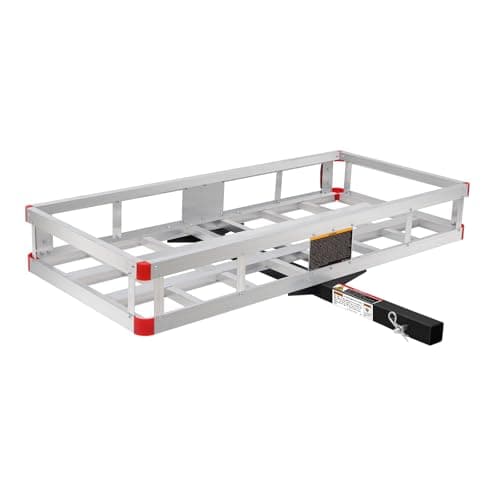 MaxxHaul 70108 Aluminum CarrierAluminum rather than steel, at roughly a third of the weight of an equivalent steel tray. The cheapest pick here, and the one that gives the most of your tongue weight back. | Budget pick — lightest to fit, and the weight you save is cargo | 7.9 |
Prices checked November 27, 2026. Product photographs come from Amazon and are refreshed with the prices. Affiliate disclosure.
#1 · Best under $500 — the one with documentation behind it
CURT 18151 Cargo Carrier
A steel cargo tray from a towing manufacturer that publishes ratings per part number and stocks the hardware for years. The sensible middle of this bracket.
- Material
- Steel
- Shank
- Fixed
- Brand
- Long-established towing manufacturer
- Documentation
- Ratings published per part number
- Receiver
- Confirm the part number against your opening
What works
- CURT publishes real specifications per part number rather than a single headline figure for a whole range
- Spares — pins, clips, hardware — are still available years later, which is the quiet difference between a product and a system
- Steel tray construction with nothing to seize, hinge or strip
What doesn’t
- Fixed shank: it does not fold, so it adds permanent length behind the car until you unbolt it
- Steel, so it is heavier than the aluminum pick and spends more of your tongue weight before you load
- Costs noticeably more than the sub-$200 trays that do the same basic job
Our scoring
8.1overall
#2 · Arrives as a complete setup
Mockins Hitch Cargo Carrier
A steel carrier usually bundled with a waterproof bag, a cargo net and straps. The bag is what makes an open basket actually usable, and here it is in the box.
- Material
- Steel
- Usually bundled with
- Waterproof bag, cargo net, straps
- Shank
- Fixed on most variants
- Weather protection
- From the bag, not the basket
- Receiver
- Confirm the variant against your opening
What works
- The bundle is the value: a bag, a net and straps bought separately is $60 to $100 on top of any bare carrier
- High-sided steel basket that a soft load can lean against
- A complete answer in one delivery, which matters if the trip is this week
What doesn’t
- Bundle contents vary between listings and over time — read the one in front of you rather than assuming the bag is there
- Value-brand hardware and finish: re-check the bolts after the first trip and grease the pin
- Smaller spares and support network than CURT or Reese
Our scoring
7.8overall
#3 · A 1-1/4 inch receiver, with a real brand behind it
Reese Towpower Rambler 63155
An alloy steel basket built for the small receiver — 48 by 20 inches of usable floor, rated 300 lb as a carrier, and 39 lb empty, from an established towing name.
- Basket
- 48 x 20 inches usable
- Rated
- 300 lb (carrier rating)
- Receiver
- 1-1/4 inch
- Material
- Alloy steel, 39 lb empty
- Brand
- Reese Towpower
What works
- Built for a 1-1/4 inch opening rather than adapted to it, which is rare above the bargain tier
- Published figures for both capacity and empty weight, so the tongue-weight arithmetic is actually possible
- Reese is a long-standing towing brand with documentation and spares
What doesn’t
- Rated 300 lb, and a Class I or II receiver on a crossover will usually allow less than that anyway
- 48 x 20 inches is a modest floor — a wide cooler will sit lengthways or not at all
- 39 lb of carrier comes straight off your usable tongue weight before you pack anything
Our scoring
7.6overall
#4 · Budget pick — lightest to fit, and the weight you save is cargo
MaxxHaul 70108 Aluminum Carrier
Aluminum rather than steel, at roughly a third of the weight of an equivalent steel tray. The cheapest pick here, and the one that gives the most of your tongue weight back.
- Material
- Aluminum
- Weight
- Roughly a third of the steel equivalent
- Shank
- Fixed
- Why it suits a car
- Less of the tongue rating spent on the carrier
- Receiver
- 2 inch
What works
- Light enough to fit and remove single-handed, which decides whether a carrier gets used or left on
- Aluminum does not rust, so a winter of road salt is cosmetic rather than structural
- The lightest carrier here means the largest luggage allowance under the same tongue weight limit
What doesn’t
- Also appears on our under-$200 page — it is the overlap between the two brackets, and we would rather say so than pretend otherwise
- Aluminum dents where steel scuffs, so it shows its history sooner
- 2 inch receiver only, and it does not fold
Our scoring
7.9overall
What the extra $300 actually buys
Floor area. The practical difference between a 48 by 20 inch tray and a 60 by 24 inch basket is whether a family cooler goes in sideways, and whether two large duffels sit flat instead of stacked. Nothing else on the spec sheet changes the trip as much.
A weatherproof load. An open basket is an open basket: the load arrives wet and gritty unless something covers it. Carriers that include a bag, a net and straps are not a gimmick — that is the kit you need, and buying it separately costs real money.
Documentation and spares. This is the quiet one. A manufacturer that publishes capacity per part number and still sells hitch pins in three years is selling a system. A value brand is selling a product. For a once-a-year trip, the product is fine; for how your family travels, the system is worth the difference.
What it does not buy: a higher real capacity. Every carrier in this bracket advertises 300 or 500 lb and your vehicle will run out first. The governing figure is your tongue weight, it includes the carrier, and no amount of money changes it. Hitch cargo carrier weight limits has the arithmetic.
Receiver size decides half this page
Put a tape across the square opening in your bumper. It is either about 1-1/4 inches or about 2 inches. A 2 inch carrier does not physically enter a 1-1/4 inch receiver, and a 1-1/4 inch shank in a 2 inch receiver needs an adapter sleeve, which adds rattle and leverage. Native fit beats adapted fit every time.
If yours is 1-1/4 inch — common on crossovers and nearly universal on sedans with a dealer-fitted hitch — the Reese Rambler is the pick on this page, and the CURT 18110 on our under-$200 page is the cheaper option. Your vehicle's tongue weight limit on a Class I or II receiver is likely lower than the carrier's rating, so do that arithmetic before buying either.
If yours is 2 inch, everything here is available to you, and the choice comes down to floor area, weight and whether the bag is included. Hitch carriers for SUVs covers the tailgate-clearance measurement that catches people out on a tall vehicle.
What to buy alongside it
An anti-rattle hitch tightener. Ten to twenty dollars, and it removes the metallic knock that otherwise accompanies every speed bump. It also reduces wear inside the receiver itself. It is the cheapest change to how a hitch carrier feels to live with.
Straps, more than you expect. Cam buckle straps for soft loads, ratchet straps for anything heavy and hard, and a net over an open basket for the small things that work themselves loose. A load behind the car sits in dirty, turbulent air and moves more than a roof load does. How to tie down cargo is the method and tie-down straps under $50 is the kit.
A plan for the plate and the lights. A loaded carrier can obscure your license plate or your tail lights, and the rules on that are set locally. Are hitch cargo carriers safe covers lighting, plate visibility and the practical checks before a long drive.
Weighing this against the roof? Roof rack or hitch carrier is the comparison with fuel and loading height in it, and the best aluminum hitch cargo carriers is the page if the weight argument above is the one that landed.
Common questions
Is a $400 hitch cargo carrier better than a $100 one?
What size hitch cargo carrier do I need?
Can I fit a hitch cargo carrier to a 1-1/4 inch receiver?
Do these prices stay under $500?
Should I buy a carrier that comes with a bag?
Sources
Not sure it fits your car?
Our vehicle pages carry the published roof load limit, the roof type by model year, and what actually mounts to it — cited, and honest about what the manufacturer does not publish.
Read next
The Best Hitch Cargo Carriers Under $200
Five hitch cargo carriers with a live price under $200, sorted by receiver size and whether the basket folds.
The Best Hitch Cargo Carriers for SUVs
Hitch carriers for SUVs, ranked — plus the tongue weight figure that really decides your load.
The Best Aluminum Hitch Cargo Carriers
Aluminum carriers ranked, plus the tongue-weight arithmetic that decides whether the price premium pays.
Hitch Cargo Carrier Weight Limits
The three ratings that cap a hitch carrier load, and why tongue weight usually decides it.
Hitch Classes Explained
Classes, receiver sizes and tongue weight ratings — and why tongue weight is the number that matters.