Guides
Are Hitch Cargo Carriers Safe?
Safer than the roof for heavy loads, and easier to get wrong in one specific way. The rating on the listing is not the number that governs you.
Roof & Route is funded by affiliate commission. If you buy through a link on this page we may earn a commission at no extra cost to you. It never decides what we recommend or the order we recommend it in — read the full disclosure.
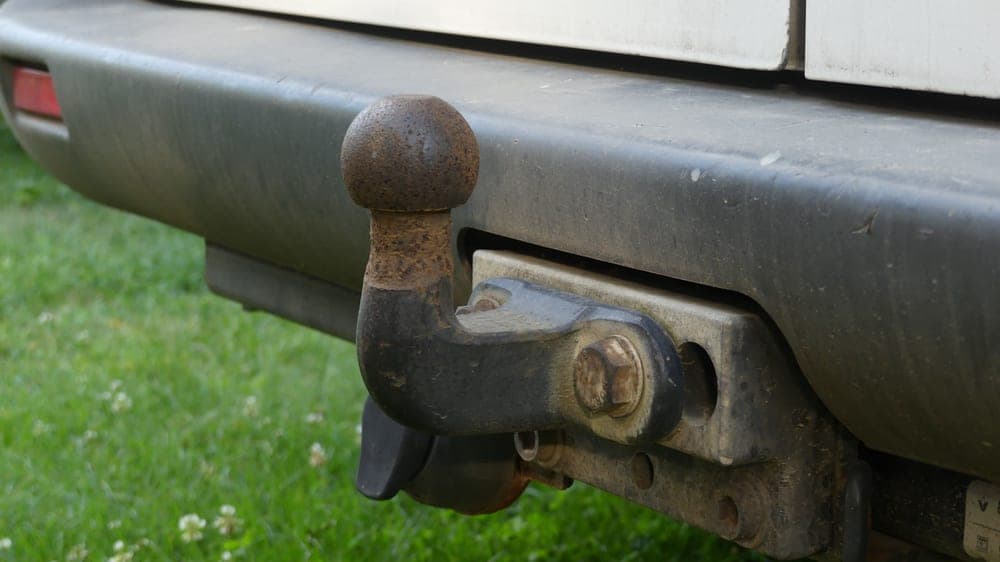
Yes — a hitch cargo carrier is safe, as long as the total downward load stays inside the tongue-weight rating printed on your hitch label, the shank is pinned with a locking pin and the slop is taken out of the receiver, and the load is strapped to the basket rather than resting in it. For heavy cargo it is meaningfully safer than the roof, because the weight stays low and you are not lifting anything over your head.
The one way people get this wrong is the number. Every carrier is advertised on a capacity figure — 400 lb, 500 lb — and that is the carrier’s rating: what the basket and shank will survive. Your limit is the tongue-weight rating of your hitch, printed on a label on the hitch itself, and it includes the carrier’s own weight before a single bag goes in. When the two numbers disagree, the smaller one governs, and it is nearly always the hitch.
That is not a technicality. A 500 lb carrier on a 350 lb hitch is a 350 lb setup minus the basket’s weight, and a heavy steel basket can spend a large share of a modest rating while empty. Our hitch carrier weight limits guide does the arithmetic properly and the hitch classes guide maps the classes to real figures.
Four things actually fail on a hitch carrier, and none of them is the steel breaking. The receiver rattles and wears. The load shifts because it was never strapped. The license plate or lights get obscured. And the extra length gets forgotten in a parking lot. All four have cheap, boring fixes, which is the rest of this page.
Quick picks
Tap any row to jump to the full write-up below. Scores are our editorial judgment on published specifications — not a star rating, and not a product we claim to have tested.
| # | Product | Best for | Score | Price |
|---|---|---|---|---|
| 1 | 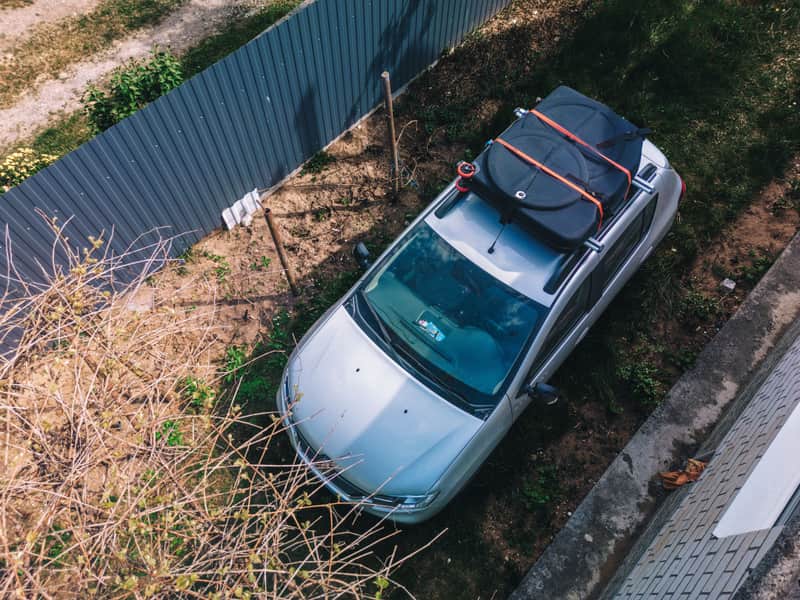 CURT 18153 Folding Cargo CarrierA folding steel basket with capacity published per part number, so you can do the tongue-weight arithmetic before you buy rather than after. | Safest everyday choice | 8.4 | |
| 2 | 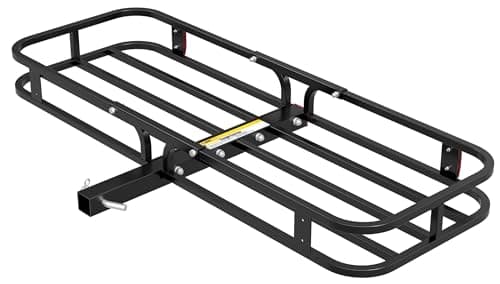 MaxxHaul 7010760 by 20 inches, steel, non-folding, and rated well above what most hitches will allow — which is exactly why you read the label and not the listing. | The honest budget baseline | 7.8 | |
| 3 |  Keeper Stretch Cargo NetA stretch net with steel perimeter hooks. Never the primary restraint — but the thing that stops small items leaving at 70 mph. | The backup that catches what the straps miss | 8.0 |
Prices checked October 17, 2026. Product photographs come from Amazon where the listing is matched, and are representative stock images otherwise. Affiliate disclosure.
#1 · Safest everyday choice
CURT 18153 Folding Cargo Carrier
A folding steel basket with capacity published per part number, so you can do the tongue-weight arithmetic before you buy rather than after.
- Basket
- 60 x 20 inches
- Material
- Steel
- Finish
- Powder coat
- Documentation
- Capacity published per part number
- Best on
- Hatchbacks, wagons and liftgate crossovers
What works
- Capacity published per part number, which is what makes a safe purchase possible
- Folds up when empty, so the hatch still opens and the length shrinks
- Stiff steel structure that does not deflect under a point load
- Powder coat holds up where the carrier takes stones
What doesn’t
- No live Amazon listing matched this model, so we show no price for it
- Substantially heavier than an aluminum tray, which spends your tongue rating
- The folding hinge is the part that wears and rattles
- Steel rusts at any chip you do not touch up
Our scoring
8.4overall
#2 · The honest budget baseline
MaxxHaul 70107
60 by 20 inches, steel, non-folding, and rated well above what most hitches will allow — which is exactly why you read the label and not the listing.
- Basket
- 60 x 20 inches
- Material
- Powder-coated steel
- Folding
- No
- Needs
- 2-inch receiver
- Also buy
- Straps and an anti-rattle device
What works
- The cheapest basket we would put on a car
- Stiffer than aluminum under a concentrated load
- Carrier rating comfortably exceeds what most hitches permit anyway
- Nothing to seize and nothing to adjust
What doesn’t
- Heavy — a big share of a Class I or II tongue rating spent empty
- Does not fold, so the hatch is awkward and the length is permanent
- Needs straps and an anti-rattle device bought separately
- 2-inch receiver only
Our scoring
7.8overall
#3 · The backup that catches what the straps miss
Keeper Stretch Cargo Net
A stretch net with steel perimeter hooks. Never the primary restraint — but the thing that stops small items leaving at 70 mph.
- Fits
- Any basket or carrier
- Hooks
- Steel perimeter hooks
- Sizing
- Several sizes
- Role
- Backup over strapped cargo
- Note
- A net is a backup, never the primary restraint
What works
- Catches the loose, light items that straps cannot hold down
- Hooks to the basket frame, so it suits any carrier
- Several sizes, so you can match the basket rather than bunch it
- Costs almost nothing against what it prevents
What doesn’t
- No live Amazon listing matched this model, so we show no price for it
- Not a restraint — the straps still do the work
- Elastic degrades in sun and will need replacing
Our scoring
8.0overall
Two ratings, and only one of them is yours
This is the whole safety question in one table. Read your own hitch label and your own carrier’s shipping weight — the figures below are the shape of the problem, not a quote for a specific vehicle.
| The number | Where it comes from | Does it limit you? |
|---|---|---|
| Carrier capacity | The product listing | Rarely — it is usually the larger number |
| Hitch tongue weight | The label on the hitch itself | Yes, almost always. Includes the carrier |
| Vehicle tongue weight | The owner’s manual | Yes, if lower than the hitch’s |
| Carrier empty weight | The shipping weight | It is subtracted from the above before cargo |
So the arithmetic is: take the smaller of the hitch label and the manual figure, subtract the carrier’s empty weight, and what is left is your cargo allowance. On a Class I or II receiver with a heavy steel basket, that remainder is sometimes shockingly small — which is exactly the case our aluminum carrier roundup exists for.
One more rating that catches people: a carrier mounted in a receiver is a cantilever, and some hitch labels state a lower capacity for a load carried behind the vehicle than for a trailer tongue. Where the label distinguishes them, use the lower figure.
The four things that actually fail
One: receiver slop. Every receiver has clearance around the shank, and that clearance becomes a rattle and then wear. It is the most common complaint about every hitch-mounted product ever made. The fix is an anti-rattle bolt or a hitch tightener, costs very little, and should be on the same order as the carrier.
Two: unstrapped cargo. A basket is not a container. Anything in it must be strapped down to the basket frame, and then strapped fore and aft so braking cannot slide it. A net over the top catches the small things. Our tie-down guide has the order of operations.
Three: obscured plate and lights. A loaded carrier can cover your license plate and your tail lights, and that is both a visibility problem and a ticket. Check it loaded, at night, from thirty feet behind the car. If the plate is hidden, you need a carrier with a plate relocation point or a different packing plan.
Four: the length you forget. A 60-inch basket adds five feet behind the car. People reverse into things, swing wide into curbs, and discover it in a drive-through. A folding carrier helps because it shrinks when empty; awareness helps more.
Notice that none of these is “the carrier broke”. NHTSA treats unsecured cargo as a genuine road hazard rather than a nuisance, and on a hitch carrier the cargo is what moves.
Why a hitch carrier is safer than the roof for heavy loads
For dense, heavy cargo the hitch beats the roof on three counts, and it is worth being explicit about them.
The weight stays low. Roof weight has leverage over the body and raises the center of gravity; hitch weight sits below the trunk floor and barely changes how the car handles. Our guide to what a roof rack changes covers the roof side of that comparison.
You load at waist height. No overhead press, no standing on a sill, and no lifting a heavy object above your head beside a road. This is a real injury reduction, not a convenience.
The fuel penalty is far smaller. A load in the wake behind the vehicle disturbs the airflow much less than the same load on the roof. Consumer Reports’ published rooftop testing is the reference for the roof side; our roof-or-hitch guide puts the two next to each other honestly.
What the roof keeps: it does not cost you the tailgate, it does not add length, and it does not need a receiver. Those are real, which is why the honest answer for most families is both — bulky and light up top, heavy and dense on the back.
The pre-trip check for a loaded carrier
Ninety seconds, before you leave and again at the first gas stop.
- Pin and clip. Hitch pin in, clip or lock engaged. Look at it rather than assuming.
- Grab the basket and shake it. Up, down, side to side. Movement at the receiver means the anti-rattle device needs tightening; movement in the basket means a bolt does.
- Tug every strap. Down first, then fore and aft. Webbing stretches in the first hour.
- Walk thirty feet behind the car. Plate readable, tail lights and brake lights visible, nothing hanging below the basket.
- Tie off the strap tails. A flapping tail scratches paint and can reach a wheel.
Then drive the first few miles expecting to stop, and stop. Nearly every problem shows up in the first ten minutes, which is the cheapest possible place to find it. Our pre-trip check guide covers the roof version of the same routine, and the ramp carrier roundup covers the case where the thing you are loading has wheels.
Common questions
Are hitch cargo carriers safe?
How much weight can I put on a hitch cargo carrier?
Why does my hitch cargo carrier rattle?
Is it legal to cover your license plate with a hitch carrier?
Are hitch cargo carriers better than a roof box?
Sources
Not sure it fits your car?
Our vehicle pages carry the published roof load limit, the roof type by model year, and what actually mounts to it — cited, and honest about what the manufacturer does not publish.
Read next
Hitch Cargo Carrier Weight Limits
The three ratings that cap a hitch carrier load, and why tongue weight usually decides it.
Hitch Classes Explained
Classes, receiver sizes and tongue weight ratings — and why tongue weight is the number that matters.
The Best Hitch Cargo Carriers for SUVs
Hitch carriers for SUVs, ranked — plus the tongue weight figure that really decides your load.
Roof Rack or Hitch Carrier?
Bulky and light goes up top; heavy and dense goes on the back. The full comparison.