Bike Racks
The Best Bike Racks for Road Bikes
The problem with carrying a road bike is not weight. It is that the cheapest racks grip exactly the part of the bike you must not grip.
Roof & Route is funded by affiliate commission. If you buy through a link on this page we may earn a commission at no extra cost to you. It never decides what we recommend or the order we recommend it in — read the full disclosure.
The verdict first. For a road bike, the rack we would buy is the Thule FastRide — a fork mount that holds the bike by its axle with the front wheel removed, which is the most secure and least invasive way to carry a light bike, and at about 7 lb the carrier barely registers on the roof. The budget pick is the RockyMounts BrassKnuckles: a front-wheel clamp with no frame contact and no wheel removal, for considerably less than any hitch platform.
The rule that organizes this page: nothing clamps the frame. A modern road frame — carbon, or thin-walled aluminum with shaped tubes — is not designed to take a point load from a rubber-lined clamp. A hanging rack that grips the top tube and a down-tube clamp are both wrong for this bike, and that rules out most of the cheap racks on the market.
What is left are three mechanisms. Fork mounts hold the front axle after you remove the wheel: the most secure option, the lightest, and the one that needs the right axle adapter. Wheel clamps arc over the front tire and hold it down: nothing is removed and nothing is squeezed. Platform hitch racks hold both wheels in trays: the easiest to load, and the choice if you are carrying two or more bikes or would rather not lift anything over your head.
One caveat on thru-axles. Most modern road and gravel bikes use a thru-axle rather than a 9 mm quick release. A fork mount needs an adapter for that, it is usually a separate purchase, and the adapter is specific to the axle standard. Check yours before buying a fork mount, or choose a wheel-clamp rack and skip the question entirely.
Quick picks
Tap any row to jump to the full write-up below. Scores are our editorial judgment on published specifications — not a star rating, and not a product we claim to have tested.
| # | Product | Best for | Score | Price |
|---|---|---|---|---|
| 1 | 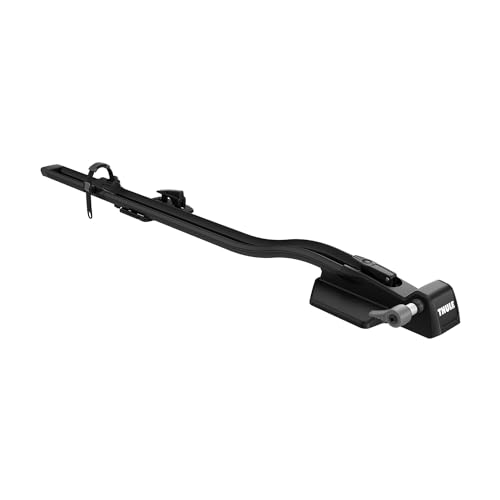 Thule FastRideA fork mount that holds the front axle with the wheel removed: the most secure carry for a light bike, the lightest carrier here, and no contact with the frame at all. | Best overall for a road bike — fork mount, nothing touched | 8.1 | |
| 2 | RockyMounts BrassKnucklesA roof tray that clamps the front wheel. Nothing is removed, nothing is squeezed, and it costs a fraction of the hitch platforms. | Budget pick — wheel-on, no frame contact, no wheel removal | 7.7 | |
| 3 | 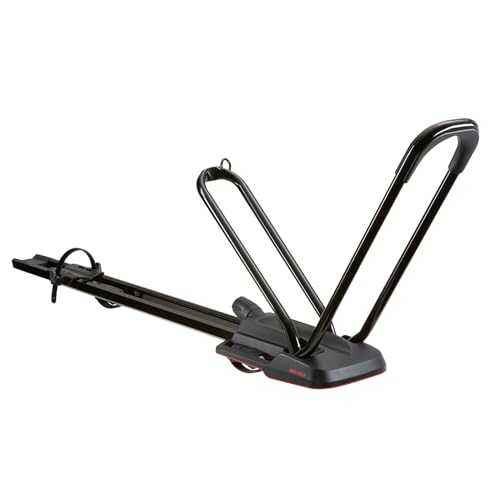 Yakima HighRoadA wheel clamp with no frame contact and the two numbers that actually decide fitment published plainly — an 18 to 40 inch bar spread and a wheelbase up to 52 inches. | Wheel-on roof carrying with published numbers | 7.7 | |
| 4 | 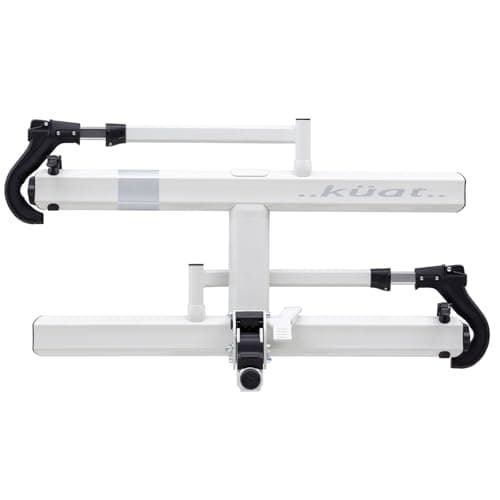 Kuat Sherpa 2.0A light aluminum two-bike platform. Wheel-based carrying at waist height, which is the comfortable answer for a pair of road bikes if you have a receiver. | Two road bikes, no lifting, no frame contact | 8.3 | |
| 5 | 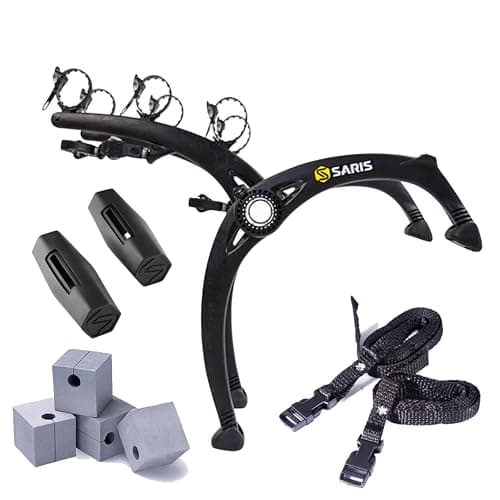 Saris Bones EXThe best-designed trunk rack here: molded arms, no metal on paint, shaped for hatchbacks. Included for completeness, with a clear warning about carbon frames. | No hitch, no crossbars — with a caveat | 6.9 |
Prices checked November 27, 2026. Product photographs come from Amazon where the listing is matched, and are representative stock images otherwise. Affiliate disclosure.
#1 · Best overall for a road bike — fork mount, nothing touched
Thule FastRide
A fork mount that holds the front axle with the wheel removed: the most secure carry for a light bike, the lightest carrier here, and no contact with the frame at all.
- Mounting
- Fork mount, front wheel removed
- Published bike limit
- 40 lb
- Carrier weight
- 7.3 lb
- Axles
- 9 mm quick-release included; thru-axle adapter extra
- Needs
- Crossbars
What works
- Holds the bike at the axle, which is the strongest and least invasive point on any bicycle
- 7.3 lb of carrier means almost nothing taken from your roof load allowance
- Removing the front wheel lowers the bike and cuts the frontal area, so it is quieter and cheaper on fuel than a wheel-on roof rack
What doesn’t
- The front wheel has to travel inside the car, which costs cabin space and needs a bag if the cabin is clean
- A thru-axle bike needs an adapter matched to its axle standard, bought separately
- Clamping a carbon fork's dropouts requires care — follow the torque guidance rather than over-tightening
Our scoring
8.1overall
#2 · Budget pick — wheel-on, no frame contact, no wheel removal
RockyMounts BrassKnuckles
A roof tray that clamps the front wheel. Nothing is removed, nothing is squeezed, and it costs a fraction of the hitch platforms.
- Type
- Roof tray, 1 bike
- Clamping
- Front wheel, frame-free
- Needs
- Crossbars
- Wheel removal
- Not required
- Bikes
- One per tray
What works
- Frame-free carrying at the lowest price here, which is the single most important thing for a carbon bike
- Both wheels stay on the bike, so nothing has to go in the car
- Leaves the hitch free and the tailgate completely clear
What doesn’t
- A wheel-on bike sits high in clean air: more drag and more noise than a fork mount
- One bike per tray, so two bikes needs two trays and the crossbar width to take them
- Lifting a bike onto a tall vehicle's roof alone is awkward even at road-bike weight
Our scoring
7.7overall
#3 · Wheel-on roof carrying with published numbers
Yakima HighRoad
A wheel clamp with no frame contact and the two numbers that actually decide fitment published plainly — an 18 to 40 inch bar spread and a wheelbase up to 52 inches.
- Mounting
- Wheel clamp, no frame contact
- Crossbar spread
- Published 18-40 in
- Wheelbase
- Published up to 52 in
- Hardware
- Tool-free, universal, fits most roof racks
- Needs
- Crossbars
What works
- Yakima publishes both the spread range and the wheelbase limit, which is what tells you whether it fits your car and your bike
- No frame contact at all, which Yakima calls out for carbon frames and custom paint
- A 52 inch wheelbase covers long road and gravel bikes that shorter trays will not take
What doesn’t
- A wheel-on bike sits in clean air, so it is draggier than a fork mount
- Needs at least an 18 inch bar spread — check yours before buying
- One bike per carrier, and the lock cores are a separate purchase
Our scoring
7.7overall
#4 · Two road bikes, no lifting, no frame contact
Kuat Sherpa 2.0
A light aluminum two-bike platform. Wheel-based carrying at waist height, which is the comfortable answer for a pair of road bikes if you have a receiver.
- Type
- Platform, 2 bikes
- Material
- Aluminum
- Receiver
- 2-inch
- Notable
- Low weight for the class
- Clamping
- Wheel-based, frame-free
What works
- No overhead lift at all, which matters more than people admit once the bikes are expensive
- Light for a platform rack, so less of the tongue weight limit is spent on the rack
- Wheel-based carrying keeps the frame untouched
What doesn’t
- Needs a 2 inch receiver, and costs several times the roof options
- Road bikes sit close together on a two-tray rack — check bar and saddle clearance
- The rack is bulky to store between trips
Our scoring
8.3overall
#5 · No hitch, no crossbars — with a caveat
Saris Bones EX
The best-designed trunk rack here: molded arms, no metal on paint, shaped for hatchbacks. Included for completeness, with a clear warning about carbon frames.
- Type
- Trunk rack, up to 3 bikes
- Construction
- Injection-molded, no metal-to-paint contact
- Fit
- Shaped for hatchbacks and spoilers
- Storage
- Folds flat
- Contact
- Top tube — use a frame protector
What works
- Works on a car with neither a receiver nor crossbars, which is the only reason to consider it here
- Molded construction keeps metal away from paint
- Folds flat and stores in a closet
What doesn’t
- It carries the bike by the frame, which is exactly what we would avoid with a carbon road bike — use a protective sleeve at minimum, and prefer another option entirely
- Blocks the trunk or tailgate while loaded
- Bikes can touch each other on a three-bike load; separators and straps are not optional
Our scoring
6.9overall
Why a frame clamp is the wrong tool for this bike
A carbon frame is extremely strong in the directions it was designed for and much less tolerant of a point load squeezing a tube from two sides. A rack clamp is exactly that. Manufacturers of down-tube clamps publish tube diameter ranges precisely because the clamp has to spread its load correctly, and aero or shaped tubing often falls outside those ranges.
Thin-walled aluminum frames are not immune either, and neither are the cables and hoses that now run inside or along the down tube on most modern bikes. A clamp in the wrong place can crush a hose or pinch a wire.
The practical rule: hold the wheels or hold the axle. Both are structural interfaces designed to take load, and neither cares what your frame is made of. Every pick above the trunk rack on this page does one or the other.
If a frame-contact rack is genuinely your only option — a rental, a borrowed rack, a car with no receiver and no bars — use a padded frame protector, keep the straps away from cable runs, and check the bike at every stop. Bike racks without a hitch covers that situation honestly.
Fork mount or wheel clamp?
Fork mount if you are happy removing the front wheel. The bike sits lower, the frontal area is smaller, the carrier is lighter, and the axle is the strongest hold on the bike. The costs are the wheel in your cabin and the thru-axle adapter question.
Wheel clamp if you want to lift the bike on and drive. Nothing is removed, nothing is squeezed, and loading takes seconds. The costs are a taller bike in faster air — so more drag and noise — and a heavier carrier.
Platform hitch rack if there are two or more bikes, or if you simply do not want to lift a bike over your head. It is the most comfortable system to live with and the most expensive to buy. Hitch bike racks is the full field, and bike racks under $1,000 is the bracket.
Either roof option needs crossbars rated for the load, and the bar spread limit on a wheel-clamp carrier is a real constraint — crossbar spread and length has the measurements, and the quietest aero crossbars is worth reading if a bike will live up there on long drives.
The small things that matter with a nice bike
Take the computer and the lights off. Head units and clip-on lights leave at highway speed. So do saddle bags that are not cinched.
Strap the rear wheel properly. On a wheel-on carrier, an unsecured rear wheel turns in the airflow and the whole bike oscillates. On a fork mount it is the entire remaining restraint.
Mind the derailleur. On a platform rack, load bikes drive-side-out where the rack allows, so the derailleur is not facing the next bike's pedal.
Re-check after the first few miles. Fork mounts and wheel clamps both settle slightly. One stop, thirty seconds, and the rest of the drive is uneventful. Our fitting roof racks safely guide has the pre-trip check, and bike racks for an SUV is the page if the vehicle rather than the bike is what is deciding this.
Common questions
What is the best bike rack for a carbon road bike?
Is it safe to use a trunk rack with a carbon frame?
Do I need to remove the front wheel for a roof bike rack?
Will a fork mount fit my thru-axle bike?
Is a roof rack or a hitch rack better for road bikes?
Sources
Not sure it fits your car?
Our vehicle pages carry the published roof load limit, the roof type by model year, and what actually mounts to it — cited, and honest about what the manufacturer does not publish.
Read next
The Best Roof Bike Racks
Roof-mounted bike carriers ranked on fit range, weight rating, loading and security.
The Best Bike Racks Without a Hitch
Trunk racks and roof carriers for cars with no receiver, and what each costs your paint.
The Best Bike Racks Under $1,000
Premium platform hitch racks with a live price under $1,000, compared on per-bike rating, folding, expansion and storage.
What Size Crossbars Do I Need?
How to measure crossbar spread and length, and what each carrier type needs.
The Best Bike Racks for an SUV
Hitch, trunk and roof bike racks for an SUV, ranked by loading height, tailgate access and what they do to your bikes.