Bike Racks
Kuat NV 2.0 vs Thule T2 Pro XTR
Both hold the bike by its wheels, both carry 60 lb a bike, both cost about the same. The decision comes down to your tires and whether you will use a repair stand.

Roof & Route is funded by affiliate commission. If you buy through a link on this page we may earn a commission at no extra cost to you. It never decides what we recommend or the order we recommend it in — read the full disclosure.
Buy the Thule T2 Pro XTR if any bike in your household has a tire wider than 3 inches, or if you want the widest published tire allowance in the mainstream market without buying an accessory. Buy the Kuat NV 2.0 if your tires are normal trail or gravel rubber and you will genuinely use the integrated repair stand — it is the better-finished object of the two.
That is the whole decision, and it is narrower than the internet makes it sound. These two racks are close to identical on the things people argue about. Both hold the bike by its front wheel with no frame contact. Both publish 60 lb per bike on a 2 inch receiver. Both are sold in 1.25 inch versions. Both expand to four bikes on the 2 inch version. Both weigh enough that you will think twice about taking them off. Both are made by companies that will still sell you a replacement strap in five years.
So this page does not pretend to a verdict the specs do not support. It lays out every published figure we could verify, says plainly where the published figures disagree between retailers, and then tells you which two buyers each rack is actually for.
One disclosure before the numbers: we have not had both racks on a vehicle. Everything below is the manufacturers’ and retailers’ published data, read carefully and compared honestly — which is a different thing from a ride test, and we would rather say so than imply otherwise. Our research method explains what we do and do not claim.
Quick picks
Tap any row to jump to the full write-up below. Scores are our editorial judgment on published specifications — not a star rating, and not a product we claim to have tested.
| # | Product | Best for | Score | Price |
|---|---|---|---|---|
| 1 | 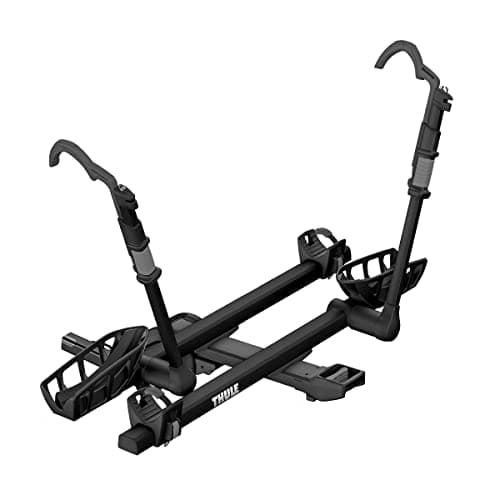 Thule T2 Pro XTRThe widest published tire allowance in the mainstream market with nothing bought extra, in both receiver sizes — the more broadly capable of the two. | Wide tires, and both receiver sizes | 8.6 | |
| 2 | 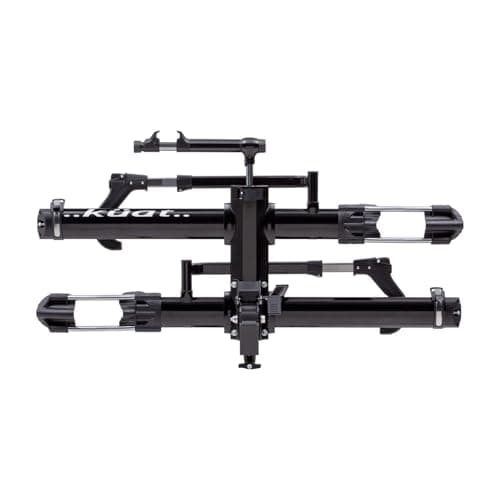 Kuat NV 2.0Aluminum, better finished, with a repair stand built into the rack — the nicer object, as long as your tires are inside 3 inches or you buy the kit. | Build quality, and the repair stand | 8.3 |
Prices checked November 11, 2026. Product photographs come from Amazon and are refreshed with the prices. Affiliate disclosure.
#1 · Wide tires, and both receiver sizes
Thule T2 Pro XTR
The widest published tire allowance in the mainstream market with nothing bought extra, in both receiver sizes — the more broadly capable of the two.
- Capacity
- 120 lb total on 2" (60 lb per tray); 100 lb on 1.25" (50 lb per tray)
- Tire width
- Up to 5", no adapter
- Wheelbase
- Up to 50"
- Wheel size
- 20 - 29"
- Rack weight
- 52 lb
- Bike spacing
- 12.5"
What works
- 5 inch tire allowance covers plus and fat tires with no accessory purchase
- Published wheelbase of 50 inches, which clears an XL modern enduro bike
- Integrated wheels for rolling 52 lb of rack around a garage
- Bikes lock to the rack and the rack locks to the receiver as standard
- Deep spares and dealer network
What doesn’t
- 60 lb per bike, and 50 lb on the 1.25 inch version — an e-MTB will exceed it
- 12.5 inch bike spacing still means wide bars negotiate with each other
- No repair stand, which the Kuat includes
- 52 lb is an awkward lift onto a hitch at bumper height
Our scoring
8.6overall
#2 · Build quality, and the repair stand
Kuat NV 2.0
Aluminum, better finished, with a repair stand built into the rack — the nicer object, as long as your tires are inside 3 inches or you buy the kit.
- Capacity
- 60 lb per bike (40 lb per bike with the four-bike add-on)
- Tire width
- Up to 3" standard; 4.8" with the Phat Bike Kit, sold separately
- Wheel size
- 20 - 29" (20 - 24" needs an adapter)
- Wheelbase
- Published as 48" by some retailers, 50" by others
- Rack weight
- Published between 52 and 56 lb depending on the retailer
- Material
- Aircraft-grade aluminum
What works
- Integrated repair stand, which turns the rack into a workstand at a trailhead
- The better-finished rack of the two, and finish is what survives a decade of road salt
- Front-wheel clamping with no frame contact, same principle as the Thule
- Offered in both receiver sizes, with four-bike expansion on the 2 inch version
What doesn’t
- 3 inch standard tire allowance — plus and fat tires need the Phat Bike Kit as a separate purchase
- Per-bike rating drops to 40 lb with the four-bike add-on fitted
- Retailers publish the wheelbase maximum as 48 inches and as 50 inches; measure a long bike first
- Its own weight is published anywhere from 52 to 56 lb, so plan for mid-fifties
- Wheels of 20 to 24 inches need an adapter kit the Thule does not require
Our scoring
8.3overall
The difference that actually matters: tire width
If you read one section, read this one. Everything else on this page is a preference; this is a fit question with a yes or no answer.
Thule publishes 5 inches for the T2 Pro XTR, with no adapter. A 2.6 inch trail tire, a 3.0 inch plus tire and a 4.8 inch fat tire all sit in the same tray with nothing bought and nothing swapped.
Kuat publishes 3 inches as standard for the NV 2.0, with up to 4.8 inches available through the Phat Bike Kit — which is a separate purchase. It is not expensive relative to the rack, and it works. But it is a part you have to know to buy, and the number of people who discover it after the rack arrives is not small.
So: a household on gravel bikes, road bikes and 2.4 inch trail tires will never notice the difference. A household with one plus bike, one fat bike or one kid’s bike on balloon tires has its answer, and the answer is the Thule unless you budget for the kit up front.
Worth noting for completeness: a fat tire in a tray is not the only fat-bike constraint — wide tires also tend to come with long wheelbases, which brings us to the next figure.
Where the published figures disagree
Two of the Kuat figures are not consistent across retailers, and we would rather flag that than pick the convenient number.
Wheelbase. Some retailers publish 48 inches for the NV 2.0, others publish 50. Wheelbase is measured axle center to axle center, most bikes are nowhere near either number, and a size XL modern enduro bike can be. If you own a long bike, this two-inch discrepancy is worth resolving with Kuat before you order. The Thule’s published figure is 50 inches.
Rack weight. We found 52 lb, 51 lb, 54 lb and 56 lb for the NV 2.0 across retailers and reviews — the spread is probably variants and configurations rather than error, but it means the honest answer is “mid-fifties.” Thule publishes 52 lb for the XTR. Either way you are lifting about the same thing, and both are heavy enough that most owners leave the rack on the vehicle.
The four-bike figure is where they genuinely part company. Kuat states plainly that fitting the four-bike add-on drops the per-bike rating from 60 lb to 40 lb. That is not a flaw — a longer lever on the same receiver has to cost something — but it is a real planning constraint, because 40 lb rules out a lot of adult bikes. We did not find an equivalent published downgrade for the Thule add-on in the documentation we reviewed, which is not the same as there not being one: if four bikes is the plan, confirm the loaded figures with the manufacturer before you buy either rack. Our four-bike rack page covers the alternative of two cheaper racks over one expanded expensive one.
And the figure that overrides both: your vehicle’s tongue weight rating. A 55 lb rack plus two 35 lb bikes is 125 lb hanging off a receiver, and the hitch weight limits guide works through why the rack’s rating is never the only one that matters.
The repair stand, and whether you will use it
The NV 2.0’s signature feature is a repair stand that stows in the rack and swings out to hold a bike by the frame at working height. It is the main reason to pay Kuat money over Thule money if your tires are normal.
Be honest with yourself about this one. If you adjust derailleurs at the trailhead, true a wheel after a rocky descent or fix a chain in a parking lot, it is genuinely excellent and there is nothing like it on the Thule. If your bike maintenance happens in a garage with a proper stand, you are paying for a feature you will use twice.
Two practical notes. The stand holds the bike by the frame, so the usual carbon and dropper-post cautions apply when you clamp it — the rack itself never touches the frame, but the stand does. And the version matters: Kuat’s NV Base 2.0 is the same rack without the stand and without the premium anodized finish, which is the cheaper way into the same tray design if the stand is not the draw.
On the Thule side, the equivalent “feature that earns its keep” is less photogenic: integrated wheels for rolling 52 lb of rack around a garage, and a tilt lever positioned where you can reach it with bikes loaded. Both racks tilt for rear access; if the vehicle is a Jeep or anything else with a side-hinged tailgate, that tilt is the feature that decides the purchase — our Wrangler bike rack page goes into why.
Neither one is an e-bike rack
Both racks publish 60 lb per bike on a 2 inch receiver. A full-power e-MTB with a large battery sits in the low fifties before you add a lock, a bottle and a frame bag; a cargo-style e-bike can be in the seventies.
So the honest answer for an electric household is that neither of these is the right rack, however much you like either brand. The Yakima StageTwo publishes 70 lb per bike, and a purpose-built e-bike carrier goes further and usually offers a loading ramp, which is the other thing a 55 lb bike makes you want. Our e-bike rack picks cover that category properly.
On the 1.25 inch versions the problem is worse on both racks — Thule’s drops to 50 lb per tray — which rules out most electric bikes outright. If you have a 1.25 inch receiver and an e-bike, the answer is a hitch upgrade before a rack purchase.
Verdict
These are both excellent racks and either one will still be working in ten years. The decision is narrow and it is not really about quality.
Thule T2 Pro XTR if your garage contains anything with a wide tire, if you want the 1.25 inch option at the best available rating, or if you simply do not want to think about accessory kits. It is the more broadly capable rack and the safer blind buy.
Kuat NV 2.0 if your tires are inside 3 inches, you will use the repair stand, and you care about owning the nicer object. Check the wheelbase figure with Kuat if you ride a long bike, and buy the Base 2.0 instead if the stand is not the reason you are here.
Neither if any bike is electric — go and read the e-bike picks instead. And if you want the same frame-free principle for substantially less money, the RockyMounts MonoRail in our hitch bike rack roundup does the actual job with cruder hardware. The full T2 Pro XTR review goes deeper on the Thule, and Kuat vs Thule vs Yakima compares the three brands’ whole ranges rather than these two models.
Common questions
Is the Kuat NV 2.0 or the Thule T2 Pro XTR better for fat bikes?
Do both racks carry the same weight per bike?
Which rack is heavier, the NV 2.0 or the T2 Pro XTR?
What is the difference between the Kuat NV 2.0 and the NV Base 2.0?
Can either rack carry an e-bike?
Do both racks come in a 1.25 inch version?
Sources
Not sure it fits your car?
Our vehicle pages carry the published roof load limit, the roof type by model year, and what actually mounts to it — cited, and honest about what the manufacturer does not publish.
Read next
Thule T2 Pro XTR Review
What the T2 Pro XTR's published figures actually mean for your bike, and the two racks that beat it on weight ceiling and on price.
Kuat vs Thule vs Yakima Bike Racks
Three premium platform brands compared on rating, fit range, loading and price.
The Best Bike Racks for a Jeep Wrangler
Hitch racks that clear a Wrangler's rear spare and let the tailgate open, plus the two measurements to take before you order.
The Best Hitch Bike Racks
Platform hitch racks ranked on fit range, weight rating, loading and security.
The Best Bike Racks for Electric Bikes
Racks rated for e-bike weight, ramps that remove the lift, and the hitch arithmetic to do first.