Guides
Hitch Bike Rack Weight Limits Explained
Three numbers govern you and only one is on the box. Here they are, with the published figures from the racks this site recommends.
Roof & Route is funded by affiliate commission. If you buy through a link on this page we may earn a commission at no extra cost to you. It never decides what we recommend or the order we recommend it in — read the full disclosure.
A hitch bike rack is governed by three numbers, and only one of them is printed on the box. In order of which one usually stops you:
- The per-bike limit for your receiver size. Most platform racks publish a lower figure on a 1-1/4 inch receiver than on a 2-inch one, for the same rack.
- The tongue-weight rating on your hitch label. The total downward load the receiver will accept, including the rack itself.
- The rack’s total capacity. Usually the least binding of the three.
The clearest published example is the Thule T2 Pro XTR: 120 lb total on a 2-inch receiver, which is 60 lb per tray, and 100 lb total on a 1-1/4 inch receiver, which is 50 lb per tray. Same rack, same bikes, 10 lb less per bike because of the receiver. The Kuat NV 2.0 is rated 60 lb per bike; the Yakima StageTwo publishes 70 lb per bike; the Thule ProRide XT roof carrier publishes a 44 lb bike limit (and some retailers list 40 lb). Those are the figures to work from.
Then there is the number that is yours and nobody else’s: the label on your hitch. A rack rated to carry 120 lb of bikes on a hitch rated to 350 lb of tongue weight is fine. The same rack on a Class I receiver with a low rating may be over the limit with the rack’s own weight plus two bikes. Our hitch classes guide maps classes to real numbers.
And the thing that breaks all of this arithmetic: electric bikes. They are considerably heavier than the bikes most of these racks were designed around, which is why racks sold specifically for e-bikes exist and why our e-bike rack roundup is a separate page.
Quick picks
Tap any row to jump to the full write-up below. Scores are our editorial judgment on published specifications — not a star rating, and not a product we claim to have tested.
| # | Product | Best for | Score | Price |
|---|---|---|---|---|
| 1 | 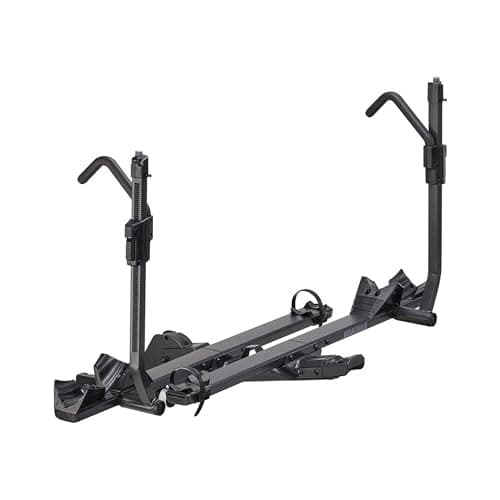 Yakima StageTwoPublishes 70 lb per bike on a 2-inch receiver with staggered trays, which is the most headroom of the racks on this page. | Highest published per-bike figure here | 8.9 | |
| 2 | 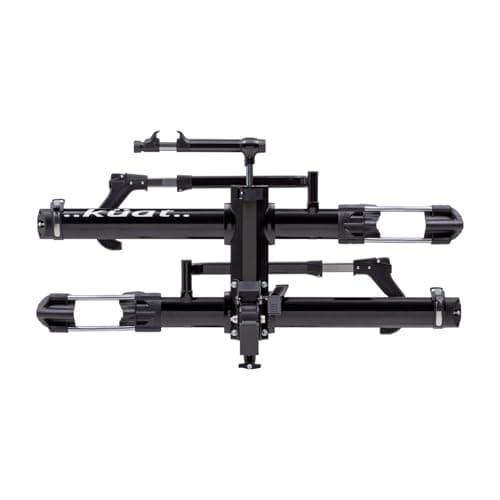 Kuat NV 2.0Aircraft-grade aluminum, rated 60 lb per bike, with an integrated repair stand — a published figure and a genuinely useful extra. | 60 lb per bike with a repair stand | 8.6 | |
| 3 | 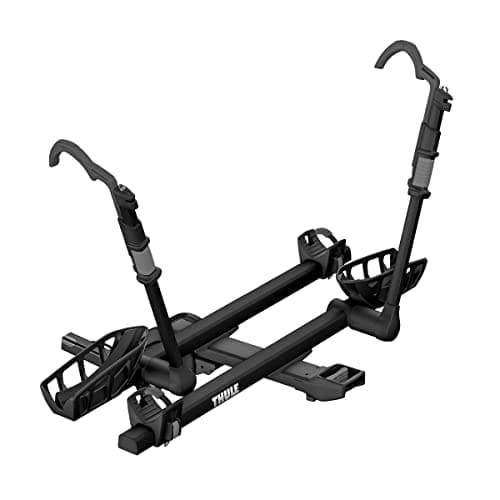 Thule T2 Pro XTRThe rack whose published figures show the 2-inch versus 1-1/4 inch penalty in black and white — 60 lb per tray against 50 lb. | The clearest published receiver comparison | 8.8 | |
| 4 | 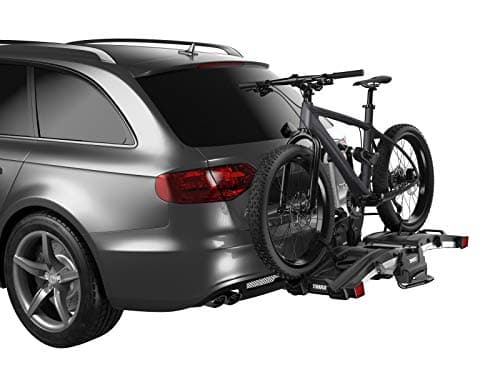 Thule EasyFold XT 2A folding platform designed around e-bike weight, with a ramp available so you push the bike up instead of lifting it. | Designed for electric bikes | 8.7 |
Prices checked October 17, 2026. Product photographs come from Amazon and are refreshed with the prices. Affiliate disclosure.
#1 · Highest published per-bike figure here
Yakima StageTwo
Publishes 70 lb per bike on a 2-inch receiver with staggered trays, which is the most headroom of the racks on this page.
- Type
- Platform, 2 bikes, expandable
- Per-bike rating
- 70 lb
- Receiver
- 2-inch
- Trays
- Staggered
- Locks
- SKS locks, tilt lever
What works
- 70 lb per bike published, which covers heavy mountain bikes with margin
- Staggered trays keep handlebars and saddles from fighting each other
- Tilt lever for tailgate access, and integrated locks
- Expandable, so the capacity decision is not permanent
What doesn’t
- 2-inch receiver only
- Heavy, so its own weight is a real share of your tongue rating
- Premium price
Our scoring
8.9overall
#2 · 60 lb per bike with a repair stand
Kuat NV 2.0
Aircraft-grade aluminum, rated 60 lb per bike, with an integrated repair stand — a published figure and a genuinely useful extra.
- Type
- Two-bike platform
- Material
- Aircraft-grade aluminum
- Per-bike rating
- 60 lb
- Extra
- Integrated repair stand
What works
- 60 lb per bike published, so the arithmetic is possible before you buy
- Aluminum construction keeps the rack's own weight down
- Integrated repair stand, which is more useful than it sounds on a trip
- No frame contact
What doesn’t
- 60 lb per bike rules out the heavier e-bikes
- Premium price for the category
- Still a substantial rack to lift on and off
Our scoring
8.6overall
#3 · The clearest published receiver comparison
Thule T2 Pro XTR
The rack whose published figures show the 2-inch versus 1-1/4 inch penalty in black and white — 60 lb per tray against 50 lb.
- Capacity
- 120 lb total on 2" (60 lb per tray); 100 lb on 1.25" (50 lb per tray)
- Per-bike rating
- 60 lb on a 2" receiver, 50 lb on 1.25"
- Bike spacing
- 12.5"
- Clamping
- Front wheel arm
- Expansion
- 2-bike add-on
What works
- Publishes both receiver figures, which almost nothing in this category does
- 60 lb per tray on a 2-inch receiver covers heavy mountain bikes
- Front wheel arm, so nothing clamps a frame
- Expands to four bikes with the add-on
What doesn’t
- The 1-1/4 inch figure is 10 lb per bike lower, and people miss it
- Heavy enough to be a two-person lift
- Among the most expensive two-bike racks
Our scoring
8.8overall
#4 · Designed for electric bikes
Thule EasyFold XT 2
A folding platform designed around e-bike weight, with a ramp available so you push the bike up instead of lifting it.
- Type
- Folding platform, 2 bikes
- Designed for
- Electric bikes
- Ramp
- Available accessory
- Storage
- Folds flat
What works
- Built for the weight class that breaks ordinary bike racks
- The optional ramp turns an e-bike lift into a push, which is the real win
- Folds flat for storage, which matters because it is a big rack
- Platform design, so no frame contact
What doesn’t
- Expensive, and the ramp is extra
- Heavy itself, which eats into your tongue-weight allowance
- Still bounded by your hitch label, not by the rack's rating
Our scoring
8.7overall
The published figures, side by side
Every number in this table is published by the manufacturer for that model and is the figure this site already carries for its listing. Where a manufacturer publishes nothing, the cell says so.
| Rack | Receiver | Per bike | Total |
|---|---|---|---|
| Yakima StageTwo | 2 inch | 70 lb | Not published as a single figure |
| Thule T2 Pro XTR | 2 inch | 60 lb | 120 lb |
| Thule T2 Pro XTR | 1-1/4 inch | 50 lb | 100 lb |
| Kuat NV 2.0 | 2 inch | 60 lb | Not published as a single figure |
| Thule ProRide XT (roof) | n/a — roof carrier | 44 lb per Thule; some retailers list 40 lb | One bike |
The two Thule rows are the ones to internalize. The same rack loses 10 lb of capacity per bike because of the receiver it is fitted to. If you have a 1-1/4 inch receiver, assume every rack you look at carries less and verify it on the manufacturer’s figures.
The roof row is there for scale. Roof carriers publish much lower bike limits than hitch racks, which is a large part of why heavy bikes go on the back. Our mount type comparison covers the rest.
The tongue-weight check, worked through
The rack’s rating tells you what the rack survives. Your hitch label tells you what the car permits. Here is the order of operations.
- Find the label on the hitch itself. Not the listing, not the forum. It states the tongue weight the receiver accepts.
- Check the owner’s manual too. If the vehicle states a lower figure than the hitch, the vehicle governs.
- Subtract the rack’s own weight. The rack is tongue weight. A heavy platform spends a real share of a modest rating before any bike is on it.
- Compare what is left with your bikes, weighed. Not catalog weights. The actual bikes, with pedals, cages, lights and whatever is still bolted to them.
- Check the per-bike figure separately. Two numbers have to pass: total tongue weight, and per-bike rating for your receiver size. Failing either one is failing.
A cantilever note worth knowing: a load carried behind the vehicle puts more strain on the receiver than the same weight sitting on a trailer tongue, and some hitch labels state a lower figure for carried loads. Where the label distinguishes them, use the lower number. Our cargo carrier weight limits guide covers the same arithmetic for baskets.
Why e-bikes break the arithmetic
An electric bike is heavier than the bikes these racks were designed around, and the weight is concentrated low in the frame where a wheel tray has least leverage. Two consequences follow.
The per-bike figure becomes the binding constraint. A 60 lb per-tray rating has margin for a heavy mountain bike and little or none for a full-size e-bike. Two e-bikes on a 100 lb total rating is not a close call — it is over.
Lifting becomes the real problem. Even where the numbers pass, getting a heavy e-bike up onto a tray is a genuine injury risk. This is why ramps exist as accessories and why we rate the Thule EasyFold XT 2 for this job: pushing a bike up a ramp is a different activity from lifting it.
The honest rule: if either bike has a motor, shop the racks sold for e-bikes rather than hoping a general-purpose rack copes. Our e-bike rack roundup covers them, and the two-bike roundup covers the conventional case.
One more thing to weigh, literally: the battery. Many e-bike racks publish their figures with the battery removed, and taking the battery off before loading is the cheapest capacity you will ever find.
The limits that are not weight
Three more constraints decide whether a rack works, and none of them is a pound figure.
Bike spacing. The T2 Pro XTR publishes 12.5 inches between bikes. Wide handlebars, mirrors and child seats all eat into that, and two bikes fighting each other is how paint gets scraped.
Wheel and tire compatibility. A wheel-tray rack has a range of tire widths and wheelbases it accepts. Fat tires and very long bikes fall outside some of them.
Tailgate access. Tilt-away is standard on good platform racks but it tilts more easily empty than loaded, and a spoiler or a high-mounted plate can change the answer on your specific car. Test it loaded, before the trip.
Then the rattle, which is not a limit but is the thing you will actually complain about. Receiver slop becomes noise and then wear, and an anti-rattle bolt or hitch tightener fixes it for very little money. Our hitch safety guide covers that and the plate, lights and length checks that go with any rear-mounted load.
Common questions
How much weight can a hitch bike rack hold?
Why does a hitch bike rack carry less on a 1-1/4 inch receiver?
Does the bike rack's own weight count toward my hitch limit?
Can a normal hitch bike rack carry an electric bike?
Which number matters most for a hitch bike rack?
Sources
Not sure it fits your car?
Our vehicle pages carry the published roof load limit, the roof type by model year, and what actually mounts to it — cited, and honest about what the manufacturer does not publish.
Read next
The Best Bike Racks for Two Bikes
Two-bike racks ranked by receiver size and per-bike weight limit, including the no-hitch option.
The Best Bike Racks for Electric Bikes
Racks rated for e-bike weight, ramps that remove the lift, and the hitch arithmetic to do first.
Hitch Cargo Carrier Weight Limits
The three ratings that cap a hitch carrier load, and why tongue weight usually decides it.
Hitch Classes Explained
Classes, receiver sizes and tongue weight ratings — and why tongue weight is the number that matters.