Cargo Boxes
The Best Cargo Boxes for a Subaru Outback
Your model year decides your box more than your budget does: 150 lb, 176 lb or 220 lb, and the empty box spends a third of it before you pack.
Roof & Route is funded by affiliate commission. If you buy through a link on this page we may earn a commission at no extra cost to you. It never decides what we recommend or the order we recommend it in — read the full disclosure.
For most Outbacks the box to buy is the Thule Force 3 — dual-side opening, a sensible weight for the car’s allowance, and available in sizes that suit a long low roof. If you want the most usable interior for the length, the Yakima SkyBox NX is long and narrow and leaves bar space alongside for a kayak or a bike. If your garage has a height limit, the INNO Shadow 16 is the genuinely low one. And if the budget is the constraint, the SportRack Vista XL does the job in Thule’s own value label.
The Outback is the best-suited vehicle on this site for roof loading — a low roof you can reach, factory rails on every trim, and a published figure for every generation. But that last part is also the trap, because the figure moves and most owners do not know it has:
- 2020 onward (non-Wilderness): 150 lb (68 kg) total, including bars and carrier.
- 2014-2019: 176 lb (80 kg) total — higher than the cars either side of it.
- 2022 onward, Wilderness trim: 220 lb (100 kg) dynamic and 700 lb (317 kg) static, the outlier of the range, and the only Outback rated for a roof-top tent.
Those are Subaru’s own numbers from the owner’s manual roof rail section, and the reason they matter here is subtraction. An empty hard-shell box is 40 to 50 lb. Bars are 10 to 15 lb. On a 2021 Outback that is a third of your entire allowance gone before the first duffel goes in, which is why box weight is a specification on this car, not a footnote.
Our Outback fit guide carries the figures by generation with sources, and our Outback bars page covers the hardware underneath. This page is about what goes on top of it.
Quick picks
Tap any row to jump to the full write-up below. Scores are our editorial judgment on published specifications — not a star rating, and not a product we claim to have tested.
| # | Product | Best for | Score | Price |
|---|---|---|---|---|
| 1 | 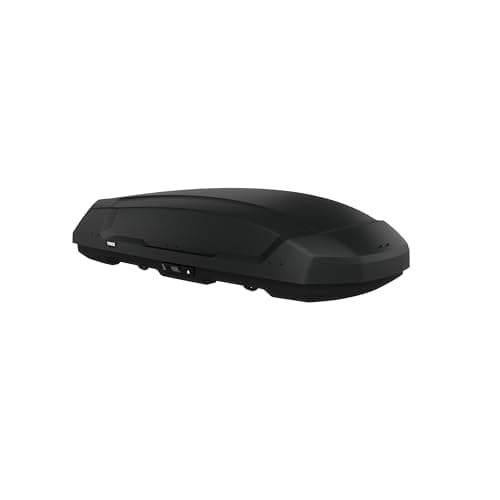 Thule Force 3Dual-side opening, a spread of sizes that suit a long low roof, and the best balance of usable volume against the weight it spends from your allowance. | Best overall for an Outback | 8.7 | |
| 2 | 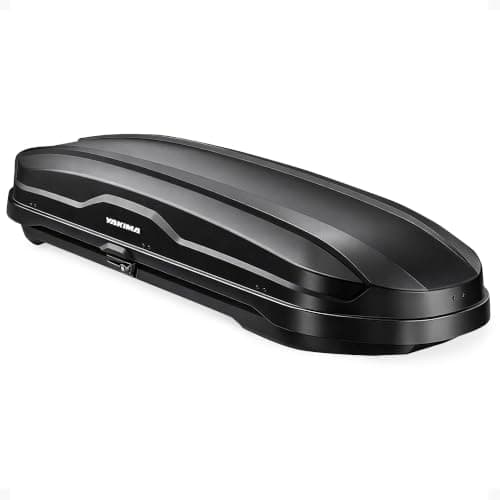 Yakima SkyBox NXLong, narrow and tall-ish — the box that leaves usable bar space beside it, which on an Outback often means a kayak or a bike alongside. | Best shape for skis, and for sharing the bars | 8.4 | |
| 3 | INNO Shadow 16The genuinely low-profile box — the one that gets an Outback into a parking structure and costs the least drag of anything with a hard shell. | Best for a height-limited garage | 8.1 | |
| 4 | 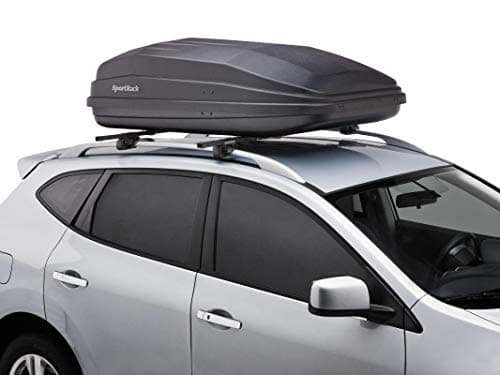 SportRack Vista XLA large hard shell from Thule's own value label — the sensible pick when the box will be used twice a year and the money has better uses. | Best on a budget | 7.9 | |
| 5 |  Thule OutboundA soft bag rather than a shell — the lightest way to add volume, and the honest answer when your generation's allowance is the binding constraint. | Best light option, and for the 150 lb cars | 7.9 |
Prices checked November 11, 2026. Product photographs come from Amazon where the listing is matched, and are representative stock images otherwise. Affiliate disclosure.
#1 · Best overall for an Outback
Thule Force 3
Dual-side opening, a spread of sizes that suit a long low roof, and the best balance of usable volume against the weight it spends from your allowance.
- Type
- Hard shell
- Opening
- Both sides
- Sizes
- Roughly 300 to 610 liters, five variants
- Replaces
- Thule Force XT
- For an Outback
- Mid sizes suit the roof length best
What works
- Opens from either side, which on a wagon means you can load from the curb whichever way you park
- Size range wide enough to pick one that fits your generation's allowance rather than your optimism
- Mounts quickly to aftermarket bars and comes off for the rest of the year
- Thule's spares and lock-barrel network is the deepest in the category
What doesn’t
- The larger variants are heavy enough to eat a third of a 150 lb allowance empty
- Needs two people to lift onto the roof safely, even on a low car
- Premium pricing against the value-label boxes further down this page
- A long variant can overhang far enough back to foul a fully open tailgate — check the arc
Our scoring
8.7overall
#2 · Best shape for skis, and for sharing the bars
Yakima SkyBox NX
Long, narrow and tall-ish — the box that leaves usable bar space beside it, which on an Outback often means a kayak or a bike alongside.
- Shape
- Long and narrow
- Opening
- Both sides
- Notable trait
- Leaves bar space alongside
- Mounting
- Tool-free clamp
What works
- Narrow footprint frees up half the bar for a second carrier — the single most useful Outback trait here
- Long enough inside for skis and poles without diagonal packing
- Tool-free clamp mounting, so fitting and removing is a one-person job once the box is up
- Dual-side opening like the Thule
What doesn’t
- Taller profile than a low-line box, so more drag and more garage-height risk
- Narrow interior is awkward for wide soft bags
- Costs about as much as the Thule without the same spares depth
- Still heavy enough to matter against a 150 lb allowance
Our scoring
8.4overall
#3 · Best for a height-limited garage
INNO Shadow 16
The genuinely low-profile box — the one that gets an Outback into a parking structure and costs the least drag of anything with a hard shell.
- Type
- Hard shell
- Profile
- Genuinely low
- Opening
- Single side on most variants
- Best for
- Garages and height-restricted parking
- Bonus
- Lower drag than a tall box of similar volume
What works
- Low enough to change which garages and car parks you can use, which is a real constraint for a wagon owner
- Lower drag than a tall box of similar volume, so less fuel and less noise
- Shallow interior loads neatly with flat soft bags
- Looks right on an Outback's long roofline rather than perched on it
What doesn’t
- Shallow depth is wrong for bulky items like sleeping bags in stuff sacks
- Single-side opening on most variants means you load from one side only
- Lock and hardware are a step below the premium brands
- Volume per dollar is worse than a tall box
Our scoring
8.1overall
#4 · Best on a budget
SportRack Vista XL
A large hard shell from Thule's own value label — the sensible pick when the box will be used twice a year and the money has better uses.
- Brand
- Thule's value label
- Type
- Hard shell
- Size
- Large
- Opening
- Single side
What works
- Large hard-shell volume for materially less money than the premium boxes
- Backed by the same parent company as Thule, so it is not an anonymous listing
- Fine on factory-style and aftermarket bars alike
- Perfectly adequate weather sealing for a family trip
What doesn’t
- Single-side opening, so where you park decides how you load
- Lid is less rigid than a premium shell and flexes more when part-loaded
- Hardware and lock feel cheaper, because they are
- Large footprint on a 150 lb allowance leaves less cargo headroom than it looks like it should
Our scoring
7.9overall
#5 · Best light option, and for the 150 lb cars
Thule Outbound
A soft bag rather than a shell — the lightest way to add volume, and the honest answer when your generation's allowance is the binding constraint.
- Type
- Soft cargo bag
- Mounting
- Crossbars
- Build
- Heavier fabric than the budget tier
- Shape
- Holds form better when part-loaded
What works
- A fraction of a hard box's empty weight, which on a 150 lb Outback is cargo you get back
- Packs away into a closet instead of occupying a garage wall year-round
- Costs far less than any hard shell here
- No height penalty when empty, because it is not up there when empty
What doesn’t
- Not lockable in any meaningful sense — treat it as a lunch-stop, not an overnight
- Fabric is weather-resistant rather than a sealed shell; pack in dry bags for a long wet drive
- Loading and unloading is slower than a hinged lid every single time
- Noisier than a hard box at highway speed when part-loaded
Our scoring
7.9overall
What we ranked on
Four criteria, in the order they decide the purchase on this specific car.
1. Empty weight against your generation’s figure. This is first and it is arithmetic, not preference. A 2021 Outback has 150 lb; a 2017 has 176 lb. Subtract bars, subtract the empty box, and what is left is your real packing budget. A box that leaves you 95 lb is a different product from one that leaves you 120 lb even if the brochure volumes match.
2. Length against the roofline, not against the brochure. The Outback’s roof is long, which is good news — but a full-length box can still reach far enough back to interfere with the tailgate when it is fully open. Open the tailgate, look at the arc, then choose a length.
3. Spread, measured. Every box publishes a minimum crossbar spread it needs, center to center. Rail-mount bars slide, so this is yours to set — but the factory integrated bars are a fixed, narrower spread, which is the single most common reason an Outback owner finds their new box will not mount. Our crossbar spread guide shows how to measure it in two minutes.
4. Which side it opens. On a wagon used for family trips, dual-side opening is worth more than it sounds: it decides whether you can unload from the curb or have to walk into traffic.
What we did not rank on is the box’s own load rating. Every box here is rated above what the car allows, so the box’s number is not the constraint — Subaru’s is.
The factory crossbar trap
If your Outback is a 2015 or later, it probably has integrated crossbars that stow inside the side rails and swing across the roof. They are a genuinely clever piece of design and they are the reason a lot of cargo box purchases go wrong.
Two problems, both practical. The spread is fixed and narrow — you cannot slide the bars apart to meet a box’s published minimum, so a box that needs a wider spread simply will not mount. And the bars have their own rating, separate from the roof figure, which on the stow-away designs is lower than a dedicated aftermarket bar set.
So the honest sequence for a loaded box on a later Outback is: check the integrated bars’ rating and spread first, and if either one does not clear your intended box, buy dedicated bars before you buy the box. That is not an upsell — it is the order that avoids a return, and our Outback bars page covers which ones.
The flip side: for a light load, a bag or a single bike, the factory bars are fine and free. Not every trip needs new hardware.
What size box an Outback actually needs
The instinct is to buy the biggest box that fits. On this car that is usually the wrong instinct, for two reasons.
The first is the weight budget above: the biggest boxes are the heaviest, and on a 150 lb car the biggest box can leave you with less usable cargo weight than a mid-size one. Volume you cannot fill is not volume.
The second is that an Outback already has a long, usable trunk. The box is there for the bulky-and-light overflow — bedding, coats, camp chairs, a tent — not for the dense items that should travel low. Most families are better served by a mid-size box they can actually lift than by a 610 liter shell they need help with every time.
Two sizing shortcuts. If skis are the reason you are buying, length is the only spec that matters and a long narrow box wins — our ski and snowboard box picks cover the lengths. If the reason is a family of four for a week, volume matters more than shape, and what size cargo box do I need works through the capacity arithmetic properly.
And if you are still deciding between a shell and a bag at all, the cargo box versus cargo bag comparison is the page for it — on a 150 lb Outback the bag’s weight advantage is a stronger argument than it is on most cars.
The Wilderness is a different car
One Outback does not play by the rules above. The Wilderness trim from 2022 is published at 220 lb (100 kg) dynamic and 700 lb (317 kg) static, which is a different class of allowance entirely — the static figure is there because this is the Outback Subaru rates for a roof-top tent.
If you own one, the box arithmetic stops being tight: a large shell and a full load are comfortably inside the dynamic figure, and the tent question is actually on the table. Our roof-top tent guide explains why the static number is the one tent buyers need and why most vehicles never publish one.
If you do not own one, do not borrow its numbers. This is the single most consequential figure difference inside one model name on this site, and the trim badge is the only thing that distinguishes them at a glance.
The short version
Buy the Thule Force 3 in a mid size if you want one box to do everything and you load from both sides of the car.
Buy the Yakima SkyBox NX if skis are the reason, or if you want to keep half the bar free for a kayak or a bike — in which case our J-cradle comparison covers the two carriers that share a bar best.
Buy the INNO Shadow 16 if a garage or a parking structure has a height limit you cannot negotiate with.
Buy the SportRack Vista XL if the box is for two trips a year, and the Thule Outbound bag if your generation’s 150 lb allowance is the thing you keep running into.
And before any of them: check your model year’s figure, check the integrated bars’ spread, and weigh what you plan to pack. On an Outback those three checks matter more than the ranking does. If the load turns out to be heavy rather than bulky, the back of the car is the better place for it — our Outback hitch carrier picks cover that route, including the 1-1/4 inch receiver that rules most carriers out.
Common questions
What is the roof weight limit on a Subaru Outback?
Can I fit a cargo box to the Outback's factory crossbars?
What size cargo box should I buy for a Subaru Outback?
How much does an empty cargo box weigh?
Is a cargo box or a hitch carrier better on an Outback?
Can I put a roof-top tent on a Subaru Outback?
Sources
Not sure it fits your car?
Our vehicle pages carry the published roof load limit, the roof type by model year, and what actually mounts to it — cited, and honest about what the manufacturer does not publish.
Read next
The Best Roof Racks for a Subaru Outback
Aftermarket bars that beat the Outback's factory integrated crossbars, and Subaru's limit by model year.
The Best Cargo Box for an SUV
Hard-shell boxes for SUVs, ranked — plus the weight arithmetic that decides your size before volume does.
What Size Cargo Box Do I Need?
Roof box liters by family size, and the four measurements that constrain the choice.
The Best Hitch Cargo Carriers for a Subaru Outback
Carriers light enough for an Outback's modest tongue rating, plus the receiver-size check that comes first.