Guides
Do I Need a Roof Rack for a Roof Top Tent?
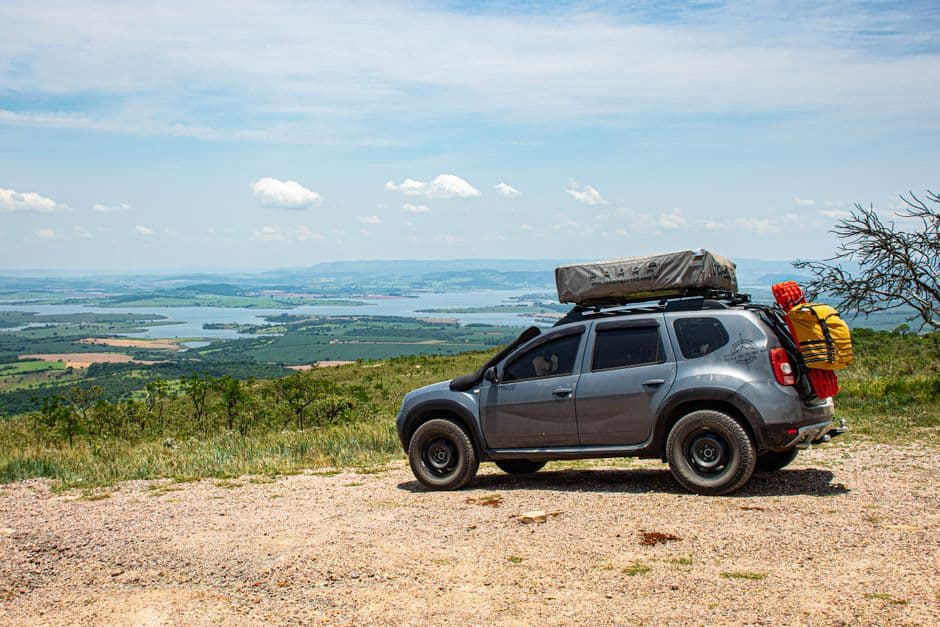
Yes — and the number that stops most people is not the one they check. Static load is generous; dynamic load is what you have to live inside.
Roof & Route is funded by affiliate commission. If you buy through a link on this page we may earn a commission at no extra cost to you. It never decides what we recommend or the order we recommend it in — read the full disclosure.
Yes, a roof top tent needs a rack, and in most cases a pair of crossbars is not enough. What a tent wants is a platform or a pair of heavy-duty bars at the spread the tent specifies, mounted on a foot pack rated for the load — and the limit that decides whether any of it is possible is your vehicle’s published roof figures, not the rack’s.
Two numbers, and the confusion between them is why this question gets answered badly everywhere. Static load is what the roof will hold when the vehicle is parked — people asleep in a tent. It is a much larger number and manufacturers often do not publish it at all. Dynamic load is what the roof will hold while the car is moving, and it is the small number, commonly around 150 lb on an ordinary car, including the rack itself.
So the arithmetic that governs the purchase is the driving one. A hard-shell tent plus a platform plus the feet can meet or exceed a typical dynamic limit before anyone gets in. The sleeping weight is almost never the problem; the driving weight is.
Which produces an honest and unpopular answer: a lot of cars cannot carry a roof tent, and no rack purchase fixes that. Vehicles with high published dynamic roof loads — body-on-frame SUVs, pickups with a bed rack, vans — are where tents belong. Check your owner’s manual before you shop, and our weight limits guide walks the arithmetic. Our vehicle fit pages carry published roof figures where the manufacturer publishes them and say so plainly where it does not.
Quick picks
Tap any row to jump to the full write-up below. Scores are our editorial judgment on published specifications — not a star rating, and not a product we claim to have tested.
| # | Product | Best for | Score | Price |
|---|---|---|---|---|
| 1 | 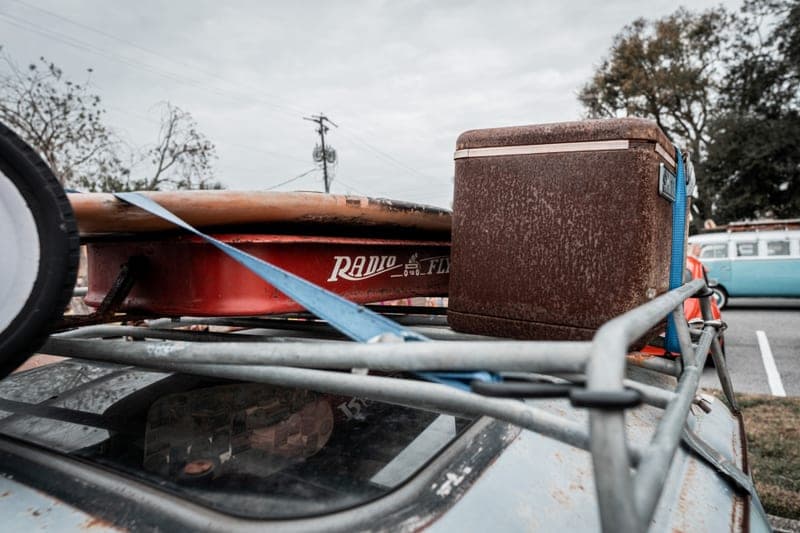 Front Runner Slimline IIVehicle-specific kits with Grab-On feet that clamp to factory rails, slats tapped for mounts, and T-slots top and bottom on standard 8 mm bolts. | Best platform for a roof tent | 8.2 | |
| 2 | 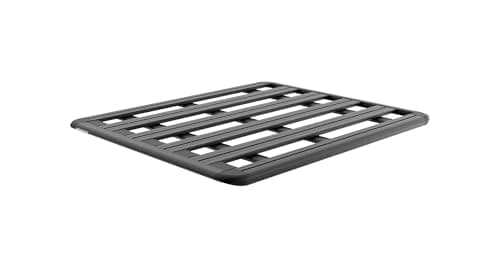 Rhino-Rack Pioneer 6 Platform 59 x 49A 59 by 49 inch four-plank deck with east-west channels and detachable fairing inserts, rated per vehicle rather than by one marketing number. | Best platform with published per-vehicle ratings | 8.2 | |
| 3 | 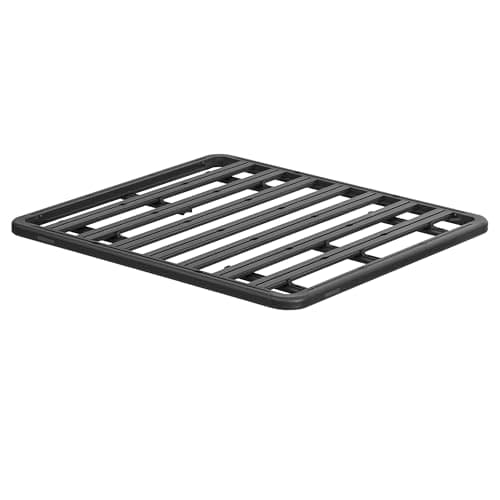 Yakima LockNLoad Platform 60 x 54A 60 by 54 inch aluminum deck that publishes 165 to 330 lb depending on vehicle and roof type — the clearest statement of why the vehicle governs. | Best platform if you already run Yakima | 8.0 | |
| 4 | 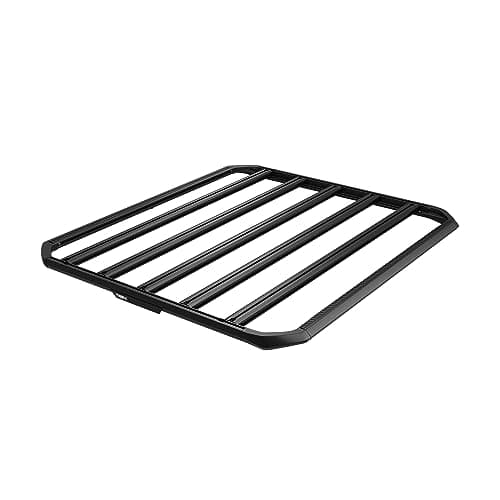 Thule Caprock XL65 by 59 inches of aluminum deck, rated 330 lb as a rack, that bolts onto an existing crossbar system rather than replacing it. | Best platform on bars you already have | 8.1 |
Prices checked October 17, 2026. Product photographs come from Amazon where the listing is matched, and are representative stock images otherwise. Affiliate disclosure.
#1 · Best platform for a roof tent
Front Runner Slimline II
Vehicle-specific kits with Grab-On feet that clamp to factory rails, slats tapped for mounts, and T-slots top and bottom on standard 8 mm bolts.
- Deck
- Slatted aluminum tray
- Mounting
- Grab-On feet clamp to factory flush or raised rails, no drilling
- Interface
- T-slots top and bottom, standard 8 mm bolts
- Grab-On rail kit load
- 110 lb evenly distributed
- Sold as
- Vehicle-specific kits only
What works
- T-slots top and bottom on standard bolts, which is what tent and awning mounts expect
- Grab-On kits clamp to factory rails with no drilling
- Vehicle-specific kits, so the geometry is right rather than approximate
- Slats tapped for accessory mounts across the whole deck
What doesn’t
- No live Amazon listing matched this model, so we show no price for it
- The published Grab-On rail kit figure is 110 lb evenly distributed — read it before buying a tent
- Vehicle-specific, so it does not move to a different car
- A full platform is a real fuel and noise penalty
Our scoring
8.2overall
#2 · Best platform with published per-vehicle ratings
Rhino-Rack Pioneer 6 Platform 59 x 49
A 59 by 49 inch four-plank deck with east-west channels and detachable fairing inserts, rated per vehicle rather than by one marketing number.
- Size
- 59 x 49 x 2 inches
- Planks
- 4, with east-west mounting channels
- Load rating
- Not published per platform — rated per vehicle instead
- Leading edge
- Detachable wind fairing inserts
- Mounting
- Vehicle-specific base, sold separately
What works
- Rated per vehicle, which is the honest way to publish a roof platform limit
- East-west channels let a tent mount land where the tent's rails want it
- Detachable fairing inserts help with the noise a flat deck creates
- Only 2 inches deep, so it costs less clearance than most platforms
What doesn’t
- The vehicle-specific base is a separate purchase
- No single headline load figure, so you have to look yours up
- Big frontal area and a real fuel cost
- Heavy enough to be a two-person fit
Our scoring
8.2overall
#3 · Best platform if you already run Yakima
Yakima LockNLoad Platform 60 x 54
A 60 by 54 inch aluminum deck that publishes 165 to 330 lb depending on vehicle and roof type — the clearest statement of why the vehicle governs.
- Deck
- 60 x 54 in
- Material
- Powder-coated aluminum
- Interface
- T-slots in every slat and the outer frame
- Max load
- 165-330 lb depending on vehicle and roof type
- Weight
- 65.1 lb
What works
- Publishes its range by vehicle and roof type instead of one optimistic figure
- T-slots in every slat and the frame, so the tent mounts where it needs to
- Mounts on Yakima towers and tracks you may already own
- Large deck suits a hard-shell tent footprint
What doesn’t
- 65.1 lb empty, which is a large share of an ordinary car's dynamic limit before the tent
- The 330 lb top figure applies only to the strongest roof types
- Two-person fit and removal
- Significant drag
Our scoring
8.0overall
#4 · Best platform on bars you already have
Thule Caprock XL
65 by 59 inches of aluminum deck, rated 330 lb as a rack, that bolts onto an existing crossbar system rather than replacing it.
- Size
- 65 x 59 inches
- Construction
- Aluminum
- Rated load
- 330 lb (rack rating, not the vehicle's)
- Mounting
- T-slots in every slat
- Needs
- A crossbar system already fitted
What works
- Uses the crossbars you already own, which is the cheapest route to a deck
- T-slots in every slat for tent, awning and accessory mounts
- Large footprint for a hard-shell tent
- Aluminum, so the empty weight is reasonable for the size
What doesn’t
- The 330 lb rating is the rack's — your vehicle's dynamic limit almost always governs
- Requires an existing crossbar system rated for the load
- Large frontal area and a real fuel penalty
- Two-person fit
Our scoring
8.1overall
Static and dynamic load, and which one stops you
Get these two straight and the whole question becomes simple.
| Dynamic load | Static load | |
|---|---|---|
| What it means | Weight allowed on the roof while driving | Weight allowed while parked |
| Typical size | The small number, often around 150 lb on an ordinary car | Much larger |
| Published? | Usually, in the owner’s manual | Often not published at all |
| Includes | Bars, feet, platform and the tent | All of that plus the occupants |
| Which one stops people | This one, almost always | Rarely |
So the test is: bars and feet, plus the platform, plus the tent’s own weight, has to fit inside the dynamic figure. If it does, the sleeping weight is almost never the obstacle. If it does not, nothing about the rack choice rescues it.
Where a manufacturer does not publish a static figure, treat that as what it is — unpublished. Do not substitute a number from a forum. Our weight limits guide is explicit about which figures exist and which do not.
Why crossbars alone usually are not enough
Some tents will mount directly to two heavy-duty crossbars at the right spread, and tent makers publish that spread. Three things push most people to a platform anyway.
The mounting points have to land where the tent wants them. A tent’s rails need clamps at specific positions. Two fixed bars give you two positions; a slatted platform with T-slots gives you a continuous choice. That is the single biggest practical reason platforms dominate this category.
Load spreading. A platform distributes the tent’s weight across more of the roof structure than two bars concentrating it at four feet. That is better for the car and better for the rack.
Everything else that comes with a tent. An awning, a shower, a traction board, a shovel, lights. Those all mount to slots and rails, and a platform is a grid of them. Our accessories guide covers what is actually worth adding.
The published figures underline it: Front Runner states 110 lb evenly distributed for the Grab-On rail kit, and Yakima states 165 to 330 lb for the LockNLoad depending on vehicle and roof type. Both of those are statements about how the load is carried, not just how much — which is exactly what a platform is for. Our platform roundup compares the no-drill options.
Soft-shell or hard-shell changes the arithmetic
The tent type is a load decision before it is a comfort decision.
Soft-shell tents fold out over the side of the vehicle and generally weigh less, which makes them the realistic option on a car with a modest dynamic roof limit. They take longer to set up and pack down wet.
Hard-shell tents pop up in under a minute and survive weather better, and they weigh considerably more. On a platform that already weighs 65 lb, a hard shell is where an ordinary car’s dynamic limit runs out.
Either way, add the numbers in this order and stop when you exceed the manual figure: bars and feet, platform, tent, and nothing else — the bedding stays inside the tent and counts, the ladder counts.
If the arithmetic fails on your car, the honest alternatives are a bed rack on a pickup, a trailer-mounted tent, or a ground tent and a hitch carrier for the gear. A hitch carrier is governed by the tongue-weight rating on your hitch label rather than by a roof figure, and that rating is usually far more generous — see the hitch carrier safety guide.
What a tent on the roof costs you year round
Two things, and both are larger than people expect.
Fuel. A platform plus a tent is a very large frontal area and the penalty rises sharply with speed. Consumer Reports has published testing on rooftop loads and fuel economy; our gas mileage guide works from it. A tent left on all year is one of the most expensive habits in this whole category.
Clearance. A tent on a platform is tall. Measure your garage opening at its lowest point, add the bar height and the platform and the tent, keep two inches in reserve, and write the total down for everyone who drives the car. Our guide to what a roof load changes covers clearance and handling together.
The fitting side matters more here than anywhere else, because the thing on your roof is something you will sleep in. Torque every clamp to the published figure, re-check after the first loaded trip, and re-check every season. Our safe-fitting guide covers the failure modes and the pre-trip check is the routine.
Common questions
Do I need a roof rack for a roof top tent?
What is the difference between static and dynamic roof load?
Can I mount a roof top tent on crossbars?
How much does a roof top tent weigh with the rack?
Can any car take a roof top tent?
Sources
Not sure it fits your car?
Our vehicle pages carry the published roof load limit, the roof type by model year, and what actually mounts to it — cited, and honest about what the manufacturer does not publish.
Read next
The Best No-Drill Roof Platform Racks
Flat roof trays that mount to factory rails or existing crossbars without drilling, compared on published load, weight and what the fitting hardware adds.
How Much Weight Can a Car Roof Rack Hold?
Dynamic versus static limits, what the figure includes, and why the rack's rating is not yours.
Do I Need Crossbars for a Roof Rack?
Rails versus crossbars, how to tell what you have, and the one case where rails alone work.
Roof Rack Accessories: What Actually Fits Your Bars
The three crossbar interfaces, which accessories fit each, and the order to buy in.