Bike Racks
Yakima StageTwo Review
The highest per-bike rating of the mainstream platform racks, and the heaviest thing you will ever slide into a receiver. Both facts come from the same design decision.
Roof & Route is funded by affiliate commission. If you buy through a link on this page we may earn a commission at no extra cost to you. It never decides what we recommend or the order we recommend it in — read the full disclosure.
The Yakima StageTwo is the rack this site keeps ranking first whenever the question involves heavy bikes. The reason is a single published number: Yakima rates it to 70 lb per bike on a 2-inch receiver, which is the highest of the mainstream platform racks and enough to cover most electric bikes without buying a dedicated e-bike carrier.
That rating is not free. Yakima publishes the rack’s own weight at 63 lb — several retailers list 66 lb and OutdoorGearLab measured 63.5 lb on their own scale, so call it around 65 pounds of rack to lift onto a hitch before a single bike goes on it. It is 2-inch receiver only for the four-bike configuration, it is physically large behind a small car, and off-road the rating collapses.
We have not tested this rack. What follows is a review of Yakima’s own published figures, what each one means for a real purchase, and the specific buyers who should spend the money somewhere else. If you want the three-brand version of this decision, that is Kuat vs Thule vs Yakima; if you want the ranking it sits in, that is the best hitch bike racks.
Quick picks
Tap any row to jump to the full write-up below. Scores are our editorial judgment on published specifications — not a star rating, and not a product we claim to have tested.
| # | Product | Best for | Score | Price |
|---|---|---|---|---|
| 1 | 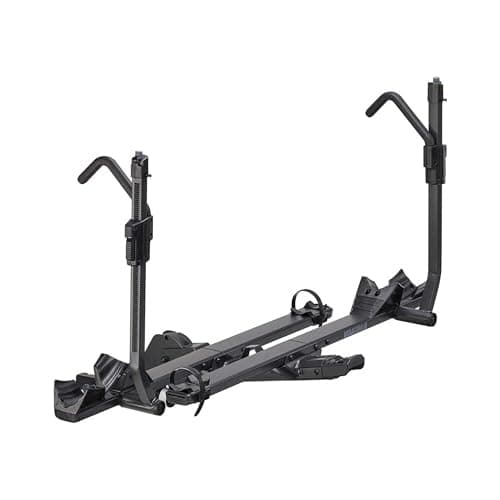 Yakima StageTwoThe highest mainstream per-bike rating, a genuinely wide wheel and tire allowance, and remote tilt — bought at the cost of being the heaviest rack in its class to fit. | Heavy bikes, and families who will add a third and fourth | 8.7 |
Prices checked November 11, 2026. Product photographs come from Amazon and are refreshed with the prices. Affiliate disclosure.
#1 · Heavy bikes, and families who will add a third and fourth
Yakima StageTwo
The highest mainstream per-bike rating, a genuinely wide wheel and tire allowance, and remote tilt — bought at the cost of being the heaviest rack in its class to fit.
- Type
- Platform, 2 bikes, expandable to 4
- Per-bike rating
- 70 lb on a 2" receiver (road and RV tested)
- Off-road rating
- 42 lb per bike (2" only)
- Receiver
- 1.25" and 2" versions; the +2 add-on is 2" only
- Wheel size
- 16" to 32"
- Wheelbase
- 30" to 52"
- Tire width
- Up to 5" (Yakima); some retailers list 3.25" without the fat bike kit
- Rack weight
- 63 lb published; 66 lb at some retailers
- Tilt
- Remote 3-position tilt, folds flat when unloaded
- Locks
- Integrated SKS — bikes to rack, rack to receiver
What works
- 70 lb per bike is the highest published rating of the mainstream platform racks, which is what makes it an e-bike answer without being an e-bike-only rack
- Staggered trays give handlebars and saddles room to pass each other, so two bikes do not have to be negotiated into place
- Remote 3-position tilt drops the whole rack for tailgate access with bikes still loaded
- 16 to 32 inch wheels and a 30 to 52 inch wheelbase covers kids' bikes and long full-suspension bikes on the same rack
- Integrated SKS locks cover both jobs — bike to rack and rack to car — on one key
- Expands to four bikes with the +2 add-on, so a growing family does not re-buy the base rack
What doesn’t
- Around 65 lb of rack to lift into a receiver, which is a two-person job for a lot of people and the single biggest reason to buy something else
- The off-road rating drops to 42 lb per bike, so the headline 70 lb does not survive a forest road
- The four-bike configuration is 2-inch receiver only, and per-bike capacity drops when the add-on is fitted
- Published tire width disagrees between Yakima and retailers — confirm the current spec for the exact SKU before buying for a fat bike
- Physically big: behind a short car it is conspicuous, and it adds real length to parking
- Premium price, and the ramp, lighting plate and swing-away adapters are all separate purchases
Our scoring
8.7overall
What the published numbers actually mean
Five figures decide whether this is your rack, and three of them are routinely misread.
70 lb per bike, on a 2-inch receiver. Yakima describes this as road tested and RV tested. In practice it is the number that lets a mid-drive hardtail e-bike or a heavy cargo-ish commuter travel on a rack that is also perfectly pleasant with a kid’s bike on it. Most mainstream platform racks stop at 60 lb per bike, which is exactly where a lot of e-bikes start. If no bike in your garage is over 50 lb, you are paying for headroom you will never use.
42 lb per bike off-road. This is the figure to take seriously if you drive to trailheads on gravel or forest roads. The derate is not Yakima being cautious for the sake of it — a rack cantilevered off a receiver sees far higher peak loads over washboard than it ever does on pavement. A 60 lb e-bike is inside the road rating and outside the off-road one. Our hitch bike rack weight limits guide explains why every brand publishes two numbers.
Your receiver’s tongue weight, which is not on this spec sheet. Around 65 lb of rack plus two 60 lb e-bikes is roughly 185 lb hanging off the back of the car, and that has to fit inside your vehicle’s published tongue weight limit, not just the rack’s. This catches people with Class I and Class II receivers in particular. Check your own figure against hitch classes explained before you order.
16 to 32 inch wheels, 30 to 52 inch wheelbase. This is the quietly excellent part of the spec. The 16-inch lower bound means small children’s bikes sit in the tray properly instead of needing an adapter, and the 52-inch wheelbase upper bound takes a long modern enduro bike. Few racks cover both ends that well.
Tire width, where the sources disagree. Yakima’s own product page states tires up to 5 inches. Several retailers list a 3.25-inch maximum with 5 inches available only via a separately sold fat bike kit. We are not going to resolve that for you from the outside — if you are buying this rack specifically for a fat bike, confirm the figure for the exact SKU in front of you before you pay.
Living with 65 pounds of rack
This is the thing that decides the purchase for more people than the weight rating does, and it gets a fraction of the attention.
A platform rack this capable is built from a lot of aluminum and steel, and the result weighs about as much as a loaded suitcase that you have to insert horizontally into a hole at bumper height, line up with a pin, and hold steady while you tighten the knob. Yakima has done the obvious things to help: a tool-free SpeedKnob, and a rack that folds flat against the car so you can leave it on. But nothing changes the lift itself.
What this means practically:
- If you intend to take the rack off between trips, try the lift before you commit. For many people it is a two-person job, and a rack that is annoying to fit is a rack that lives on the car.
- Leaving it on is a reasonable plan — it folds vertically and locks to the receiver — but you are then driving with it year round, which costs a little fuel and a lot of rear visibility in reverse.
- A swing-away adapter solves tailgate access on a vehicle with a rear door, at the cost of more weight and more money on the same receiver. Yakima lists BackSwing and StraightShot adapters as compatible.
If the lift is the dealbreaker, the honest alternative is a lighter platform rack with a lower ceiling — and that trade is covered below.
The tilt, and the thing you will do every single trip
Specs get read once. Tailgate access gets used every time you stop for lunch, and it is the feature that decides whether you like a rack a year in.
The StageTwo has a remote three-position tilt: it drops away from the car to let a hatch or tailgate open with bikes loaded, sits upright for driving, and folds flat against the vehicle when it is empty. “Remote” here means the release is reachable without crawling under loaded bikes, which is the difference between a feature you use and a feature you read about.
Two caveats worth knowing before you assume it solves your access problem. First, how much a tilted rack helps depends entirely on your vehicle’s rear door — a vertical tailgate clears easily, a big curved liftgate on a crossover may still foul loaded bikes, and a powered liftgate can try to close on them. Second, with four bikes on the rack, tilting a long loaded platform is a physical act. Nobody’s tilt mechanism makes 200 lb of rack and bikes weightless.
The staggered trays deserve a mention in the same breath, because they are a daily-use feature rather than a spec. Offsetting the two bikes vertically means handlebars clear saddles instead of fighting them, and you are not reversing one bike to make it fit. On a rack you load in a dark parking lot with a tired family waiting, that matters more than it sounds.
The +2 add-on, and the arithmetic of four bikes
The StageTwo takes a +2 add-on that extends it to four bikes. Three things are true about that at once.
It is 2-inch only. If you bought the 1.25-inch version, four bikes is not on the table. That alone is a reason to buy the 2-inch rack if your car has a 2-inch receiver, even if you only need two trays today.
Per-bike capacity drops with the add-on fitted. The headline 70 lb is the two-bike figure. Retailer specifications for the add-on configuration give a lower per-bike number, which is the normal pattern across brands — more leverage on the same receiver means less load per tray. If your plan is four e-bikes, this rack is not the answer and neither is any other hitch tray we know of; that load belongs behind a vehicle with a Class III receiver and a purpose-built carrier.
Four bikes is usually a car problem, not a rack problem. Four bikes plus a 65 lb rack is a serious amount of tongue weight and a serious amount of overhang, and the thing that gives out first is normally the vehicle’s published limit. We wrote the best bike racks for 4 bikes around that calculation rather than around the racks.
Yakima also lists a RampUp ramp kit and a SafetyMate lighting plate as compatible accessories. The ramp is the one worth knowing about if e-bikes are the reason you are here — rolling a 60 lb bike up a ramp is a different experience from lifting it to tray height.
Is it the right rack for e-bikes?
Usually yes, with two conditions.
The first is the arithmetic above: 70 lb per bike covers the large majority of e-bikes sold, but check your actual bike’s weight rather than its class, and check your vehicle’s tongue weight rather than the rack’s rating. If you drive gravel to the trailhead, use the 42 lb off-road figure instead, and a lot of e-bikes fail it.
The second is lifting. A 60 lb bike lifted to tray height is an awkward movement, and doing it twice a trip with a rack that is itself 65 lb means the whole system is heavy at every stage. This is where a dedicated folding e-bike carrier with a ramp — the e-bike rack picks cover them — earns its price, not on capacity but on how the bike gets up there.
What the StageTwo genuinely wins at is being a rack for mixed fleets. One e-bike and one analog bike. An adult bike and a 16-inch wheel kid’s bike. A hardtail now and whatever replaces it in four years. The combination of the highest mainstream weight ceiling and the widest wheel range is unusual, and it is the strongest case for spending this much.
What to buy instead, and when
If the lift is too much: a lighter platform rack with a 60 lb per bike ceiling will be easier to live with every single time you fit it. The Thule T2 Pro XTR is the obvious cross-shop — published at 52 lb of rack and 60 lb per bike, available for both receiver sizes, and holding bikes by their wheels with no frame contact at all.
If your bikes are all normal weight: you are paying for a ceiling you will not reach. A mid-priced tray rack does the same job for substantially less, and the two-bike picks rank the options for exactly that buyer.
If your receiver is 1.25 inches: buy the 1.25-inch StageTwo only if two bikes is genuinely your ceiling, because the four-bike path is closed. Otherwise look at racks designed around the smaller receiver from the start.
If you have no hitch at all: do not buy a hitch before you have read hitch vs trunk vs roof. Installed, a receiver is often the larger part of the total cost, and for two bikes a few times a year a trunk rack or a roof tray may be the better purchase.
If four e-bikes is the actual requirement: no mainstream hitch tray is the answer. Work backward from your vehicle’s tongue weight figure first, then shop.
Verdict
The StageTwo is the rack to buy when your fleet is heavy, mixed, or about to grow. The 70 lb per bike ceiling is the highest of the mainstream platform racks, the 16 to 32 inch wheel range covers a family’s whole garage, the remote tilt is genuinely usable with bikes loaded, and the +2 add-on means the base rack is not a throwaway when a third child needs a bike on it.
It is not the rack to buy if you take it off after every trip, if all your bikes weigh 30 lb, or if your receiver is 1.25 inches and you can imagine wanting four bikes later. The 63 to 66 lb of rack is a real cost paid every time you fit it, and the 42 lb off-road figure is a real limit if your trailheads are down a gravel road.
Two things to confirm before you order: the tire width specification for the exact SKU you are buying, because Yakima and its retailers do not agree, and your own vehicle’s tongue weight limit, because that is the number that will stop you rather than the rack’s.
Cross-shopping? Kuat vs Thule vs Yakima covers the three-brand decision, and the best hitch bike racks ranks this rack against the rest of the field.
Common questions
How much weight can a Yakima StageTwo hold?
How much does the Yakima StageTwo weigh?
Does the Yakima StageTwo fit e-bikes?
Can the Yakima StageTwo carry four bikes?
What tire width does the StageTwo accept?
StageTwo or Thule T2 Pro XTR?
Sources
Not sure it fits your car?
Our vehicle pages carry the published roof load limit, the roof type by model year, and what actually mounts to it — cited, and honest about what the manufacturer does not publish.
Read next
The Best Hitch Bike Racks
Platform hitch racks ranked on fit range, weight rating, loading and security.
Kuat vs Thule vs Yakima Bike Racks
Three premium platform brands compared on rating, fit range, loading and price.
Thule T2 Pro XTR Review
What the T2 Pro XTR's published figures actually mean for your bike, and the two racks that beat it on weight ceiling and on price.
The Best Bike Racks for Electric Bikes
Racks rated for e-bike weight, ramps that remove the lift, and the hitch arithmetic to do first.
Hitch Bike Rack Weight Limits Explained
The per-bike, per-receiver and tongue-weight limits that decide what a hitch bike rack can carry.